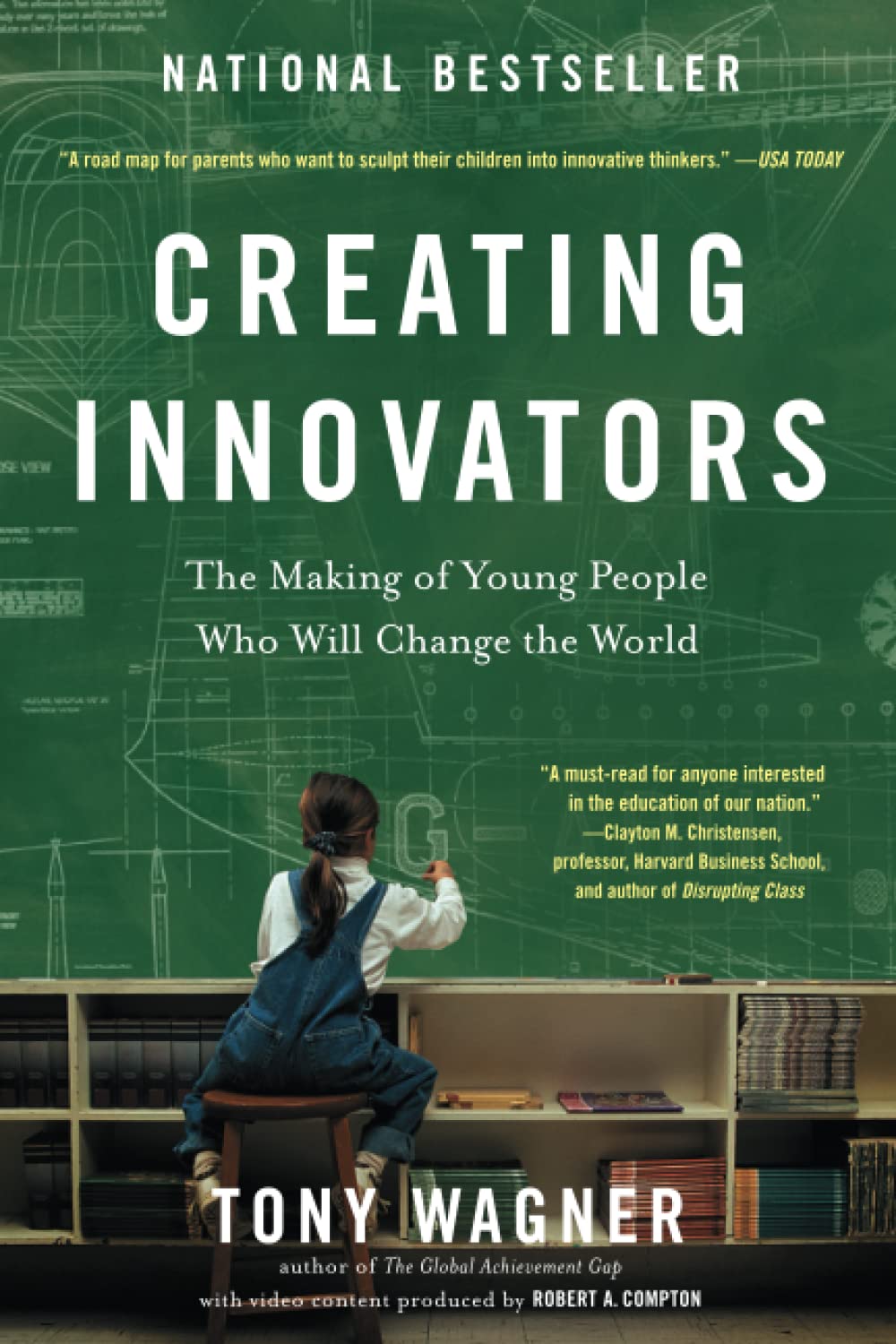
Today we’re going to look at Creating Innovators by Tony Wagner. I picked this book up a few years ago when it seemed like it would have good advice for me on how to nurture my children. While there is some advice for me, it’s only because I have money to spend. Not quite the money he talks about in the book, but more than some.
The stated purpose of the book is to show readers what it will take for America to gain the innovation lead in STEM fields1.
Initially the book starts out with some good notes about h ow 37% percent of young American families live in poverty and a disproportionate number of them are black. Wagner says that another war won’t restart the economy to help these people out of poverty as WWII did, we need innovation to do it so let’s build innovators. Once you’ve read the rest of the book the subtext here is that you need innovation by elite’s to lift these “poor” people out of poverty2.
Again he almost gets it at the beginning of the book as he brings up a study that says people agree we need innovation that addresses human needs, and doesn’t just put money into the pockets of corporations3. Sitting in 2023, we can see how that went. Corporate profits are gangbusters4 and C-Suite salaries are crazy while more and more people become working poor. So it would appear that the “people” who agreed innovation should help everyone don’t make any of the decisions about where money goes.
How Rich People Get Their Kids Ahead
Money. They spend copious amounts of money on their kids education so their kids have more paper and letters alongside their name. Wagner has stories of families renting a second house on the East Coast and relocating their family temporarily so that their child could go to the right school, which costs huge amounts of money5.
We looked at the credential race in detail when I wrote about The Case Against Education
He holds up families that can afford $12k/year preschool as models for how to raise innovators6 because the school encourages exploration and promotes lots of free play.
He tells us how supportive a family was by taking out a $50k business loan to kickstart a child’s company7.
At no point does he address how these “poor” families from the Introduction are disadvantaged because their school is underfunded and they don’t have the time or safety in their neighbourhoods to play. He never talks about how poor schools lack for everything, but students. Possibly because it’s not their own job to get out of poverty, we need elite people with $12k preschool to innovate for the poor people.
Just spend money on your kid so they go to the right school. Have a job that gives you weekends and evenings free to help your kid. Have money to spend on whatever their current obsession is and don’t get worried if it changes, just spend more money on the next thing.
Wagner Always Stops Short
Okay the book isn’t all bad. Wagner does say that play8 and invention and freedom is important for kids, which is true. He just never addresses the fact that only rich people can afford to bring these things to their kids. School for most kids is about knowledge transfer so they can perform on tests. But the companies that make the tests have textbooks that are too expensive for poor schools to purchase9. Thus the teachers are always under extra scrutiny for their “lack of performance”, which is no way to encourage innovation.
Wagner also talks about students being asked to specialize far too early, long before they know what they should be doing10. This results in poor match fit11 long term as you get a degree in something you don’t care about and then a few years into working in the field, you change your mind because the field was never a good fit. But he stops short of talking about the credentialing race or of really criticising the publish or perish tenure track model.
To end the book Wagner addresses “tiger moms” and “helicopter parents” telling them to let their kids be kids and invent stuff and just play without crazy schedules12. But he never takes the next step and looks at how society has bread this type of parenting. He never looks harder at how parents are encouraged to pour every moment of time into kids so they can get into these great innovative schools. He never says that maybe we should just put money into public schools so that every school is amazing.
Should You Read Creating Innovators?
Nope. It’s a guide to how rich people can get their kids ahead. Wagner does nothing to address the structural issues with capitalism or society that have brought about the world with less play and more scheduling and parents policing parents about children being outside.
He just says, have a good job and spend money on your kids so you can help the “poor” people.
Maybe we should look at basic income so there are fewer poor people or fund schools better instead of helping rich people justify the money they spend to help their kids get ahead at the expense of any type of public education.
Purchase Creating Innovators or don’t
Further Reading
-
Page XV ↩
-
Well there has been innovation but it’s brought us Uber and The Boring Company which mostly diverted funds away from good public projects that might have had positive impacts. Uber specifically just drove down wages and paid BIPOC people poorly for their work. Oh and sexual harassment at Uber is a thing. ↩
-
Page 6 - See the study here: GE Global Innovation Barometer for 2011 ↩
-
Thanks Matt for the citation ↩
-
Page 38, 39 ↩
-
Page 209 ↩
-
Page 76 ↩
-
Page 27 ↩
-
Page 173 ↩
-
Page 202, 208 ↩