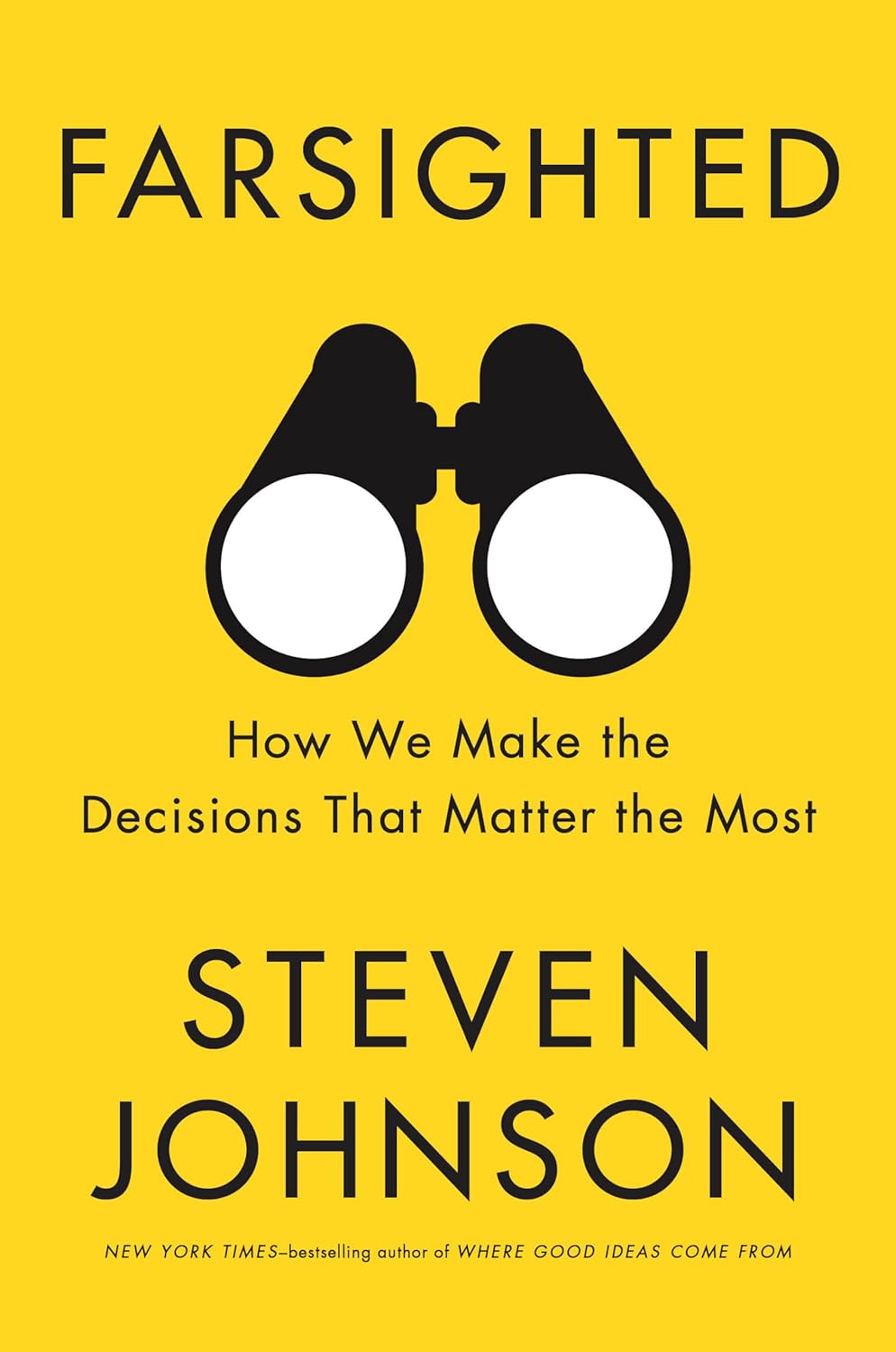
This month we looked at Farsighted by Steven Johnson in book club. Join the club to get all the content on it. Next month we're reading Meditations for Mortals.
The purpose of Farsighted is to help us make better decisions with Johnson saying that outside of a pro/con list1, we teach almost nothing to most people about how to make good decisions2. Instead, we prioritise the outcome of decisions without regard for the process that was used to arrive at the decision3. That often leaves us trying to copy a process from some famous decision maker that was bad, the outcome was sheer luck and success was achieved despite the flawed process.
Homogenous groups make bad decisions
Homogenous groups - whether they are united by ethnic background, gender, or some other worldview like politics - tend to come to decisions too quickly. They settle early on a most-likely scenario, and don’t spend the energy to question their assumptions, since everyone at the table seems to agree with the broad outline of the interpretation. - Farsighted Pg 54
The quote above encapsulates the best advice of the book. If you look around the table while making a crucial decision and all the people look like you that means you have a far higher chance to make a bad decision. You all likely share many of the same assumptions and are far less likely to question any biases you share. These base assumptions influence the options that you consider viable so you'll explore fewer options limiting the possible good options on the table.
Possibly the worst part is that you'll make this decision while feeling sure that you're correct and there are no other interpretations or knowledge that would change the decision.
Contrast this to diverse groups, which are more likely to be right but also less likely to have confidence in their decision4. Diverse groups are more likely to realise that they have incomplete information and biases that are influencing them, thus they are more likely to acknowledge where their decision may be flawed and thus not successful in its outcomes. Diverse groups are more likely to challenge their base assumptions and look further for solutions to the issue at hand.
I can't get diversity
I'm going to out my bias here, I bet you didn't work hard enough if you think it's impossible to get diversity among decision makers. You didn't set up the process by which decision makers are allowed in the room in a way that made it accessible to others that aren't like you.
But for a second, let's assume you're stuck with a group lacking diversity, in that case one thing you can do to increase the chances of coming to a good decision is ask each participant to rate their degree of confidence and then prepare a short explanation about why they're as confident as they are5. This practice seems to be a good inoculation for overconfidence causing people to question their assumptions and see past some of their biases.
Another helpful approach is to conduct a pre-mortem6. Assume that you failed to accomplish the goals expected as the outcome of your decision. Ask yourself why it failed? What obstacles came up that stopped the ideal outcome from coming to pass? How would you mitigate the roadblocks so that success is more likely?
It's also useful to look at the second most likely outcome of your decisions and note that if that outcome is catastrophic to your life/business, you need to spend more time working to find better outcomes as options7. When you've taken steps to render the second most likely outcome from causing massive damage, you're in a place to make a good decision. For a business this may mean lining up a second supplier just in case the first one can't match their processes with your needs.
The dream team for bad decisions
The most demoralising part of the book for me was Johnson's recognition that the "dream team" for making bad decisions is a group of middle-aged white guys8. Take that information and look at most of the people running tech companies, funding startups, and running governments in North American and you can't help but realise that most of our biggest players in business and politics match this "dream team" for failure and they aren't willing to admit that they're the problem.
We need some big changes to remove our failure "dream team" from influence and at this point it doesn't seem like anyone is willing to do anything about it. In fact, because they're in power they're more likely to continue putting people like themselves in places of power so we're looking at worse outcomes for most to the benefit of a very narrow band of society.
Should You Read Farsighted by Steven Johnson?
While Johnson has some good ideas we can put into practice, he takes far too long telling us stories to get them across. This is a “glossy” book, much like Malcolm Gladwell writes, which gives us a high level overview without many tactics to take home. Most chapters repeated the same advice, have a diverse group and explore many ideas before you focus down on a single idea as the best one.
That’s the main point, and after that it’s a lot of filler to tell us the same thing in many ways.
If you’re looking for an easy to read primer on making good decisions, this is a decent book. If you’re looking for depth, go somewhere else.
-
Purchase Farsighted on Bookshop.org - support local bookstores