Sure the Internet is amazing. You can start today with a tool like Obsidian then head to r/ObsidianMD or YouTube and find many creators willing to show you their note system, including myself. Unfortunately this also brings along complexity to the beginner who doesn’t need the solutions being pedalled as they start their note journey.
It’s easy for the beginner to open a tool, then search for a bunch ways others use the tool then overload themselves with complexity that looked cool but serves no purpose in their workflow. They follow others into complexity then everything bogs down under a pile of precariously balanced actions that were added not to solve a problem, but because it looked cool when someone online showed it to them. Then the system collapses and they scrap everything and migrate to a new tool/system because the problem was clearly the tool.
Then they repeat the cycle with a new tool adding complexity they don’t need to solve problems they don’t have because it looked cool and someone in the productivity content creator said it worked for them.
Complexity Curves
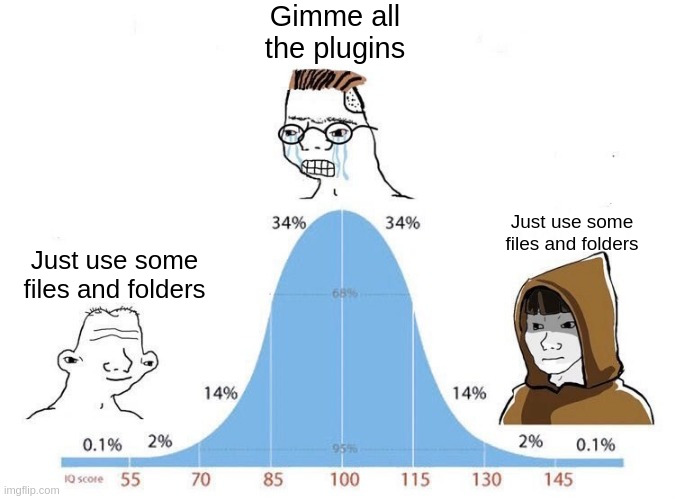
The prime example of this is the Midwit curve meme. Applying this to Obsidian we see the new user creating a few folders and then some files inside. They watch some videos and read some posts then add on huge amounts of complexity with extra folders and as many plugins as sound cool. Then they realize they’re not using any of it and they go back to just some folders and some files.
A prime example I came across recently is this question about folder names. Evidently they have so many folders and the users naming scheme is opaque enough that the folder alone isn’t enough to know what the folder is for.
I contend that if the folder name isn’t enough to tell you what the folder is for, you’re way past the point of too much complexity.
Complexity Cycles
The second type of complexity dynamic we see regularly is the circle. We’ve seen this with computing, where it was far too expensive for anyone to afford a computer so the computer was housed at a large institution and you got time on it. Then computing moved into the business and home, we owned our computing. Now AI puts much of the computing in the hands of big corporations again because they can afford1 the computing power needed for AI.
Websites were once hosted on a computer in your home. You moved it to a server you purchased and put in a co-location provider. Then it moved to the cloud, and now people are owning their servers again and self hosting your software is gaining in popularity.
Websites were once just HTML and CSS2 served to the user. Then we had build processes like gulp and grunt which turned into webpack and vite. In theory these build processes saved us time, but when they broke get ready to spend days sorting out dependency trees. Now we’re looking down the barrel of #nobuild, dropping a build process all together.
Those are just a few examples of how a complexity cycle works. Each cycle follows the same pattern: centralize, abstract, collapse under its own weight, simplify again.
The Mastery Curve
There was a time before we were all connected that you built your own system that met the real problems you encountered every day. If you got advice from someone, it was someone closely related that had similar problems. If you were a farmer then you heard from other farmers. Maybe the local dentist heard about your problem and explained a solution that he felt matched from his practice.
You didn’t have the option to search for answers across the whole world spanning many fields unrelated to to yours. This constraint was a forcing function that stopped needless complexity.
The incentives creators have for monetization can see them creating contrived solutions because a title will get clicks, and it’s their job to get clicks. Some of them look to build a system so they can build a business off the back of the system and sell you courses and coaching.
Creators don’t do this to fool you, they have families to feed and businesses to run. To make this happen they need to match their output to the incentives provided by their platform.
Most of the time when you add complexity because it worked for someone else you’re just looking for a quick fix because something doesn’t feel right. You’re looking to alleviate that feeling nagging at the back of your head, that somewhere there is a magic way to take notes that will yield amazing writing with less effort. The reality is that writing is hard and takes time, always.
When you get better at thinking and writing, you find that writing and thinking takes time and is hard. There is no magic, you just have to think and put in the time struggling with terrible ideas to find the ones that are golden beneath all the shit.
The ideal mastery curve only increases in complexity because you’ve identified a problem you’re currently having.
- You’ve spent enough time thinking about the problem that you have a one or two sentence description of it
- Does the solution add or remove friction? Friction can be good
- You understand that changing your tool won’t work in 99% of cases
- You’re willing to spend the time, maybe months, evaluating options to find the one that fits your problems
That’s how I got my Org Mode +Agenda workflow that made meeting topics easy. It’s how I built my Obsidian setup. It’s why I often say that I’m simply showing you what I do. Keep it or don’t, just do what works for you.
This slow methodical approach is why it takes me months to fix an issue in my systems. I’ll write down what the problem is, then maybe spend months watching for a possible solution before I try anything.
Next time you’re trolling productivity or note taking message boards (or YouTube) stop and think about the problem you’re trying to solve. If you can’t write it down in a sentence or two, you don’t understand it. Don’t spend your time looking for something cool that will magically fix your issues. Spend your time identifying the issue at hand so you have a narrow scope to search for your fix.
Try to only add complexity if it directly helps your goals. Mine is to have more time to think and read. If a new tool doesn’t help me turn out better writing with more relationships between my notes then I don’t use it. I watch lots of content on thinking and Obsidian when I’m otherwise occupied riding my indoor bike trainer, and implement little.
Leave a Reply