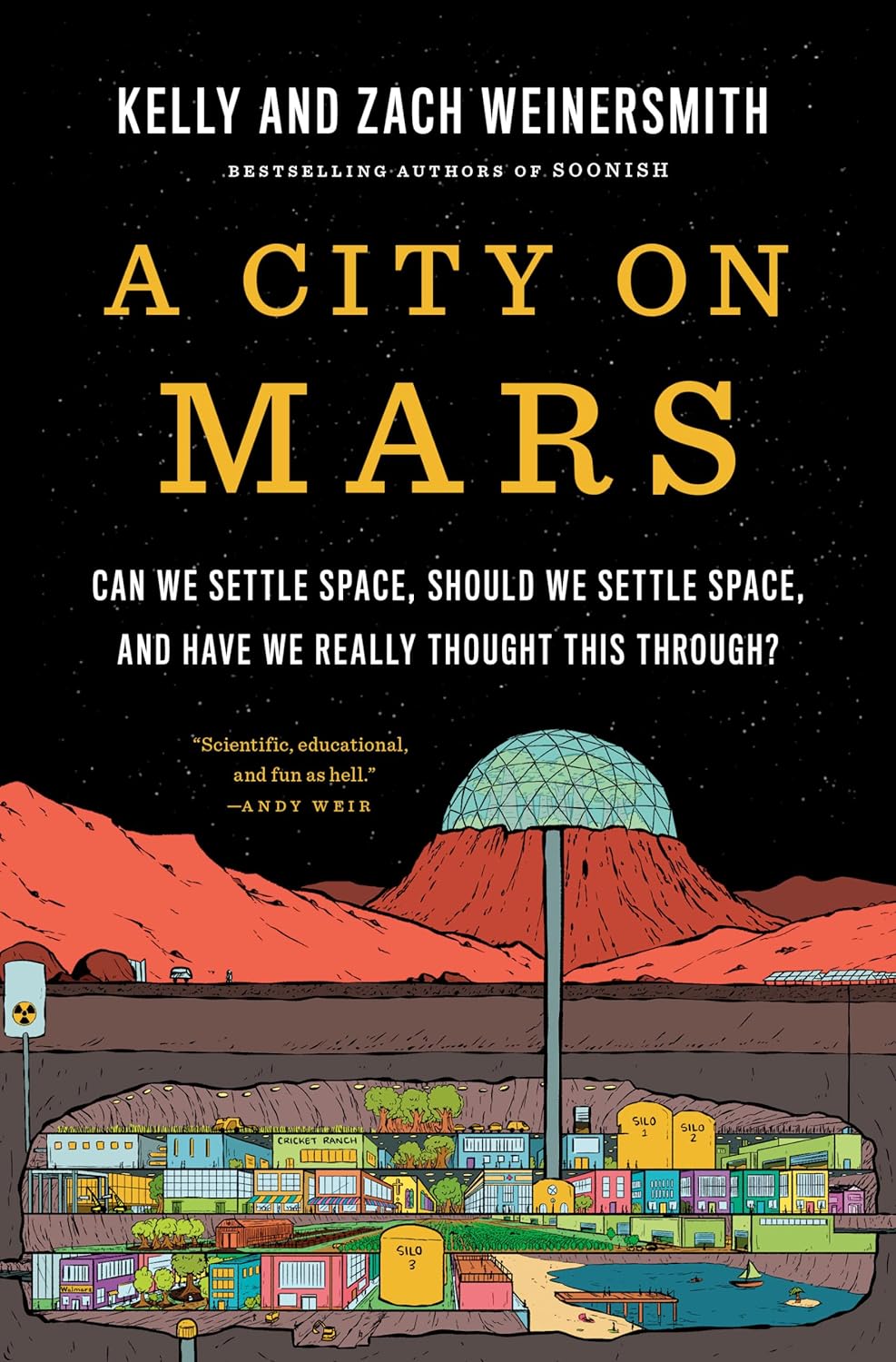
A City on Mars

A City on Mars

Kelly Weinersmith, Zach Weinersmith

RECOMMENDED NONFICTION

Started: Dec 15, 2023

Finished: Dec 21, 2023

Review

Is there any reality to the dreams of billionaires to set up civilizations on planets outside Earth? Nope.

Kelly and Zach Weinersmith started out to write a book about how to create a civilization on another planet, and after meticulous research came to the conclusion that any attempt at this within multiple generations is not even within the realm of possibility.

Sure billionaires are lifting rockets, but no one is spending a fraction of the money needed to research closed-loop ecologies which would be required to survive on Mars. That whole argument that we have to find a way to spread humanity to the stars before the climate comes for us, even if we go worst case on the climate on Earth it's far more liveable than space. A 2C warmer Earth with mega-storms and the worst coastal flooding imaginable, would still be a messy room compared to the habitability of Mars, which would be like a toxic waste dump.

Next time you hear a tech billionaire talk about moving to space, realize that they're stroking their own ego not talking about anything viable. They're simply pushing a Libertarian dream, not a viable path towards saving humanity.

We should be spending our money on Earth to improve the lives of those that currently exist.

Purchase A City on Mars on Amazon

Notes

- the idea that billionaires will escape [[climate change]] for [[mars]] is like leaving a messy room to live in a toxic waste dump. Pg 2
- a 2C warmer [[earth]] is fare more habitable than Mars is or could be with the technology we have
- at this point capitalism will still exist in space anyway so it won’t fix exploitation like those billionaires say it will due to the abundance of resources. spg 4
- think of the Belters in the Expanse series, earth and mars exploit them
- plus, if these billionaires say they want to go to space to stop exploitation and make everything fairer, why don’t they give away their fortunes now to do the same thing? We already have enough resources on earth for this ideal

- The Case For Mars - Robert Zubrin Pg 4
- they say this is a 400 page evenhanded that still leaves stuff out so no book can cover everything exhaustively about space exploration

- [[SpaceX]] Pg 6
- Soonish - Kelly Weinersmith Zach Weinersmith Pg 8
- Dark Skies - Daniel Deudney Pg 15

**Purpose**
- give us a straight-talking guide to what colonizing space would really be like and how viable it is outside the marketing hype. Pg 19

- debunking arguments for space settlement. Pg 222 - 43

- even if space does yield inexpensive access to valuable minerals they’ll make “someone” rich. Don’t assume equal distribution of the wealth because capitalism and greed. Pg 26
- we already have enough wealth on earth for everyone and don’t distribute it equally, or even semi-equally so that everyone has at least enough

- space colonization dreams are often a form of white flight. An escape from political and social realities that people don’t like to face. Pg 28

- Every Cradle Is a Grave - Sarah Perry Pg 36
- Better Never to Have Been - David Benatar Pg 36


## Part 1 - Caring for the Spacefaring

- we currently have no way to predict the long-term affect of growing up with the radiation present in space. Pg 52
- that 1859 solar flare event makes me wonder how our tech would survive a similar situation now. Pg 55
- [ ] I should write about this

- 4 months in space equals about 1% loss of spinal bone mass per month. Pg 61
- for exceptionally fit astronauts that likely have top 0.1% genetics who put in 2.5 hours of exercise a day 6 days a week and take all kinds of supplements.
- so what is your average person with average genetics who can’t be fussed to workout going to look like in space?

- two weeks in space leaves 25% far-sighted. spg 63
- 50% of people on longer ISS missions

- the research needed to find out if we can breed for generations in microgravity with Mars toxic dust and radiation is hugely costly and would consume generations. Strangely space colonization advocates aren’t spending the effort on this investigation. Pg 82
- because they’re about space/science fantasy not the hard science and spending needed to figure out if this is possible

- people honestly arguing for babies in space admit that eugenics is likely needed because of the enormous cost to a space society of a disable person that can’t contribute physically to the upkeep of the station. They’d still need resources, but likely can’t contribute to the overall crew. Pg 86

- while you can screen initial candidates for mental fitness you can’t screen their children. Any space plan that involves babies has to involve psychological help on the ground to help people cope with babies, and the babies cope with a world they never picked but is incredibly harsh and limited. Pg 95

- Packing for Mars The Curious Science of Life in the Void - Mary Roach Pg 102

- current psych and medical data isn’t true anyway because astronauts lie. You walk in to the Dr able to fly or you’re grounded because you’re not well. Thus you’re always happy and doing well so you can fly. Pg 104
- thus we don’t have honest data about the health of space flight

## Part 2 - Where Will Humans Live Off-World?

- #tagnote

A supposedly valuable moon substance but you’d have to mine and process as much as 150 tonnes of regolith to get a useful amount so it’s not economically viable to bring it to earth from the moon. When someone says there is “valuable” stuff in outerspace they’re assuming some magical technology will come along that makes it worth going to get.
- Pg 125

- when people talk about space habitat they’re wierdly okay with conditions we’d consider a toxic waste dump on earth. Pg 138
- like the whole planet being covered in toxic dust like Mars

- those spinning wheels for space habitat are even harder to pull off than a Mars colony. Pg 152
- to much mass to lift from earth to make it a viable option
- no ability to mine or build anything in space to make it a viable option

- there is of course no plans in motion to fairly distribute the promised wealth from asteroid mining. Since it will be so expensive rich companies will try it and get richer if it works without sharing anything with anyone if they can help it. Pg 159
- it would also effectively stop all barganing with the workers because they could shut off air if they wanted to and then the workers have no barganing chips because they’re dead

## Part 3 - Pocket Edens: How to Create a Human Terrarium That Isn’t All That Terrible

- for all the hype of space colonies not much money is being spent on research for closed loop ecologies which will be needed if we want to live in space. Pg 183
- but rockets are sexy and make money for companies. Closed loop ecology doesn’t make money, and is hard and not sexy so no billionaire is beating down the doors trying to do this crucial part of the puzzle.

- #tagnote

This was an attempt to build a closed loop ecology in Oracle Arizona in the early 1990’s. While there are lots of stories of how bad it was, they exaggerate, but it was not all that nice. Factions started and food was scarce due to issues with the plan. People survived, but were calorie deficient most of the time.

While this is sometimes held up as a possibility for Mars colonization, Biosphere 2 had air directly outside instead of no air and toxic soil. Mars would be so much harder than Biosphere 2 as to be not even a relevant analogue.
- Pg 184

- solar power on Mars requires so much mass lifet from Earth and hundres of KM of solar panels and “robots” (or something) to keep them clean, all of which is far outside our current capabilities. Pg 194

- nuclear fission reactors are our current best option for space power at scale. Saying no to these means saying no to space habitats until we have some theoretical exotic power sources that are outside our current dream capabilities. Pg 199

## Part 4 - Space Law for Space Settlements

- Planet Dora - Yves Béon Pg 223
- The Long Space Age - Alexander C MacDonald Pg 225
- argues that most of space spending has been about [[signalling theory]] to show that your country is powerful and rich enough to spend on space.
- this is galling when most countries have people unhoused and starving, but they’re spending stuff to space to show how powerful they are

- space law seems to put the US on the hook for anything that a US Citizen Elon Musk would do in space. I know I wouldn’t want to be responsible for anything Musk does. Pg 243

- space law says you can’t set up your own country in space with our own rules. Pg 244
- this is exactly what Musk and other tech billionaires say they want to do, run away and make their own rules.

- one big issue with the United States not pushing for laws with space to treat it as a commons is that if they get overtaken in space capabilities then they loose out. Right now they push for first come first serve, because they figure they can be first. Pg 270
- China and [[India]] are both on huge curves of expertise that could see them eclipse US space capabilities. Then I’d expect the US to start pushing for commons, because they won’t be the first to exploit space.

## Part 5 - The Path Forward

- Antarctica - Doaa Abdel-Motaal Pg 286

- Antartica has evidence of valuable resources under the ice and these would be far easier to extract and transport than even the easiest resources in space. Pg 288
- this further thwarts any current economic argument for space mining

- the ISS suffers a breakdown that requires replacement parts delivered from earth once every 5-6 months which puts like to the Martian independence theory. Mars will not be independent from Earth any time soon. They’d be subject to Earth laws because they’d need stuff that can only be manufactured on Earth for generations. Pg 298

- [[Sloboda Milosevic]] Pg 325

- there is no path to space states that doesn’t involve persecution and likely death, of lots of people and likely also requires ignoring all relevant laws on the subject. Pg 326
- and a space city will need constant Earth support to be viable with little economic benefit for Earth in any time frame outside of multiple generations

## Part 6 - To Plan B or not to Plan B

- [[company town]] Pg 335
- Soft Coal Hard Choices - Price Van Meter Fishback Pg 339

- if your employer owns your housing they are likely to use it as power over you at some point. If you strike, they kick you out of shelter, which in space means death. Pg 341

- to have genetic viability in a population with the ability to survive a plague you need at least many thousands of people and possibly up to 30k people. So no small settlement is viable, and is likely a death sentence. Pg 354

- to be economically independent you’ll need 1 million people on the low end but possibly closer to 100 million. Pg 357
- that is a lot of people and materials to lift off Earth at a very high cost.

- Why We Fight - Christopher Blattman Pg 369

## Conclusion

- it’s most likely that the timeline for space is far longer, far more costly, and far more difficult than anyone currently assumes. Pg 380

[[libertarian]] dreams of a free space settlement are dreams outside of the law. These dreamers aren’t even spending the money on the research needed in the right spots to make it a viable option. We don’t know how to build a sustaining enclosed ecology on Earth, let alone on a toxic planet like Mars.

The economic arguments for space mining are dreams based on theoretical technology and capabilities that we’re far from being able to create.

Space settlement within multiple generations is a pipe dream.

BLOG POSTS ABOUT THIS BOOK