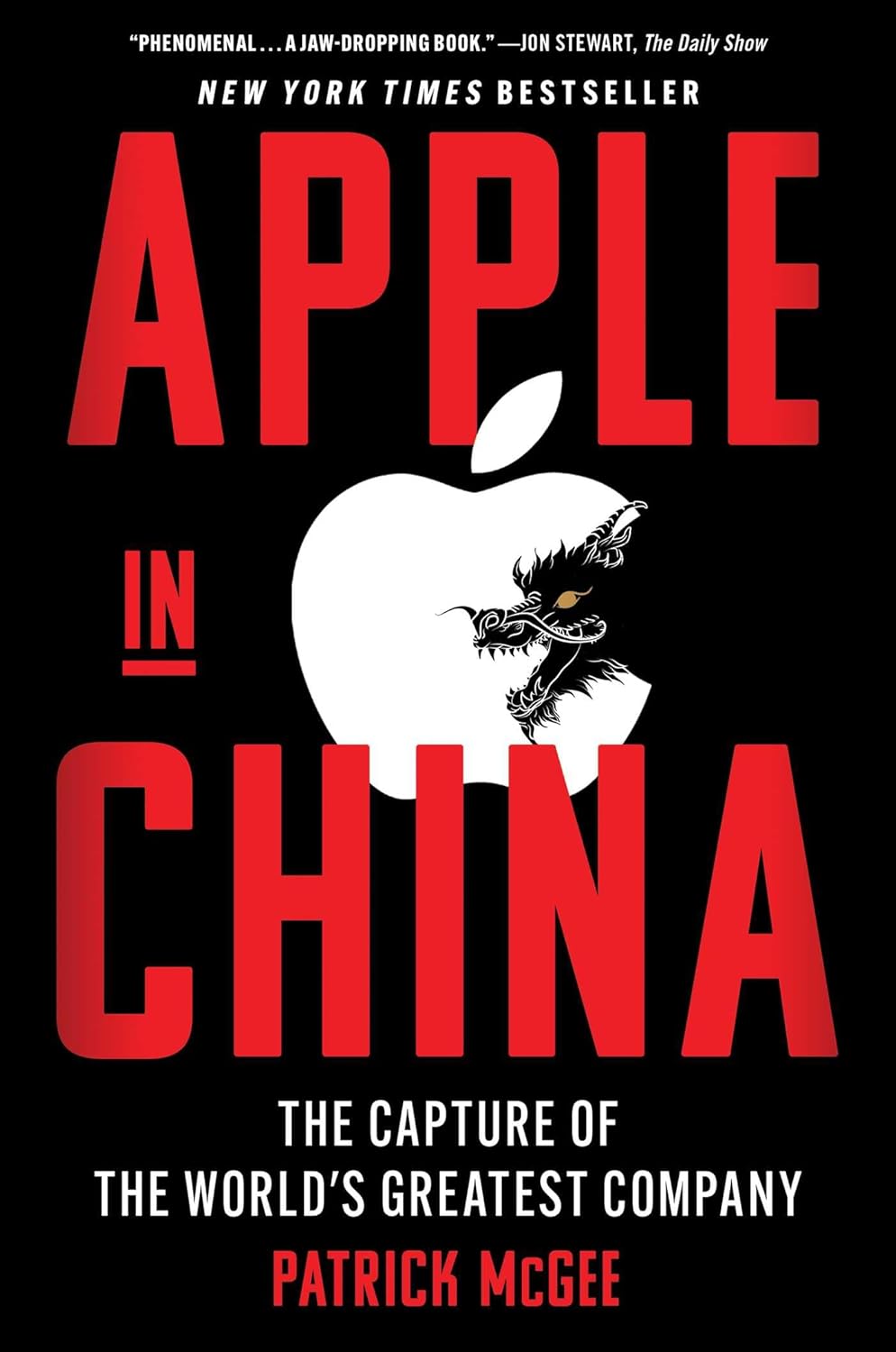
Apple in China - Patrick McGee

Apple in China - Patrick McGee

Patrick McGee

RECOMMENDED NONFICTION

Started: Jul 30, 2025

Finished: Aug 15, 2025

Review

Apple in China paints a picture of a company that took Steve Jobs personality to heart. From Tony Blevin's making deals that put workers in dire situations at Foxconn so that the company could hit the prices Apple forced on them, to Tim Cook going back on his 2017 statement about staying silent in the face of unjustness being the loudest form of agreement with the terrible acts, Apple's move to China doesn't look good.

Apple is in a tight spot, integrated so tightly into China based manufacturing so that it must tow the line of the Chinese Communist Party or risk retaliation in the form of manufacturing being shut down. McGee asks a good question at the end, while we lionize Tim Cook now for his manufacturing and deal prowess, will we later see how he sold out the United States in a quest for profits. Training hostile nations how to make things better than is possible in the US and selling out any possibility of US manufacturing catching up within the next decade.

Notes

> With no regulatory oversight of what was happening, a shift in where all this work was being performed was inevitable. The cofounder of [[Intel]], [[Andy Grove]], would later diagnose the problem as "a general undervaluing of manufacturing-the idea that as long as 'knowledge work' stays in the US, it doesn't matter what happens to factory jobs". Pg 112
- but more of the population was, maybe still is, employed in these factory manufacturing jobs and as the US and other countries try to recover their expertise even their meagre multi-million dollar investments are dwarfed by the ongoing investments and leverage that [[China]] has via [[Foxconn]] and it's government control

- Apple leveraged [[Foxconn]] for higher volumes at lower prices so while Foxconn increased revenue margins plummeted. In 2000 it had revenues of 10.6% but by 2011 they were down to 2.4% Pg 167
- I suppose this is how I get cheap [[iPhone]]s but still Apple seems like a bad company here when you combine it with how they take every drop of revenue they can get away with via [[rent seeking]] on the [[AppStore]]

- [[Tony Blevins]] also made competing contract suppliers line up in adjacent hotel rooms not letting them eat, by threatening to leave the deal, or leave the room. Then he’d sometimes play with the heat so you were either far too hot or too cold because who would need a sweater in the summer in Hong Kong. Well you would if Blevins cranked the AC until you were not dressed properly. Pg 167
- so he’s as big an asshole as [[Steve Jobs]] was and as Apple is now seems like a culture thing with the company

- [[parts pairing]] and other methods that [[right to repair]] activists hated were not started to curb repair but to stop the so called [[yellow cow]] scalpers that would steal a phone sell internal components replace with look alike copies of nothing then take the phone to Apple for exchange. PG 243
- Apple offered this replacement for phone policy in China to appease the government that felt it was being treat wrongly by Apple as a mere supplier not the integral part of a dynamic team for manufacturing which [[Foxconn]] really was

> And when [[Apple]] makes the case that it’s a leader in this area, it’s not necessarily wrong. But in general conditions of manufacturing electronics in [[China]] are poor, and he says Apple’s demanding culture promotes a “do whatever it takes” approach among suppliers. That routinely leads to subpar conditions and invariably leads to some instances of illegal practices. Pg 308
- They’re not willing to pay more for parts or finished products and expect the suppliers to reduce margins further to increase the quality of life for workers so this makes [[Apple]] seem even worse
- they’re not willing to make any sacrifices which means they’re really just paying lip service to wanting good conditions for workers.
- and why would [[Apple]] fight back against [[China]]’s crackdown on labour monitoring groups because the lack of on the grounds reporting showing bad things helps Apple keep it's production up

> In 2017, explaining why corporate executives should be more up-front about their values and "lead accordingly," Cook told journalist Megan Murphy that "silence is the ultimate consent." He went on:
>
>> If you see something going on that's not right, the most powerful form of consent is to say nothing. And I think that's not acceptable to your company, to the team that works so hard for your company, for your customers, or for your country. Or for each country that you happen to be operating in. Pg 361
- yet look at [[Tim Cook]] now, letting [[China]] abuse workers and crack down on any protest because it helps [[Apple]]'s profits. A younger Cook would be ashamed by his own admission.

- [[Dying for an iPhone - Jenny Chan Mark Selden Pun Ngai]] Pg 368
- an expose on the terrible working conditions at [[Foxconn]] that persist so we can purchase an [[iPhone]] from [[Apple]]

- [[Chip War - Chris Miller]] Pg 373
- microchips are the oil of today, needed for anything to run. While the US had dominance in design and manufacture, that's not firmly in China's hands

- [[The Man Who Broke Capitalism - David Gelles]] Pg 382
- [[Jack Welch]] was touted as a business titan, taking [[GE]] to new heights of profit, but on reflection his gains harmed [[capitalist|capitalism]], the [[United States]] and increased [[inequality]]. With a longer view, his gains were short term at the expense of the longer term health of both GE and the countries it did business in
- the author wonders if [[Tim Cook]]'s legacy will take a similar turn as looking back we see the offshoring of [[Apple]]'s manufacturing as a huge loss for Western innovation and manufacturing