Book Wars - John B Thompson

Book Wars - John B Thompson

John B Thompson

MAYBE NONFICTION

Started: Nov 18, 2022

Finished: Nov 05, 2022

Review

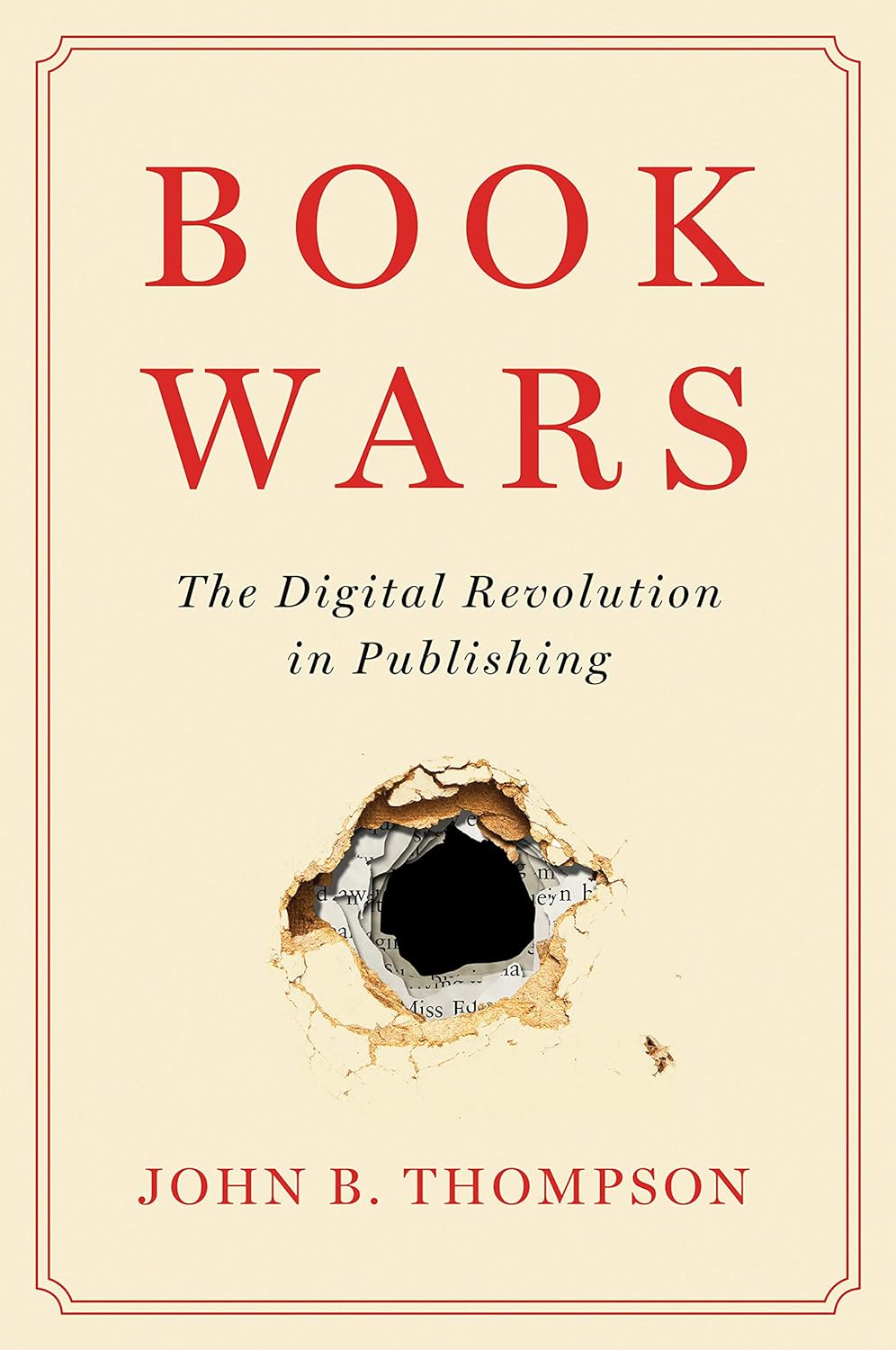
John B Thompson covers the rise of the ebook and what it meant for publishing. From the dominance of Amazon, to the metoric rise, then slow dwindle of ebook readers...there is something here for anyone that is interested in the industry of writing and books.
Read my longer review of Book Wars

Purchase Book Wars on Amazon

Notes

# Book Wars

## 1 The Faltering Rise of the eBook

While people guessed that ebooks would be mostly for busy travellers looking to keep books with them for business, fiction (specifically romance) is the leading category. eBooks grew but then plateaued and regressed slightly in most category and took much of the mass market paperback sales volume.

- no one predicted which types of books would transfer to ebooks and we shouldn't lump all genres into a single ebook line. Romantic fiction, and fiction in general, have outperformed non-fiction by a large margin in adult books. Teen and childrens books are negligble. Page 38 - 40
- They suppose that non-fiction is more like reference so you flip around which makes an e book harder to use than a paper book. Page 42
- E books took sales from paperbacks, particularly mass market paperbacks. Page 53

## 2 Reinventing the Book

Many companies tried to reinvent the book. An early one on the iPad was The Element, which was an interactive application. Ultimately, everyone had trouble and prices cratered in many different attempts at reinventing the format of a book.

## 3 The Backlist Wars

[[eBook]] rights prior to 1994 were very vague in contracts. A bunch of companies purchased the digital rights to backlist titles and sold them. There were legal challenges by publishers, but they didn't hold up and the practice was allowed. Overall, the startup backlist companies had to do more traditional publisher things to stay solvent or had to become marketing companies. They couldn't survive solely on the income from backlist books.

## 4 Google Trouble

This dealt with the legal wrangling around [[Google]] digitizing books. Authors, publishers, and a bunch of other groups put up legal blockades to Google scanning books. In the end they came to an agreement with Google that they could share snippets of books via their search engine in their full text search scans of books. Then they'd refer to sources to purchase the book in some format.

## 5 Amazon's Ascent

With Amazon being the biggest marketplace for publishers they have exerted pressure on publishers to keep prices low. Once they achieved a dominant market position, they were happy to move to a pricing model that has made it harder for competitors to join the market. They now also compete directly with publishers via KDP so that writers go right past publishers and direct to Amazon.


- for most publishers [[Amazon]] is their single biggest account, which is a problem because the bigger Amazon gets the more they demand and the harder it is to deal with them. Page 141
- [[The Innovator's Dilemma - Clayton M Christensen]] Page 146
- when [[Amazon]] released the [[Kindle]] they never told publishers what they'd be selling [[eBook]] for until the presentation. At $9.99 that was very low and Amazon was loosing money. Publishers were scared (rightly so) that this price would become the norm and their already thin profit margins would get squeezed. Page 146
- Amazon is a [[monopsony]] which means it doesn't raise prices with it's dominant market position, like a [[monopoly]] would. It uses it's position of power to drive down the prices it's willing to pay for items and squeezes out the margins of it's suppliers. Page 161

## 6 Struggles for Visibility

Publishers have been slow to see the power Amazon wielded and how it collected so much data they never had on their own purchasers. Now they use a combination of promotions on Amazon, building their own lists, and BookBub to bring visibility to books they want to sell.

- at first publishers would look for display space at the front of the store, or somewhere in a store to push their books
- traditional media like Newspapers were alse big, but they continued to drop coming into the 2000's and [[Web 2.0]] and publishers started to engage with blogs. Page180
- ultimately a good book marketing plan has online and offline parts that all build on each other to bring a book to the attention of readers
- relying on [[algorithm|algorithms]] to present books means you only see things like what you already have purchased at a particular retailer. Having books in a physical space means you have some measure of serendipity to find new books that you never would see otherwise. Page 189
- so does this push us towards more [[polarized|polarization]] due to [[filter bubbles 090920200646]] and [[Confirmation Bias]]?
- to combat the power that Amazon has publishers are building their own databases of emails and user preferences so they can market directly to interested readers. Page 202

## 7 The Self-Publishing Explosion

So more and more people are self-publishing and the big 5 publishers really have no numbers on what that means.

- When you take into account that KDP authors get a higher % of sales than they would from a traditional publisher, it's likely that self-published authors take as much in sales as traditionally published authors do. Page 273
- it's also possible that ebook sales didn't decline so much as errode due to the big publishing houses getting squeezed out by indie publishers on Amazon via [[KDP]]. Page 276

## 8 Crowdfunding Books

Crowdfunding lets users choose which books get made and stops some of the gatekeeping of the big 5 publishers. It does put more on the author though as they have to market and then higher editors and arrange all the printing and distribution. Some services like [[Unbound]] will do that for you once you've had your book funded though.

- crowdfunding isn't just the source of capital for your project, it's the future audience for your product as well. Page 284
- publishers use crowdfunding because it's a audience building machine for the book they're about to sell. Page 297
- [[Unbound]] is a crowdfunding publisher. They crowdfund the books and those that get enough support (initial sales) get printed. Page 299

## 9 Bookflix

There are three main payment methods for subscription media services. First, used by [[Netflix]] is the pay up front for rights model. You pay up front and can stream/deliver content. Second, the pool model used by [[Spotify]] and [[Amazon]] for [[Kindle Unlimited]]. You put aside a portion of revenue/profit and content creators get a portion of that pool based on how much their content was consumed relative to the total consumption. Third, pay full price based on thresholds of consumption used by [[Scribd]]. Here when a reader gets around 20% of a book read [[Scribd]] pays full price to the publisher as if the book was bought.

The biggest issue with the [[Scribd]] model is that some genres read lots. Romance in particular is a huge reading genre, like 20+ books a month. Scribd had to cut Romance and then institute a 3 book per month limit on readers to get profitable again.

## 10 The New Orality

- the [[audiobook]] industry started for [[accessibility]] reasons, to bring books to those that were incapable of reading. Page 351
- now it's a huge industry that many use. Think of all the books my kids listen to that would be inaccessible to a 6 and 8 year old.
- if we didn't have them around due to accessibility, how much longer would it have taken to develop the industry. [[accessibility]] work bears fruit for us all.
- In 2008 [[Audible]] was sold to [[Amazon]], it had only been profitable in 2004, but lost money every other year despite the 2003 deal with [[Apple]] to be the sole supplier of audiobooks on their platforms. Page 363
- this further entrenches [[Amazon]] as the biggest player in the book industry for publishers
- it used to be that publishers only did [[audiobook]] versions if they thought the book would sell over 50,000 print copies as they used a 10% rule. They figured audiobooks would sell 10% of the print sales. Now they realize they don't know and a poor print book may be a bestseller in audiobook format. Page 367
- after some investigation by [[Germany]], [[Apple]] and [[Audible]] announced in Jan 2017 that the exclusive deal would end. Now publishers of audiobooks could go directly to [[iTunes]] on their own. Page 375

## 11 Story Telling in Social Media

- [[Wattpad]] is a social network for serialized stories used by around 80 million people Page 398
- one of the keys to Wattpad is that readers comment and interact with the stories as they're told. They discuss them chapter by chapter and that means they're heavily invested in the story. Their comments also have some opportunity to influence the writer's direction as well. Page 401
- Where traditional publishers us a top down approach to book selection (they decide what gets published) Wattpad uses a bottom up approach. They see what stories people on their platform are reading and the publish them. Page 412

## 12 Old Media, New Media

- while paper book sales did decline in the face of ebooks, the revenue from ebooks and audiobooks made up for it and due to decreased overhead from print costs, the bottom line improved for many publishers. Page 418
- the digitization of books was different than music in a few ways. First, you can't unbundle chapters of a book like you can songs in an album. The chapters all go together to form one whole. Second, the experience of reading on a screen is different enough for many readers that they don't embrace it. The experience of music is different in that the is no tactility to music. Page 424
- another vote for physical books is ownership...in that you own it for real and can do what you want with it. eBooks can't be lent out or traded back. This is similar to digital vs physical copies of music, but it seems that access is more important in music and movies than it is in books.
- reading a book is always a time intensive investment where listening to a song is a few minutes, an album maybe an hour. Pretty much every book is going to be a multi-hour investment with the text and the object, more if you're taking notes and reading a "hard" book.
- [[Amazon]] accounts for 45% of all print book sales and 75% of all ebook sales in the Anglo-American publishing world. This gives them unprecidented power to dictate terms to the publishers, who may see more than half of their sales volume coming through Amazon. Page 430
- [[The Age of Surveillance Capitalism 190920202307]] Page 433
- while publishers, an the traditional publishing industry, is a content based industry that wants to make sure content is generated and profitable...most of the big tech companies make their money not from content but from other methods like ads or hardware. Thus the content is merely a way to collect data and they want to drive the cost of it as low as possible, which is unsustainable for those producing content. Page 446
- this is why publishers fought hard against [[Google]]'s library project which treated the content like something to just scan an feed a search engine. If there is no value to content, people will stop writing it and publishers main income will dry up.
- [[Curation - Michael Bhaskar]] Page 452
- When publishers gather data on readers they're not doing it to sell to another party for ads, they're going to market their own stuff to them based on the reading preferences. This is in contrast to Facebook, Google, Amazon...who use that data to sell ads to 3rd parties. Page 466
- of course publishers pushed hard enough may sell their customer data to others just because it is so valuable
- [[The Shallows]] Page 470
- [[Social Acceleration - Hartmut Rosa]] Page 471
- Is the reading of books a backlash/desire to slow down based on the frenetic pace of life. It's a long term (at least hours, maybe days) committment to focus on one thing instead of being pulled in many directions. The continued popularity of paper books is possibly a statement that we want less time on screens. Page 472
- [[Slow Media - Jennifer Rauch]] Page 472

## Conclusion - Words in Flux

- ?? he didn't really address publishers taking more out of libraries via ebooks and the rights on ebooks than they ever have been able to with print books. This means that libraries may have more costs in ebook borrowing than print borrowing.
- see [[print is governed by first sale 202006170933]] for more on this

**Print is governed by first sale from BiblioTECH**
[[BiblioTECH]]

- that means you purchase it and then you can do whatever you want with it [^Page 186]
- digital you end up leasing under restrictive covenants and continuing to pay for access which makes it expensive for libraries to hold onto digital content