I think the best summary of this book comes from the title of the blog post I wrote about it: "The Rich Person's Guide to Creating an Innovative Child". Wagner highlights how a bunch of families that could afford second homes and private schooling, or the time to homeschool, raised children that created what Wagner terms as innovations.
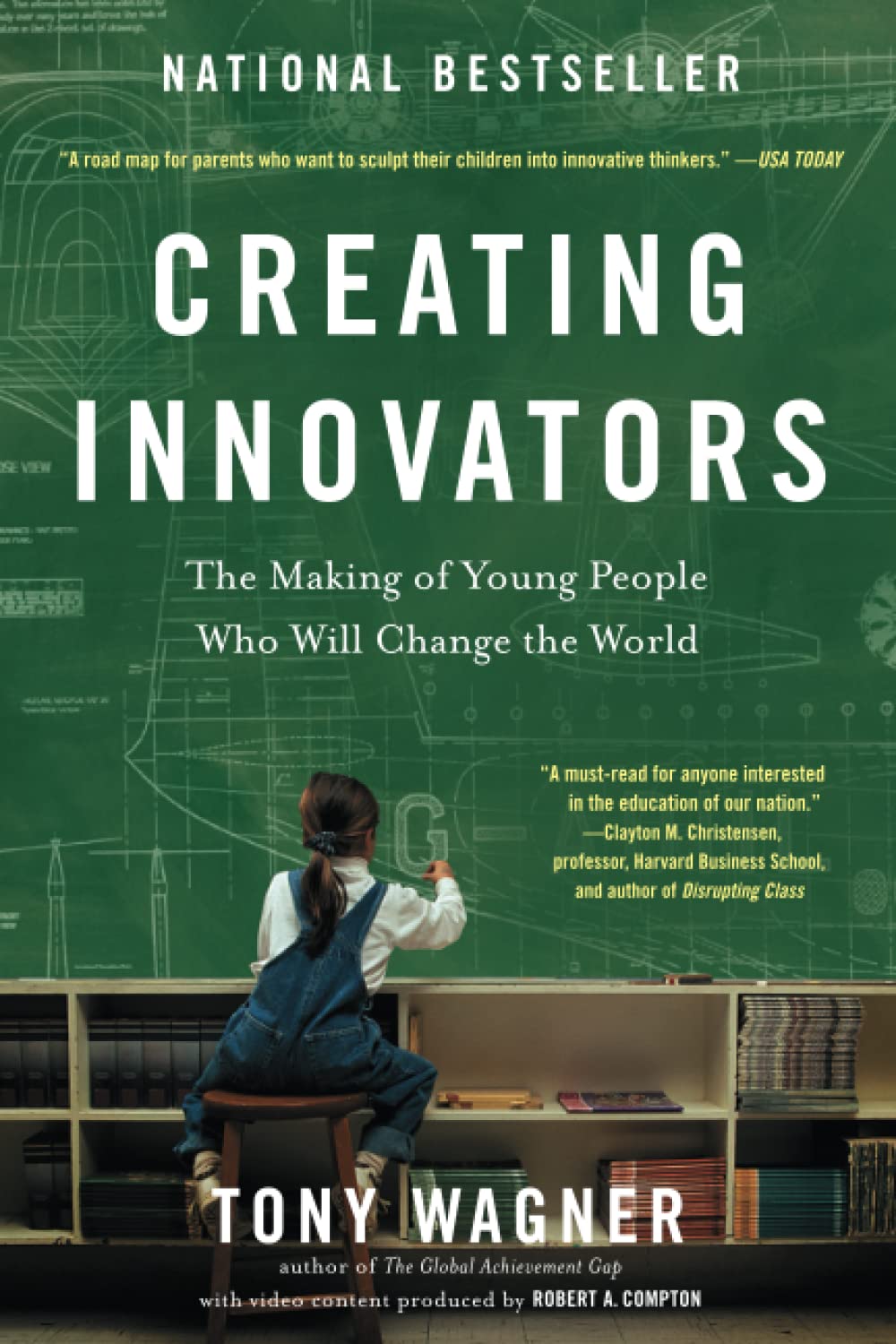
Creating Innovators - Tony Wagner
NOT RECOMMENDED
NONFICTION
Started: Jan 14, 2023
Finished: Feb 08, 2023
Review
Notes
- [[The Global Achievement Gap - Tony Wagner]] Page XIII
**Purpose**
- to determine what education needs to bring to the table to create [[STEM]] innovators. Page XV
- ?? I wonder if he addresses any of the ideas in [[Scarcity 180920201044]] about why people even get to be educated to the levels they currently are. Or if he looks at any ideas around [[Sources/Books/The Case Against Education]]
- No he does not
### 1 A Primer on Innovation
- 37% of young American families live in poverty and they are disproportionately [[BIPOC]] - Page 2
- see [[The Color of Law in Real Life - Housing Price Racism]] and [[Scarcity 180920201044]]
- the author says it’s agreed that innovation is what will drive economic growth but offers no citation we’re just supposed to take his word. Page 2
- according to this people agreed in 2015 that the most important innovations will address human needs not increased corporate profit. Yet we got [[Uber]] and [[The Boring Company]] which funneled money away from transit and increase [[congestion]] on the roads and runaway c-suite sallaries. Page 6
- so [[capitalist|capitalism]] went the opposite way from what everyone agreed on
- [[How to Kill Creativity 170120230631]] Page 24
- [[The Scientist In The Crib - Alison Gopnik Andrew N Meltzoff Patricia K Kuhl]] Page 25, 26 ish
- [[play]] is important for child development. Page 27
- but school isn’t structured for play.
- Kids are restricted from outdoor play in neighbourhoods as adults police where children are allowed to be
- if we cared about “the children” it would be law that kids were allowed to play unsupervised
- if we cared about “the children” school would involve more outdoor time for kids
- instead kids get crazy schedules to “get ahead” so they can get into a good schools and run the education race as far as debt will take them
- see [[Sources/Books/The Case Against Education]]
- [[Drive - Daniel H Pink]] Page 29
### 2 - Portrait of the Innovator as a Young Man
- sigh, young person not man
- this is just a chapter about how rich families can afford outdoor space for their children to play unsupervised. Or how they can afford to purchase chemistry sets and other things for their children to experiment with. Or how they can afford to get a second house (38, 39) on the opposite coast and move their entire family there to make sure their child got the “good” schooling
- there is nothing here about middle class people, or poor people, that can’t afford all those things. Just spend money on your kid and give them space, that is safe and unpoliced by adults, that they can explore in
### 3 - STEM Innovators
- another chapter about rich parents spending money on their kids so they could explore and invent and doo stuff like this. One family had an extra $30k a year for private high school (61)
- then could pay for Carnegie Melon University
- plus they had jobs that let them move and time to spend without 2nd or 3rd jobs that they needed to work at to even feed the family
- another family had $50k they could borrow against a business to invest in their child’s company. Page 76
- He’s only talking to those that hit [[survivorship bias]] as well. What about all the parents that did similar things and then their kid was lame and just went to [[Wall Street]] and became a finance bro?
- how often do we squash the “what-if” questions in kids. Do we shut down the things they could invent before they even start down the path towards that invention. Page 97 ^2dfeeb
- do teachers even have time to allow those types of questions to thrive at school?
### 3 - Social Innovators
- the culture of academia and the publishing requirements of [[tenure]] means school focuses on pure information transmission and regurgitation of the information instead of hands on practical discovery work. Page 114
- practical work takes more time to grade and more time to help students invent
- practical work is likely better for kids needing actual experience
- when your school has been underfunded and the life you were born into is full of scarcity [[capitalism wants you to believe you picked your life]] because then it’s your fault and the system is just fine. Page 125
- is school performance based funding more about making sure “poor” kids can’t get the needed education to be a “threat” to rich kids. Rich kids parents can just pay for “better” schools
- [[is performance based school funding around to keep poor families out of the race for position]]
- when you’re interested in a field filled with degrees and don’t have one people don’t take you seriously even when you show competence. Page 137
- [[if you have a degree you must validate it was worthwhile]]
### 5 Innovative Learning
- if we want [[STEM]] innovators then teaching to the test schools all the creativity out of students as they just have to memorize the answers for the test. Page 148
- teachers just have to plow through information that’s on the test
- standardized tests tell us nothing about what the students can do with their knowledge, just that they can memorize facts. Page 151
- see [[Revisionist History - The Tortoise and the Hare]] on how the [[LSAT]] is just testing for how fast you can answer questions
- [[Academically Adrift - Richard Arum Josipa Roksa]] Page 154
- after 2 years in college nearly 1/2 of students show no improvement in complex reasoning skills
- [[We’re Losing Our Minds - R Keeling R Hersh]] page 154
- business leaders highering recent grads say they don’t have enough experience in collaborative problem solving and experience across disciplines. Page 156
- this is not what school is for. It’s for getting paper that says you’ll listen long and hard to get a job. see [[Sources/Books/The Case Against Education]]
- see [[Range]] for more on breadth of experience
- students are asked to specialize before they can possibly know what they actually want to specialize in. Page 173 ^cf91f1
- thus poor [[match fit 201020200723]]
- though the huge cost of school pushes specialization so you stop building huge debt and just get out of there with your ribbon of participation
- lets rich people take longer to decide and get more ribbons to get better jobs
- money given to [[University]] is one of the biggest catalysts for decisions. Not what is best for the school and the students. Page 188
- this is saying the quiet part loud
- [[tenure]] track [[publish or perish]] dictum means teaching is seen as a distraction from research and publishing. Page 189, 190
- this means your teachers may not want to be there because teaching threatens their job as teaching isn’t as high as publishing on what they get credit for
### 6 - The Future of Innovation
- he addresses [[tiger moms]] and [[helicopter parenting]] but then never addresses the structural issues with society that help cause this type of parenting. Page 202. 208
- he says to give your kids freedom to explore, and never addresses the space needed and the cultural conditions needed to make this possible and make this safe. Page 206
- the innovative nursery school he holds up as an example is $12k/year Page 209
- so it’s a school for rich people to help their rich kids get ahead of poor people who can’t afford to do this schooling. They may not even be able to afford basic pre-school and siblings watch young kids.
- [[How - Why How We Do Anything Means Everything - Dov Seidman]] Page 216
- [[The Race Between Education and Technology - Claudia Dale Goldin Claudia Goldin Lawrence F Katz]] Page 231
- [[The Innovator's Dilemma - Clayton M Christensen]] Page 241
**Purpose**
- to determine what education needs to bring to the table to create [[STEM]] innovators. Page XV
- ?? I wonder if he addresses any of the ideas in [[Scarcity 180920201044]] about why people even get to be educated to the levels they currently are. Or if he looks at any ideas around [[Sources/Books/The Case Against Education]]
- No he does not
### 1 A Primer on Innovation
- 37% of young American families live in poverty and they are disproportionately [[BIPOC]] - Page 2
- see [[The Color of Law in Real Life - Housing Price Racism]] and [[Scarcity 180920201044]]
- the author says it’s agreed that innovation is what will drive economic growth but offers no citation we’re just supposed to take his word. Page 2
- according to this people agreed in 2015 that the most important innovations will address human needs not increased corporate profit. Yet we got [[Uber]] and [[The Boring Company]] which funneled money away from transit and increase [[congestion]] on the roads and runaway c-suite sallaries. Page 6
- so [[capitalist|capitalism]] went the opposite way from what everyone agreed on
- [[How to Kill Creativity 170120230631]] Page 24
- [[The Scientist In The Crib - Alison Gopnik Andrew N Meltzoff Patricia K Kuhl]] Page 25, 26 ish
- [[play]] is important for child development. Page 27
- but school isn’t structured for play.
- Kids are restricted from outdoor play in neighbourhoods as adults police where children are allowed to be
- if we cared about “the children” it would be law that kids were allowed to play unsupervised
- if we cared about “the children” school would involve more outdoor time for kids
- instead kids get crazy schedules to “get ahead” so they can get into a good schools and run the education race as far as debt will take them
- see [[Sources/Books/The Case Against Education]]
- [[Drive - Daniel H Pink]] Page 29
### 2 - Portrait of the Innovator as a Young Man
- sigh, young person not man
- this is just a chapter about how rich families can afford outdoor space for their children to play unsupervised. Or how they can afford to purchase chemistry sets and other things for their children to experiment with. Or how they can afford to get a second house (38, 39) on the opposite coast and move their entire family there to make sure their child got the “good” schooling
- there is nothing here about middle class people, or poor people, that can’t afford all those things. Just spend money on your kid and give them space, that is safe and unpoliced by adults, that they can explore in
### 3 - STEM Innovators
- another chapter about rich parents spending money on their kids so they could explore and invent and doo stuff like this. One family had an extra $30k a year for private high school (61)
- then could pay for Carnegie Melon University
- plus they had jobs that let them move and time to spend without 2nd or 3rd jobs that they needed to work at to even feed the family
- another family had $50k they could borrow against a business to invest in their child’s company. Page 76
- He’s only talking to those that hit [[survivorship bias]] as well. What about all the parents that did similar things and then their kid was lame and just went to [[Wall Street]] and became a finance bro?
- how often do we squash the “what-if” questions in kids. Do we shut down the things they could invent before they even start down the path towards that invention. Page 97 ^2dfeeb
- do teachers even have time to allow those types of questions to thrive at school?
### 3 - Social Innovators
- the culture of academia and the publishing requirements of [[tenure]] means school focuses on pure information transmission and regurgitation of the information instead of hands on practical discovery work. Page 114
- practical work takes more time to grade and more time to help students invent
- practical work is likely better for kids needing actual experience
- when your school has been underfunded and the life you were born into is full of scarcity [[capitalism wants you to believe you picked your life]] because then it’s your fault and the system is just fine. Page 125
- is school performance based funding more about making sure “poor” kids can’t get the needed education to be a “threat” to rich kids. Rich kids parents can just pay for “better” schools
- [[is performance based school funding around to keep poor families out of the race for position]]
- when you’re interested in a field filled with degrees and don’t have one people don’t take you seriously even when you show competence. Page 137
- [[if you have a degree you must validate it was worthwhile]]
### 5 Innovative Learning
- if we want [[STEM]] innovators then teaching to the test schools all the creativity out of students as they just have to memorize the answers for the test. Page 148
- teachers just have to plow through information that’s on the test
- standardized tests tell us nothing about what the students can do with their knowledge, just that they can memorize facts. Page 151
- see [[Revisionist History - The Tortoise and the Hare]] on how the [[LSAT]] is just testing for how fast you can answer questions
- [[Academically Adrift - Richard Arum Josipa Roksa]] Page 154
- after 2 years in college nearly 1/2 of students show no improvement in complex reasoning skills
- [[We’re Losing Our Minds - R Keeling R Hersh]] page 154
- business leaders highering recent grads say they don’t have enough experience in collaborative problem solving and experience across disciplines. Page 156
- this is not what school is for. It’s for getting paper that says you’ll listen long and hard to get a job. see [[Sources/Books/The Case Against Education]]
- see [[Range]] for more on breadth of experience
- students are asked to specialize before they can possibly know what they actually want to specialize in. Page 173 ^cf91f1
- thus poor [[match fit 201020200723]]
- though the huge cost of school pushes specialization so you stop building huge debt and just get out of there with your ribbon of participation
- lets rich people take longer to decide and get more ribbons to get better jobs
- money given to [[University]] is one of the biggest catalysts for decisions. Not what is best for the school and the students. Page 188
- this is saying the quiet part loud
- [[tenure]] track [[publish or perish]] dictum means teaching is seen as a distraction from research and publishing. Page 189, 190
- this means your teachers may not want to be there because teaching threatens their job as teaching isn’t as high as publishing on what they get credit for
### 6 - The Future of Innovation
- he addresses [[tiger moms]] and [[helicopter parenting]] but then never addresses the structural issues with society that help cause this type of parenting. Page 202. 208
- he says to give your kids freedom to explore, and never addresses the space needed and the cultural conditions needed to make this possible and make this safe. Page 206
- the innovative nursery school he holds up as an example is $12k/year Page 209
- so it’s a school for rich people to help their rich kids get ahead of poor people who can’t afford to do this schooling. They may not even be able to afford basic pre-school and siblings watch young kids.
- [[How - Why How We Do Anything Means Everything - Dov Seidman]] Page 216
- [[The Race Between Education and Technology - Claudia Dale Goldin Claudia Goldin Lawrence F Katz]] Page 231
- [[The Innovator's Dilemma - Clayton M Christensen]] Page 241