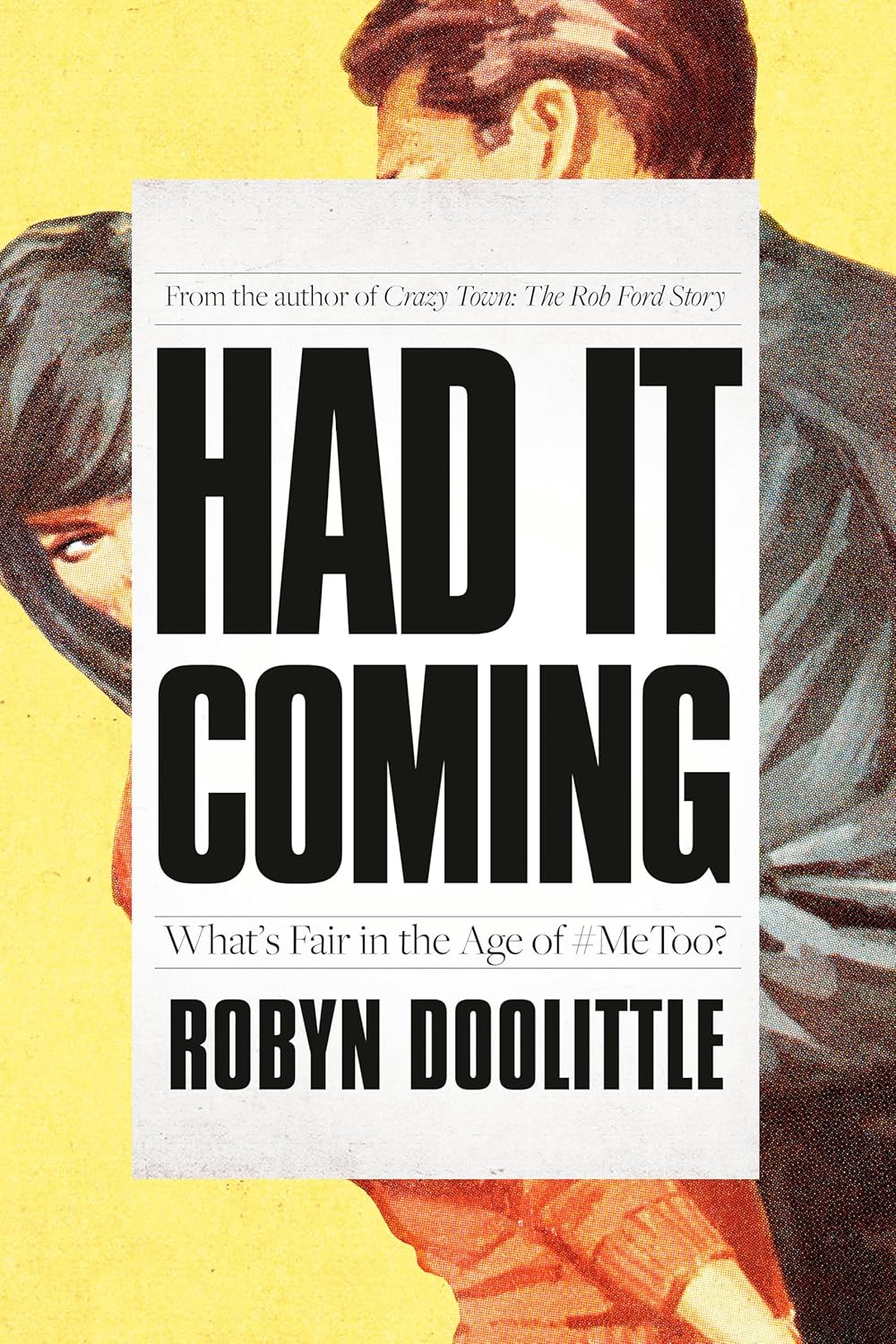
Had it Coming - Robyn Doolittle

Had it Coming - Robyn Doolittle

Robyn Doolittle

RECOMMENDED NONFICTION

Started: Jan 31, 2026

Finished: Feb 10, 2026

Review

Let's start with a disclaimer. This book is about how police, and society, disbelieve sexual assault complainants and pronounce up to twice as many sexual assaults as unfounded compared to common physical assault1. This is going to be a tough read for many.

Early on Doolittle explains that she wants to sit in the nuanced discussion around sexual assault, something that is hard to do in today's bite sized rage driven social culture2. She's not here to excuse those who commit sexual assault, but to explore why it is poorly understood and poorly prosecuted.

Doolittle establishes that despite Canada having some of the best laws around sexual assault3, it's on par with it's Western peers with the number of cases that are deemed unfounded due to the unwillingness to enforce the laws that are on the books4. This unwillingness is often because they investigating officer doesn't have a solid grasp of the laws5, so takes things like past sexual activity as a factor in deciding how to proceed. This is specifically excluded, as are many rape culture tropes, in Canadian law and have been excluded for decades.

Police also fall into the same view that much of society does, that one stupid night shouldn't ruin your life6. This often is directed towards the male assaulter though, not towards the complainant, who will have to live with the effects of the night for their whole life regardless of how the justice system treated their complaint.

Just like society, police also believe that false accusations are far more common than they truly are. This is in part because when a false accusations happens, it gets blown up in the media7 and used as a way to show that a deceitful seductive woman can't be trusted.

Doolittle ends on the note that if we want gender equality and feminism to be effective it needs to not only bring equality for women, it needs to give men another way to live. Men also have gender stereotypes that they live inside that are harmful, and culture is doing little to help provide another option while telling men that they're existing way of living is abhorrent and unwelcome in society8.

Should You Read Had it Coming by Robyn Doolittle

Maybe, but only because those who have experience sexual assault may find it hard to read. Otherwise, yes this is a great quick read on the state of sexual assault in society that doesn't just tell us that men are bad, but digs into the cultural systems that enable sexual assault and devalue victims.


  1. Had it Coming Pg 122, 123 

  2. Had it Coming Pg XI 

  3. Had it Coming Pg 27 

  4. Had it Coming Pg 29 

  5. Had it Coming Pg 34 

  6. Had it Coming Pg 37 

  7. Had it Coming Pg 134, 135 

  8. Had it Coming Pg 239 

Notes

> Unfortunately, as a culture we aren't very good at having nuanced, complicated discussions. The public space is not a safe venue to talk about controversial subjects. [[social media]] has seen to that. Pg XI

- the purpose is to address the messy complicated discussions around being a woman and how men and women interact. Pg XI

- compared to the number of physical assaults, [[Canada|Canadian]] [[police]] dismiss nearly twice as many sexual assault cases as unfounded. Pg 7

- [[raped|rape culture]] Pg 9
- a societal framework that enables sexual violence by blaming victims and excusing perpetrators. It judges women's clothing as as a factor in their rape.

- a YouGov survey found 18% of Americans thought false accusations of [[sexual violence|sexual assault]] are a bigger issue than unreported attacks. Pg 11
- and 1/3 of people believe women complaining about [[sexual violence|sexual assault]] does more harm than good

- [[Jian Ghomeshi]] Pg 13
- I didn't know that Jian and CBC thought the Oct 19 2014 [[Canadaland]] scoop about Canadian surveillance was actually about Jian and his [[sexual violence|sexual abuse]] of women. Jian told CBC about all the stuff he did because he feared what Canadaland was about to say publicly.

- [[Putting Trials on Trial - Elaine Craig]] Pg 20
- dissects the ways rape myths and stereotypes taint our court systems

- even the most activist lawyers interviewed agreed that [[Canada]] has some of the best laws around [[sexual violence|sexual assault]] on the books. Pg 27
- Canada started moving to these laws in 1982 and bettered them throughout the 80s

- it's not Canadian laws that are the problem it's the willingness to enforce them. Pg 29

- in many of the unfounded cases the author looked at the investigating office didn't have a solid grasp of Canadian law and blamed the victim or used past sexual history as a deciding factor in how to proceed. Both of these ideas are specifically excluded as factors in Canadian law. Pg 34

- there seems to be a general view among police that one stupid night shouldn't run your life. Pg 37
- this is usually the life of the male though, because the female has to live with the rape for her life and deal with it's consequences even when the police refuse to do anything

- the stereotype of gendered sex roles in North America is the female puts up roadblocks and the male's job is to pursue through the roadblocks. Pg 76
- we get conditioned that a strong sexy man takes charge and pursues through the roadblocks

- people not interested in sex give non-committal answers or mumble affirmations or hedge. Pg 79

- often [[police]] and prosecutors respond favourably to a calm coherent statement with no gaps; but that discounts the effects of trauma on memory and the brain. We don't remember all the details and do have gaps after trauma. Pg 86

- in general the way [[police]] are trained to investigate crime is the exact opposite approach that should be taken with someone that's been through a traumatic event. Pg 91
- they focus on the threat not the details about the room, or a tie someone was wearing, but the details are what the police ask about and expect

- if you're not upset enough you're unlikely to be believed even though talking about trauma can make you relive and disassociate to avoid being retraumatized. This is a natural protection mechanism. Pg 92, 93

- [[The Body Keeps the Score - Bessel van der Kolk MD]] Pg 94
- shows how trauma reshapes the body and the brain

- critics of the trauma of neurobiology like Emily Yoffe contend it has so much influence it is impossible for accused to get due process an a fair trail. Pg 98
- because it excuses any gap or faulty memory in the complainant as because of trauma, not because maybe they're just wrong.

- [[Against Our Will - Susan Brownmiller]] Pg 112

- a trauma informed approach doesn't mean a complainant struggling to communicate should be believed because "trauma", bit we shouldn't simple dismiss them as we often do now as unreliable. Pg 119

- social scientists say there is strong evidence that only 2-8% of sexual assault allegations are false Pg 122, 123
- but the threat of a lying woman looms in our culture so we see rates of unfounded claims between 20-30%
- nearly twice as many [[sexual violence|sexual assault]] complaints are dismissed as unfounded compared to common physical assault

- studies that cite a 40% (or more) false complaint rate don't control for how the [[police]] treated the victim. Many recant because they don't trust how they're being treated and don't want to go through the trauma when they don't think they'll be believed by the officer. Pg 130, 131
- why put in the emotional and physical energy when nothing will happen anyway. Better to spend it on recovery
- see what Philadelphia Police have done to revamp their [[sexual violence|sexual assault]] case process because it's held up as a model

- the few times there is a false complaint it dominates the media. Pg 134, 135
- like when a robo-taxis has an issue
- and of course we want to protect men's place so showing false accusations helps keep people quiet
- culturally society wants to believe a blameless male and seductive lying woman narrative

- [[Remembering Trauma - Richard J McNally]] Pg 167
- examines how victims memory is affected by trauma

- we spend a lot of time looking for a path to redemption for men, an far less time on worrying about justice and healing for their victims. Pg 185

- [[Carnal Crimes - Constance Backhouse]] Pg 198
- explores 9 historical [[sexual violence|sexual assault]] trials in Canada between 1900-1975 looking at the failures of the Canadian justice system

- Backhouse suspects views aren't charging much on [[sexual violence|sexual assault]] because if a woman has had sex before people figure there isn't really any harm done. This discounts any violation of bodily autonomy, privacy, and right to safety. Pg 205

- [[Against Our Will - Susan Brownmiller]] Pg 212

- [[intersectionality]] acknowledges overlap between social justices and that only by stepping back and viewing the whole can you properly include marginalized groups. Pg 232
- yes a company may hire women, and black people, but you need to step back and see how they treat black women as a group to see if there is justice in how they hire black women

- [[Boys - Rachel Giese]] Pg 238
- while the opportunities for women and how they're defined have expanded the same can't be said for the definitions shackling men and boys. Men still muzzle their emotions and must never show weakness.

- if [[gender equality]] and [[feminism]] is going to be effective it needs to not only improve the lives of women, it has to transform the lives of men too. Pg 239
- like freeing them from the stoic male stereotype

- [[Political Tribes - Amy Chua]] Pg 244
- The United States needs to understand tribal politics if it's going to be effective with it's foreign policy