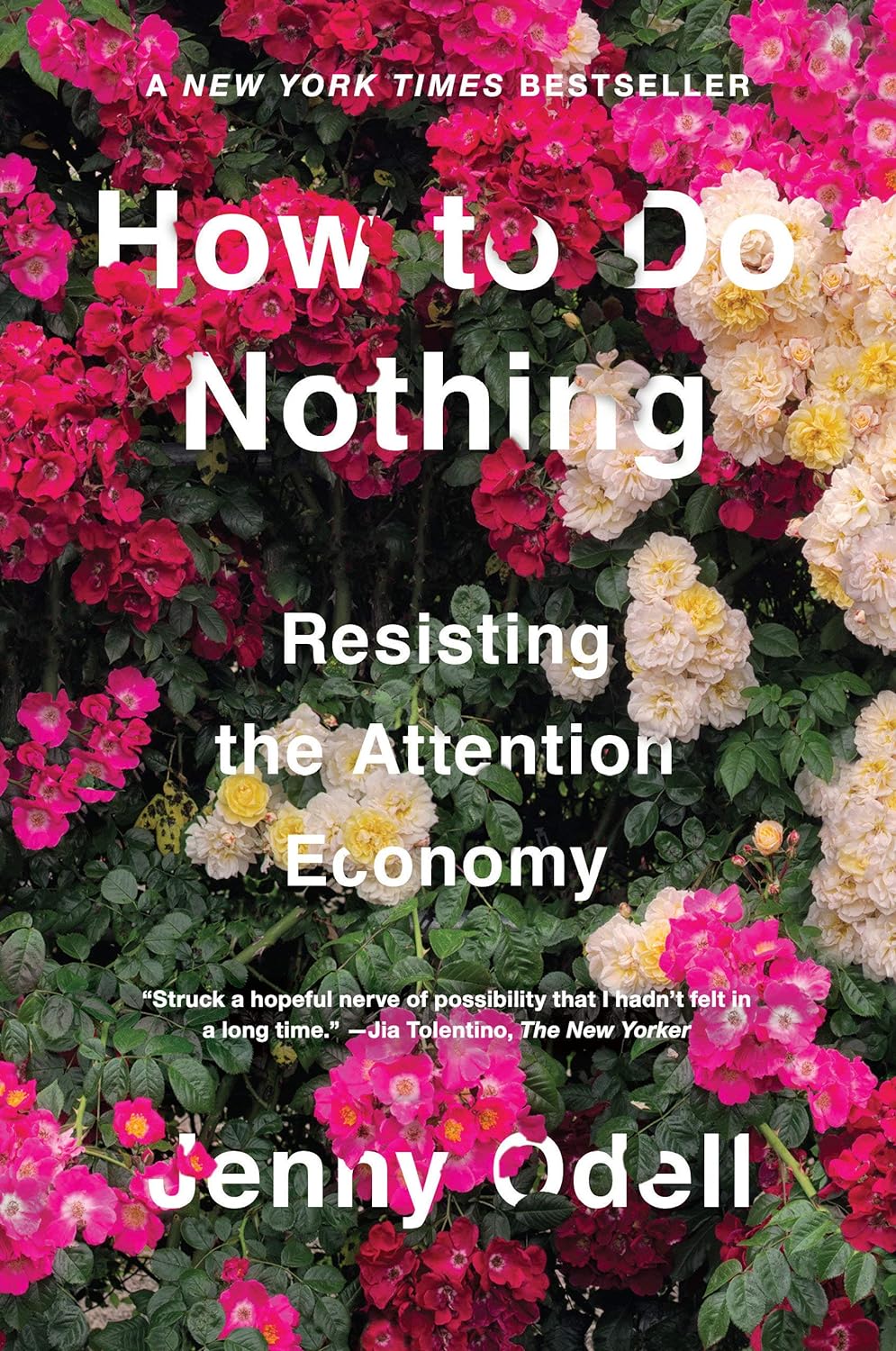
How to Do Nothing

How to Do Nothing

Jenny Odell

MAYBE NONFICTION

Started: Apr 16, 2020

Finished: Apr 28, 2020

Review

Jenny Odell spends the first half of this book looking at how to disengage from the attention economy and the second half trying to give us the tools to engage with something worthwhile in our live. I particularly like the idea she presents that social media promotes connectivity, mere likes and shares, while what we need in life is connectivity...that personal conversation with others. Connection is what gives life meaning.

Odell also spends a bunch of time talking about how our economy and world is geared towards productivity being the highest form of "good". Thus we often feel bad if we aren't being productive.

I also like that she acknowledges that taking a stand and saying goodbye to social media is a privilege that not everyone can use. You first have to have other forms of connecting with your group before you can leave behind the drain of social media. If you're isolated, social media may be the only thing that gives you anything resembling connection, even if it is far inferior to real life connection.

I enjoyed Odell's book, but I like Cal Newport's work more. Specifically Deep Work addresses many of the same concepts as Odell does here. It may be that I've read Newport's book a few times and thus was more familiar with the ideas when I read this book.

If you're newer to this type of book, this may be exactly what you're looking for.

Read my longer review of How to Do Nothing.

Purchase How to Do Nothing on Amazon

Notes

> Nothing is harder to do than nothing. In a world where our value is determined by our productivity, many of us find our every last minute captured, optimized, or appropriated as a financial resource by the technologies we use daily. We submit our free time to numerical evaluation, interact with algorithmic version of each other, and build and maintain personal brands. Pg 1

**Purpose**

- to show us how to do nothing as an act of political resistance to the attention economy.

**Structure**

- 1/2 about disengaging from the [[attention economy]]
- 1/2 is about reengaging with something else that’s not “productive”

## 1 - The Case for Nothing

- spaces deemed commercially unproductive are always under threat. Doesn’t matter how good gathering spaces and gardens are for community health.

- connectivity is a simple like or share. It’s a quick easy thing. Sensitivity is an in person talk, it takes time and means more. Pg 24
- social platforms encourage lots of the first and little of the second

## 2


- we can’t just walk away from the [[attention economy]]. We need to step back and have space to form a perspective and chapter 3 will show us how. Pg 62
-

## 3 - Anatomy of Refusual

> To pay attention to one thing is to resist paying attention to other things; it means constantly denying and thwarting provocations outside the sphere of one’s attention. Pg 81

- taking a stand or action is a privilege of those that can afford the consequences. Students have little to loose and can protest risking the little they have. Pg 84
- I can protest [[Facebook]] because I don’t care or need the connections it offers. Some can’t make this stand because it’s the only place their community connects

- once you quit [[Facebook]] how do you then direct your attention to other things? Is the new thing of any more value than what [[Facebook]] was providing? Are you allowing something else to steal the attention you should be directing as you want? Pg 92

- >…there is a significant portion of people for whom the project of day-to-day survival leaves no attention for anything else, that’s part of the vicious cycle too. Pg 94
- [[Scarcity 180920201044]] talks about this at length

## 4 - Excercises in Attention

- it’s fine to put laws around addictive tech, but don’t abdicate your responsibility to train your attention. Pg 119

- the whole chapter is about training your attention and spending your time focusing.

## 5- Ecology of Strangers

- you may not know the true story of those around you. Maybe the person that cut you off was heading to the hospital for a dying family member and didn’t do it with malice. We default to focus on our stories as the most important thing in the world. Pg 129

## 6 - Restoring the Grounds for Thought

- angry social media pile-ons are like a flood eroding our empathy. But they are good for social media companies as they gather our attention to them. Pg 160

- what if we stopped shouting into the void and instead talked into groups for which our words were meant for. Pg 176
- groups where we could have connection with the members

- to stop being pulled to devices you need to find something more interesting to occupy your time. The “truth” is that after most device time I feel hollow as if my time went into a hole with no value. Like a Dementor in Harry Potter, part of my was sucked away. Pg 185

## Conclusion

- 19th Century views of progress ignore what’s already around us as we turn everything into a unit of production. Pg 192
- wealthy neighbourhoods have more parks because the people there have time and resources to fight for it. They aren’t in [[Scarcity 180920201044]]