Paul J Silvia shares his tips for writing a lot and in that he identifies the place that most people fall down in their writing, they dream of it without having any plan on how to do the damn work. If you're looking for a short guide to kick you in the ass about not writing, this is a great book.
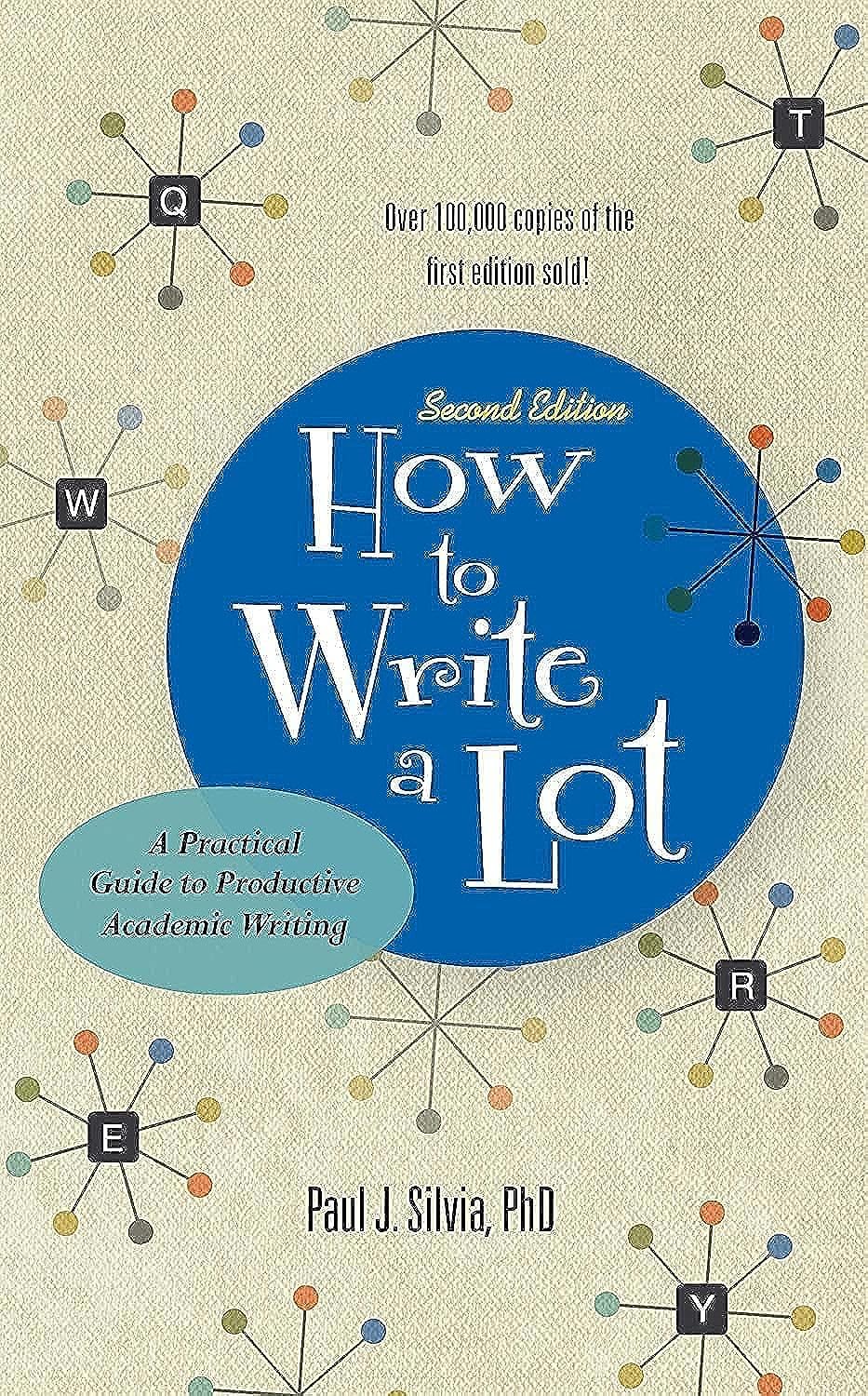
How to Write a Lot - Paul Silvia
RECOMMENDED
NONFICTION
Started: Apr 04, 2022
Finished: Apr 10, 2022
Review
Notes
These are from Kindle so the Location should correspond to the expected page on a Kindle no matter the platform.
- Writing productively is a skill, not a genetic gift, so you can learn how to do it. This book will show you how to make writing routine and mundane. ([Location 38](https://readwise.io/to_kindle?action=open&asin=B001Y35G60&location=38))
#### Chapter 1. Introduction
- Instead, we’ll talk about your outer writer. Writing productively is about actions that you aren’t doing but could easily do: making a schedule, setting clear goals, keeping track of your work, rewarding yourself, and building good habits. ([Location 54](https://readwise.io/to_kindle?action=open&asin=B001Y35G60&location=54))
- Note: But those aren't the quick fixes most people are looking for. Those are real work that must hbe done.
- Writing is a skill, not an innate gift or a special talent. Like any advanced skill, writing must be developed through systematic instruction and practice. ([Location 75](https://readwise.io/to_kindle?action=open&asin=B001Y35G60&location=75))
#### Chapter 2. Specious Barriers to Writing a Lot
- specious barriers: At first they appear to be legitimate reasons for not writing, but they crumble under critical scrutiny. ([Location 125](https://readwise.io/to_kindle?action=open&asin=B001Y35G60&location=125))
- Note: As in barriers to writing but really they apply to anything
- If you don’t plan to make a schedule, gently close this book, clean it so it looks brand new, and give it as a gift to a friend who wants to be a better writer. ([Location 163](https://readwise.io/to_kindle?action=open&asin=B001Y35G60&location=163))
- Note: Haha awesome
- the people who are happy to intrude on your writing time would never ask to intrude on your teaching time, your time that you spend with your family, or your sleeping time. They simply see your writing time as less important. ([Location 178](https://readwise.io/to_kindle?action=open&asin=B001Y35G60&location=178))
- Note: So it seems my work time is seen as less important in the house often.
- Equipment will never help you write a lot; only making a schedule and sticking to it will make you a productive writer. ([Location 240](https://readwise.io/to_kindle?action=open&asin=B001Y35G60&location=240))
#### Chapter 3. Motivational Tools
- The first step is to realize that goal setting is part of the process of writing. It’s a good idea to devote a writing session to developing and clarifying your writing goals; I usually do this once a month. Planning is part of writing, so people who write a lot also plan a lot. ([Location 303](https://readwise.io/to_kindle?action=open&asin=B001Y35G60&location=303))
- Here’s a sample list—it’s a rough average between my own priorities and the typical set of priorities. Use it as an example and write down your own priorities, perhaps next to your list of project goals. ([Location 332](https://readwise.io/to_kindle?action=open&asin=B001Y35G60&location=332))
- Note: Sample prioroty list
##### Checking page proofs and copyedited manuscripts.
##### Finishing projects with deadlines.
##### Revising manuscripts to resubmit to a journal.
##### Reviewing manuscripts and grant proposals.
##### Developing a new manuscript.
##### Doing miscellaneous writing.
## New highlights added April 26, 2022 at 6:29 AM
- Writer’s block is a good example of a dispositional fallacy: A description of behavior can’t also explain the described behavior. Writer’s block is nothing more than the behavior of not writing. Saying that you can’t write because of writer’s block is merely saying that you can’t write because you aren’t writing. ([Location 439](https://readwise.io/to_kindle?action=open&asin=B001Y35G60&location=439))
#### Chapter 4. Starting Your Own Agraphia Group
##### Component 1: Set Concrete, Short-Term Goals and Monitor the Group’s Progress
##### Component 2: Stick to Writing Goals, Not Other Professional Goals
- On Writing Well ([Location 510](https://readwise.io/to_kindle?action=open&asin=B001Y35G60&location=510))
- Tags: [[book]]
- Junk English ([Location 510](https://readwise.io/to_kindle?action=open&asin=B001Y35G60&location=510))
- Tags: [[book]]
##### Component 3: Big Carrots Can Double as Sticks
##### Component 4: Have Different Groups for Faculty and Students
##### Component 5 (Optional): Drink Coffee
#### Chapter 5. A Brief Foray Into Style
- Most scientists are impressed by good ideas and interesting findings, so don’t hide your ideas behind a wall of junk English. ([Location 557](https://readwise.io/to_kindle?action=open&asin=B001Y35G60&location=557))
- Junk English, ([Location 611](https://readwise.io/to_kindle?action=open&asin=B001Y35G60&location=611))
- Tags: [[book]]
- Even active sentences can be limp and lifeless. Psychologists often start a sentence with “Research shows that …,” “Recent studies indicate that …,” “Many new findings suggest that …,” or “A monstrous amount of research conclusively proves that ….” These phrases add little to your meaning, and citations at the end of the sentence will show that research bolsters your point. ([Location 712](https://readwise.io/to_kindle?action=open&asin=B001Y35G60&location=712))
- Note: So lean on the footnote and be confident in your point.
- Generating text and revising text are distinct parts of writing—don’t do both at once. ([Location 733](https://readwise.io/to_kindle?action=open&asin=B001Y35G60&location=733))
- Note: Messy first draft then revise.
#### Chapter 6. Writing Journal Articles
- People who write a lot outline a lot. “Clear thinking becomes clear writing,” said Zinsser (2001, p. 9). Get your thoughts in order before you try to communicate them to the world of science. ([Location 768](https://readwise.io/to_kindle?action=open&asin=B001Y35G60&location=768))
- Note: Zettelkasten means linked outlines are more easily written
- To refine your inner audience, make a rough list of the journals that you would want to publish your paper. ([Location 781](https://readwise.io/to_kindle?action=open&asin=B001Y35G60&location=781))
- Note: Same goes for sites you want to publish for
- Your References section documents the sources that influenced the ideas in your paper. ([Location 871](https://readwise.io/to_kindle?action=open&asin=B001Y35G60&location=871))
- Note: Bit when does a writer rely on their own experience in a field?
- First, writers can’t develop a new idea if they don’t have any new ideas. It happens. After reading a massive body of work, you might learn that you have nothing original to add. If so, don’t stubbornly write a review article to justify the time spent reading the articles. ([Location 1046](https://readwise.io/to_kindle?action=open&asin=B001Y35G60&location=1046))
- Note: Same goes for books read. Only review those that are worthy of the effort. Similar to the book pyramid
#### Chapter 7. Writing Books
- Writing to learn is a good way to develop a sophisticated understanding of a complex problem (Zinsser, 1988). ([Location 1086](https://readwise.io/to_kindle?action=open&asin=B001Y35G60&location=1086))
- Note: Should see about finding thijs paper
##### Step 1: Find a Coauthor
##### Step 2: Plan Your Book
##### Step 3: Write the Damn Thing
- To write a lot, you must make a schedule and stick to it. That's how you write a book. ([Location 1133](https://readwise.io/to_kindle?action=open&asin=B001Y35G60&location=1133))
- Note: Like my old writing Monday
- Writing a book involves monstrous amounts of reading, research, and filing. One of the best tips I ever got was to organize my resources by chapter, not by topic. Authors quickly think of their books in terms of chapters—"that article would fit well in Chapter 4," they say. "I'll use that quote to end Chapter 8." ([Location 1143](https://readwise.io/to_kindle?action=open&asin=B001Y35G60&location=1143))
#### Chapter 8. "The Good Things Still to Be Written"
- You don't need special traits, special genes, or special motivation to write a lot. You don't need to want to write—people rarely feel like doing unpleasant tasks that lack deadlines—so don't wait until you feel like it. Productive writing involves harnessing the power of habit, and habits come from repetition. ([Location 1249](https://readwise.io/to_kindle?action=open&asin=B001Y35G60&location=1249))
- If you plan to write only a few things in your life, your writing time can be thinking time. Use your scheduled writing time to read good books and to think about your professional development. ([Location 1265](https://readwise.io/to_kindle?action=open&asin=B001Y35G60&location=1265))
- Note: So it's not just writing time, it's self development time as well.
- Prolific writers have more publications, but they don't necessarily have more good ideas than anyone else. Writing isn't a race. Don't publish a paper just for the sake of having one more published paper. ([Location 1268](https://readwise.io/to_kindle?action=open&asin=B001Y35G60&location=1268))
- Binge writers foolishly search for big chunks of time, and they "find" this time during the evenings and weekends. Binge writing thus consumes time that should be spent on normal living. ([Location 1274](https://readwise.io/to_kindle?action=open&asin=B001Y35G60&location=1274))
- A dog unpetted is a sad dog; a cup of coffee forsaken is caffeine lost forever. ([Location 1276](https://readwise.io/to_kindle?action=open&asin=B001Y35G60&location=1276))
- Bernese mountain dog; and enjoys not writing. ([Location 1370](https://readwise.io/to_kindle?action=open&asin=B001Y35G60&location=1370))
- Writing productively is a skill, not a genetic gift, so you can learn how to do it. This book will show you how to make writing routine and mundane. ([Location 38](https://readwise.io/to_kindle?action=open&asin=B001Y35G60&location=38))
#### Chapter 1. Introduction
- Instead, we’ll talk about your outer writer. Writing productively is about actions that you aren’t doing but could easily do: making a schedule, setting clear goals, keeping track of your work, rewarding yourself, and building good habits. ([Location 54](https://readwise.io/to_kindle?action=open&asin=B001Y35G60&location=54))
- Note: But those aren't the quick fixes most people are looking for. Those are real work that must hbe done.
- Writing is a skill, not an innate gift or a special talent. Like any advanced skill, writing must be developed through systematic instruction and practice. ([Location 75](https://readwise.io/to_kindle?action=open&asin=B001Y35G60&location=75))
#### Chapter 2. Specious Barriers to Writing a Lot
- specious barriers: At first they appear to be legitimate reasons for not writing, but they crumble under critical scrutiny. ([Location 125](https://readwise.io/to_kindle?action=open&asin=B001Y35G60&location=125))
- Note: As in barriers to writing but really they apply to anything
- If you don’t plan to make a schedule, gently close this book, clean it so it looks brand new, and give it as a gift to a friend who wants to be a better writer. ([Location 163](https://readwise.io/to_kindle?action=open&asin=B001Y35G60&location=163))
- Note: Haha awesome
- the people who are happy to intrude on your writing time would never ask to intrude on your teaching time, your time that you spend with your family, or your sleeping time. They simply see your writing time as less important. ([Location 178](https://readwise.io/to_kindle?action=open&asin=B001Y35G60&location=178))
- Note: So it seems my work time is seen as less important in the house often.
- Equipment will never help you write a lot; only making a schedule and sticking to it will make you a productive writer. ([Location 240](https://readwise.io/to_kindle?action=open&asin=B001Y35G60&location=240))
#### Chapter 3. Motivational Tools
- The first step is to realize that goal setting is part of the process of writing. It’s a good idea to devote a writing session to developing and clarifying your writing goals; I usually do this once a month. Planning is part of writing, so people who write a lot also plan a lot. ([Location 303](https://readwise.io/to_kindle?action=open&asin=B001Y35G60&location=303))
- Here’s a sample list—it’s a rough average between my own priorities and the typical set of priorities. Use it as an example and write down your own priorities, perhaps next to your list of project goals. ([Location 332](https://readwise.io/to_kindle?action=open&asin=B001Y35G60&location=332))
- Note: Sample prioroty list
##### Checking page proofs and copyedited manuscripts.
##### Finishing projects with deadlines.
##### Revising manuscripts to resubmit to a journal.
##### Reviewing manuscripts and grant proposals.
##### Developing a new manuscript.
##### Doing miscellaneous writing.
## New highlights added April 26, 2022 at 6:29 AM
- Writer’s block is a good example of a dispositional fallacy: A description of behavior can’t also explain the described behavior. Writer’s block is nothing more than the behavior of not writing. Saying that you can’t write because of writer’s block is merely saying that you can’t write because you aren’t writing. ([Location 439](https://readwise.io/to_kindle?action=open&asin=B001Y35G60&location=439))
#### Chapter 4. Starting Your Own Agraphia Group
##### Component 1: Set Concrete, Short-Term Goals and Monitor the Group’s Progress
##### Component 2: Stick to Writing Goals, Not Other Professional Goals
- On Writing Well ([Location 510](https://readwise.io/to_kindle?action=open&asin=B001Y35G60&location=510))
- Tags: [[book]]
- Junk English ([Location 510](https://readwise.io/to_kindle?action=open&asin=B001Y35G60&location=510))
- Tags: [[book]]
##### Component 3: Big Carrots Can Double as Sticks
##### Component 4: Have Different Groups for Faculty and Students
##### Component 5 (Optional): Drink Coffee
#### Chapter 5. A Brief Foray Into Style
- Most scientists are impressed by good ideas and interesting findings, so don’t hide your ideas behind a wall of junk English. ([Location 557](https://readwise.io/to_kindle?action=open&asin=B001Y35G60&location=557))
- Junk English, ([Location 611](https://readwise.io/to_kindle?action=open&asin=B001Y35G60&location=611))
- Tags: [[book]]
- Even active sentences can be limp and lifeless. Psychologists often start a sentence with “Research shows that …,” “Recent studies indicate that …,” “Many new findings suggest that …,” or “A monstrous amount of research conclusively proves that ….” These phrases add little to your meaning, and citations at the end of the sentence will show that research bolsters your point. ([Location 712](https://readwise.io/to_kindle?action=open&asin=B001Y35G60&location=712))
- Note: So lean on the footnote and be confident in your point.
- Generating text and revising text are distinct parts of writing—don’t do both at once. ([Location 733](https://readwise.io/to_kindle?action=open&asin=B001Y35G60&location=733))
- Note: Messy first draft then revise.
#### Chapter 6. Writing Journal Articles
- People who write a lot outline a lot. “Clear thinking becomes clear writing,” said Zinsser (2001, p. 9). Get your thoughts in order before you try to communicate them to the world of science. ([Location 768](https://readwise.io/to_kindle?action=open&asin=B001Y35G60&location=768))
- Note: Zettelkasten means linked outlines are more easily written
- To refine your inner audience, make a rough list of the journals that you would want to publish your paper. ([Location 781](https://readwise.io/to_kindle?action=open&asin=B001Y35G60&location=781))
- Note: Same goes for sites you want to publish for
- Your References section documents the sources that influenced the ideas in your paper. ([Location 871](https://readwise.io/to_kindle?action=open&asin=B001Y35G60&location=871))
- Note: Bit when does a writer rely on their own experience in a field?
- First, writers can’t develop a new idea if they don’t have any new ideas. It happens. After reading a massive body of work, you might learn that you have nothing original to add. If so, don’t stubbornly write a review article to justify the time spent reading the articles. ([Location 1046](https://readwise.io/to_kindle?action=open&asin=B001Y35G60&location=1046))
- Note: Same goes for books read. Only review those that are worthy of the effort. Similar to the book pyramid
#### Chapter 7. Writing Books
- Writing to learn is a good way to develop a sophisticated understanding of a complex problem (Zinsser, 1988). ([Location 1086](https://readwise.io/to_kindle?action=open&asin=B001Y35G60&location=1086))
- Note: Should see about finding thijs paper
##### Step 1: Find a Coauthor
##### Step 2: Plan Your Book
##### Step 3: Write the Damn Thing
- To write a lot, you must make a schedule and stick to it. That's how you write a book. ([Location 1133](https://readwise.io/to_kindle?action=open&asin=B001Y35G60&location=1133))
- Note: Like my old writing Monday
- Writing a book involves monstrous amounts of reading, research, and filing. One of the best tips I ever got was to organize my resources by chapter, not by topic. Authors quickly think of their books in terms of chapters—"that article would fit well in Chapter 4," they say. "I'll use that quote to end Chapter 8." ([Location 1143](https://readwise.io/to_kindle?action=open&asin=B001Y35G60&location=1143))
#### Chapter 8. "The Good Things Still to Be Written"
- You don't need special traits, special genes, or special motivation to write a lot. You don't need to want to write—people rarely feel like doing unpleasant tasks that lack deadlines—so don't wait until you feel like it. Productive writing involves harnessing the power of habit, and habits come from repetition. ([Location 1249](https://readwise.io/to_kindle?action=open&asin=B001Y35G60&location=1249))
- If you plan to write only a few things in your life, your writing time can be thinking time. Use your scheduled writing time to read good books and to think about your professional development. ([Location 1265](https://readwise.io/to_kindle?action=open&asin=B001Y35G60&location=1265))
- Note: So it's not just writing time, it's self development time as well.
- Prolific writers have more publications, but they don't necessarily have more good ideas than anyone else. Writing isn't a race. Don't publish a paper just for the sake of having one more published paper. ([Location 1268](https://readwise.io/to_kindle?action=open&asin=B001Y35G60&location=1268))
- Binge writers foolishly search for big chunks of time, and they "find" this time during the evenings and weekends. Binge writing thus consumes time that should be spent on normal living. ([Location 1274](https://readwise.io/to_kindle?action=open&asin=B001Y35G60&location=1274))
- A dog unpetted is a sad dog; a cup of coffee forsaken is caffeine lost forever. ([Location 1276](https://readwise.io/to_kindle?action=open&asin=B001Y35G60&location=1276))
- Bernese mountain dog; and enjoys not writing. ([Location 1370](https://readwise.io/to_kindle?action=open&asin=B001Y35G60&location=1370))
BLOG POSTS ABOUT THIS BOOK
Productivity as a Fetish
Oct 11, 2025
Good Notes Take Discipline - Not Magic
Mar 23, 2025
Content Plans for 2024
Jan 27, 2024