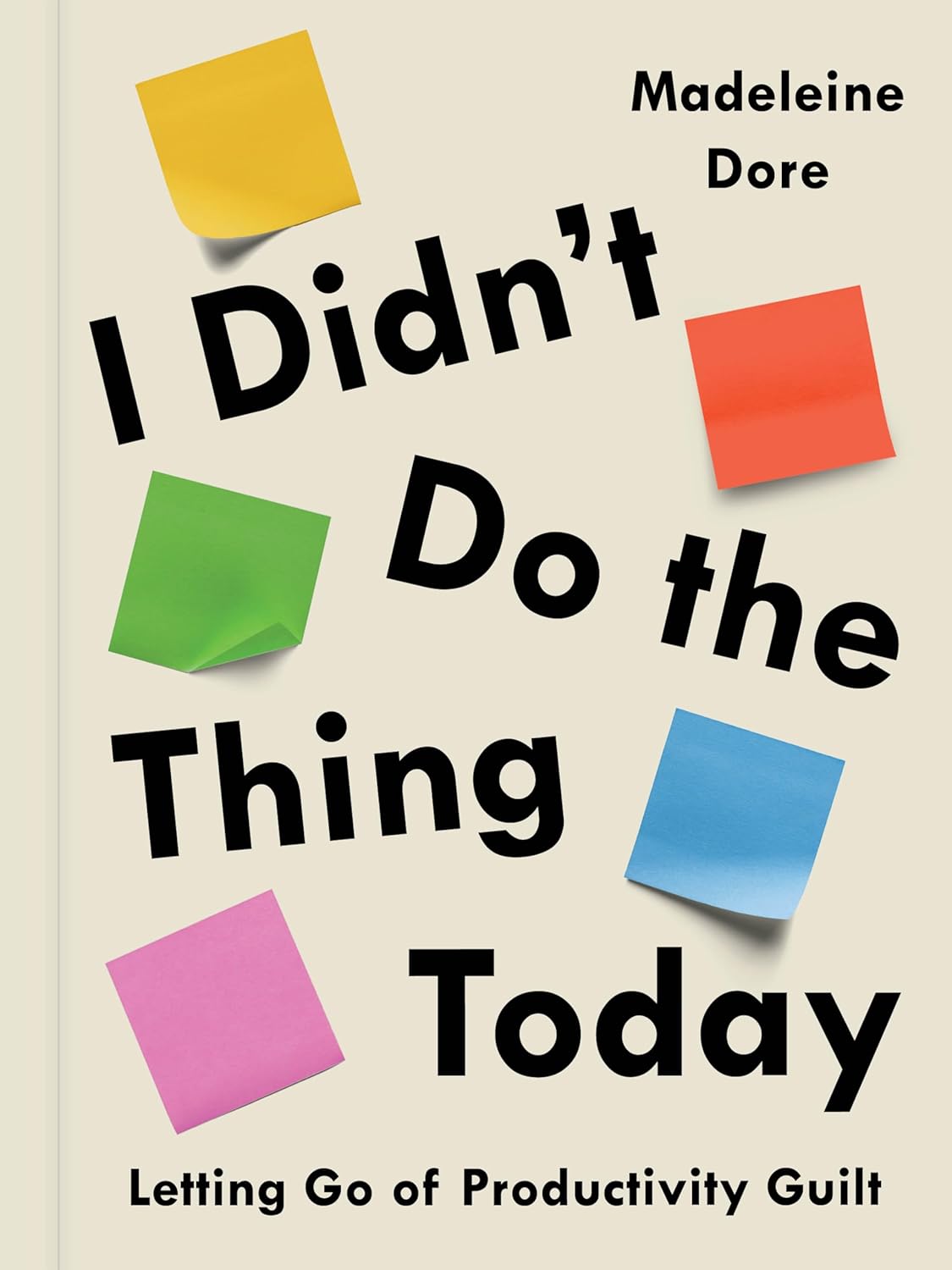
I Didn't Do The Thing Today - Madeline Dore

I Didn't Do The Thing Today - Madeline Dore

Madeline Dore

RECOMMENDED NONFICTION

Started: Nov 16, 2022

Finished: Nov 22, 2022

Review

Madeline Dore takes a hard look at the poisonous productivity culture that has permeated our lives and gives readers tools to reject it. No you don't need to find the best morning routine on YouTube, or the best task manager and system to use it.

You need to take a break, visit a friend with no aim but to visit and do nothing. The biggest predictor of resilience when life gets hard, is the friendships you have around you, not the task manager that is at inbox 0.

Purchase I Didn't Do the Thing Today on Amazon

Notes

**Purpose**
- to celebrate those days when we stumble in our "ideal" plan and yet have a great day anyway, without [[productivity]] Page 14

**Structure**
- each chapter focuses on one stumbling block to "productivity" not to denounce the struggles, but to accept them. Page 16

## Part 1 - At the Start of the Day

### 1 The Narrowing of Productivity

Society forces us to view our value in terms of how much we get done in a day, our [[productivity]]. This is why we get up earlier, or search for better routines...so that we have more value. I think what we're really searching for is belonging though, and the [[moral ecologies]] of current culture is that if you are busy, you have value.

#### Notes

- we all have to engage in a culture that measures our value by how productive we are Page 3 ^f4725d
- thus the hunt for better morning routines...we'll get more done and be more "valuable"
- we'll have better belonging in the world
- [[Cal Newport]] Page 5
- [[quiet quitting]] Page 6
- what is the problem with just doing the amount of work required?
- goes back to [[Puritan Work Ethic]] and forcing value/production as the best thing you can do in life
- taking someone else's daily routine is like trying to repeat a recipe, without the same ingredients Page 13
- you can't repeat it because you don't have the same inputs


### 2 The Expansion of Creativity

Instead of being bound by [[productivity]] in your day, let your day expand and be creative throughout everything you do. [[creativity]] is a state of being.

#### Notes

- merely being productive is to narrow a lens with which to judge a day well lived. Page 19
- [[The Art of Thought 251020210621]] Page 20
- [[creativity]] can simply be in the way we live our lives. It doesn't have to be some big art project. Page 23
- [[universal basic income|basic income]] would free more people to explore their creativity and engage in [[life design process 20070624]] to build some life they're happy to live


## Part 2 - The Stumbles in the Day

### 3 The Hopless Search for the Ideal Routine

We search for the ideal routine as if it will give our life fulfillment, but that routine can just as easily be a fragile tour that gives us no flexibility and brings guilt when we don't accomplish all of the items in the routine. A routine makes us feel like we can control the life around us.

#### Notes

- we idolize routines until they become precarious structures built atop our aspirations to be better people Page 32 ^b3781d
- maybe we should inhabit who we are and be okay with that
- and if we miss an elaborate step, we are far too hard on ourselves. Most times that schedule was never achievable in the long term anyway
- routines are not for everyone, despite how much we hold them up as the best ideal way to be. Page 44
- we reach for routine because we think it will help us control the life that happens to us. Page 46


### 4 The Worry of Wasted Time

Do we spend more time worrying about the time we wasted, than that initial time we're worrying about? Sometimes work just takes as long as it takes and we shouldn't be worrying about filling every gap with something [[productivity|productive]].

#### Notes

- [[Time Warped - Claudia Hammond]] Page 54
- instead of merely filling time, we should see if the things we do with our time bring us fulfillment. Are our actions leading to a life well lived? Page 55
- we wait for that uninterrupted large swath of time to do things, but are we just procrastinating with an ideal? Just use the time you have when you have it. Page 58
- sure you want to journal in the morning, but the afternoon with it's 20 free minutes can work too
- [[Getting Things Done 160920200653]] Page 59

> Time-management techniques might offer us a semblance of control, but they often overlook the fact that we aren't vacuums designed to suction every discretionary minute in our day; we are human beings, with varying rhythms, living in fragmented days. Page 61

- when we worry about wasting time, we are often simply comparing ourselves to how [[productivity|productive]] we think others must be. We compare our lived in day to the ideal they project. Page 61
- when society focuses on [[productivity]] it's easy to forget that time we enjoyed wasting, is not wasted. That afternoon in the park instead of working is not bad. Page 62
- [[How to Live on 24 Hours a Day 280920200533]] Page 63
- we shouldn't feel guilty when we optimize something and then use our new freedom to do nothing. We shouldn't just be filling our days with more stuff despite what the world says. Page 65

### 5 The Shifting Goalposts of Ambition

Big end goal ambition isn't bad, but it often leaves us looking to the "next" thing when we accomplish our goals. Maybe we should just look at the here and now and do the best we can in the moment.

#### Notes

- the rise of Western [[individualism]] brought with it the pursuit of personal greatness. Page 73
- [[The Principles of Psychology - William James]] Page 74
- while we're told we are what we accomplish, we are also told that we will never be enough. Page 74
- there is always something more to do and to accomplish

> We make our days busier in the hope that we will one day be recognized for our efforts, all the while leaving ourselves with less time for things we really want to do or the people we want to spend time with. Page 78

- [[hedonic adaptation]] Page 84


### 6 The Myth of Balance

Balance seems to lead you towards a "perfection" in your day. That everything should fit all the time. I truth you're more likely to wobble in seasons. Read a bunch of books, then none for a while. It's also easy to fall into the trap of judging our life against someone else's and start to view our wobble as a bad thing compared to some ideal that the other person rarely reaches.

Let your wobble be yours and let others be theres.

#### Notes

- no matter how "together" someone appears, they often feel likey they're a wreck and way out of balance. Page 90
- balance is a quest for consistency, but life is inconsistent so it's something we'll never achieve. Page 92
- then add one another dose of crazy if you have kids
- because society views [[productivity]] as the best good for you, we don't allow ourselves to sit and think and absorb things. That doesn't feel like we're doing enough. Page 96
- when we always go for activity, how do we know ourselves?
- nothing in nature blooms all year, it all shuts down for longer periods. Why should humans be on the go all the time? Page 99
- [[Better Than Before]] Page 101

### 7 The Standstill of Indecision

Indecision is easy, because it seemingly leaves all possibilities open to us, but that's not true. Some will die on the vine as we don't take their paths. We also tend to find reasons to support the good in the decisions we make and demote the good outcomes possible from the paths we didn't take.

#### Notes

- indecision leaves all possible futures open so we can feel good...without accomplishing any of them. Page 110
- it's like browsing on [[Netflix]]. You flip around for 30 minutes and never commit to watching something. Page 111
- so you never watch anything instead of just making a choice
- [[decision fatigue]] Page 115
- [[choice-supportive bias]] Page 122
- we tend to ascribe positive outcomes to a decision we made and demote any good that could have come out of a path we didn't take

### 8 The Deflation of Comparison

We compare the highlight reel of someone's life to our lived in reality and find that we come up wanting. But if we inhabited that ideal life we'd find that it's not as clean as it looks, and we probably don't like most of the trade-offs the person has made anyway. We'd make a totally different set of them.

#### Notes

- it's easy to compare a sliver of someone else's life and decide they're doing better than us. Page 125
- remember, you're comparing their highlight to your own lived life with all it's lumps not hidden behind the camera
- it's entirely possible, even likely, that if you got close to the life you idolize you'd realize that it's not a life you want. It's not compatible with what's important to you. Page 131 ^62a95b
- I think of that when I hear about crazy work hours poeple do. I don't want that. I want a life where I have time and space to do things for myself, with [[Cynthia McHale]] and with my children.
- [[keeping up with the Joneses]] or upward social comparison is the tendency to compare yourself to someone you think is "above" or ahead of you. Page 135

### 9 The Great Disappointment of Expectation

We start most days with so many things we "should" do that we are always behind. Instead, we should do less and let ourselves wander more.

I think the hard part of this is that we have to pay for things and without [[universal basic income|basic income]] we have to do what some boss somewhere tells us, which is often far more than we can really do and live a life that's not all about work. The author never gives us any path/idea how to deal with that reality, nor does she acknowledge it.

#### Notes

- how big a hurdle have you set for yourself with your task list even before you get up in the morning? Page 138
- what we "should" do simply crams more expectation between the lines of our already long todo lists. Page 138

> Perhaps what's most corrosive to our ability to feel good about the day is when we keep trying to do so much in a day that we only disappoint ourselves. Page 140
- we should be more realistic about what's possible instead of creating crazy wishlists. Page 140

- [[How to Live on 24 Hours a Day 280920200533]] Page 143
- [[Weight of Glory - C S Lewis]] Page 146
- [[How Do We Know We're Doing It Right - Pandora Sykes]] Page 149
- [[What If This Were Enough? - Heather Havrilesky]] Page 158

### 10 The Trap of Busyness

The [[capitalist]] society we live in currently traps us into [[Busyness as a Proxy for Productivity]]. We need to show that we're busy to keep our jobs so that we can pay for things, much of which we do not need. We spend so much time working we feel like we have no time for things that cost nothing, meandering walks or naps. What if we just slowed down as it's suggested in [[Readwise/Books/Rest]].

#### Notes

- we're all so "busy" but busy doing what? Is the stuff that keeps us so busy bringing any meaning to our lives? Does that time scrolling social media instead of sitting with nothing going on something that's valuable to you? Page 164
- ultimately it seems like we're talking about [[Busyness as a Proxy for Productivity]] here
- it's an interesting thing, the things that we don't have time for are the ones that cost nothing. That walk, the snuggle on the couch...when we're so busy that our time is limited we pay for easy ways to distract ourselves. Page 167 ^8900cd
- but without [[universal basic income|basic income]] we can't all just choose to work less so that we have more time and earn less. Far to many live in [[scarcity trap 180920201111]] and their time is all taken
- we don't count the work of living, taking kids to stuff doing dishes, as work so we must do *more* stuff to be productive. Page 171
- this work more often falls on [[women]] as well so the problem is bigger for them
- [[Readwise/Books/Rest]] Page 172
- [[The Weekend Effect - Katrina Onstad]] Page 175
- [[The Art of Frugal Hedonism - Annie Raser-Rowland Adam Grubb]] Page 180

### 11 The Denial of Limitation

Most of us plan so much in the day because we deny that we have any limitations on our time and energy. We create wish lists, instead of realistic lists of things we can actually accomplish in a day.

#### Notes
- we create our lists as if there is unlimited time and energy in the day. Page 185 ^e0377b
- instead we should respect the amount of stuff we can do well
- some new time management technique is often us not embracing our limitations and looking for some magic fix to get everything done. Page 185
- [[Having and Being Had - Eula Biss]] Page 187
- [[How to Live on 24 Hours a Day 280920200533]] Page 197
- [[Mindset - The New Psychology of Success 270720212101]] Page 200

### 12 The Harsh Rules of Discipline

Instead of aiming for hard discipline and just working to tighten the screws why not look at discipline like a learning experience and cultivate that discipline.

#### Notes

- Just being more disciplined Is a harsh task master we place on ourselves. Page 204
- When discipline is looked at as a skill then we are disciplined creates delight as we learn to be better at the discipline we are cultivating. Page 205
- We don't need more rules and discipline to get things done, we need to make our tasks delightful. Page 207
- [[Zeigarnik Effect]] Page 208
- [[Mihaly Csikszentmihalyi 160920200724]] 211
- [[This One Wild and Precious Life - Sarah Wilson]] Page 213
- [[Why We Write - Meredith Maran]] Page 215
- Maybe instead of going for [[Eat That Frog!]] and doing the most onerous thing first, we should start our day with delight and do the most awesome stuff. Page 219

### 12 The Push and Pull of Distraction

The devices in our pockets mimic the bottom up distractions that are instincts are honed to notice, but notifications are **not** about deadly predators. We heed these notifications, but if we fail we often chide ourselves for not keeping up. Maybe we were never meant to keep up with everything we try to fit in.\

#### Notes

- Our devices mimic the bottom up forces of our instincts and push us towards distraction. A notification is not about a deadly predator. Page 223
- [[the social dilemma 190920202145]] page 223
- [[Gravity and Grace - Simone Weil]] Page 226
- We blame ourselves for not keeping up with everything going on, but maybe we were never meant to track with thousands of people and events. Page 228
- Where you spend you attention defines who you are. Page 229
- maybe it's not about squeezing more in, but removing the distractions that break our attention and provide no value. Page 234
- so coffee with a visiting friend is good, doomscrolling bad
- attend to one thing at a time instead of flipping to make sure you stay distracted from any boredom

### 13 The Trying Pursuit of Perfection

Perfectionism is the pursuit of a shortcut to being good at something instead of realzing when we "begin" something we are a beginner and it won't be perfect. Couple this with performative social media, and we have a recipe for turning everything we do into a pursuit of perfection so no one knows we fail.

#### Notes
- how often do we want (and try to find shortcuts) to jump right past progressing (learning and getting better) to perfection and then faulting ourselves (or the world around us faulting us) when we're not perfect. Page 241
- there is an entire industry of productivity sites/videos that are showing you perfection, while never achieving it themselves
- perfectionism fools us into thinking we're striving for quality, when we're really just bullying ourselves for not being good enough. Page 241
- [[Trying Not to Try - Edward Slingerland]] Page 243
- [[Grit]], [[Angela Duckworth]] Page 245
- has our performative [[social media]] focused culture taken the fun out of any hobbies? We can't be just spending time painting, we are building a following as we show our stuff off. Page 246
- we don't start because we're not confident in our abilities, but we forget that when we "begin" we are a beginner. That confidence only comes through experience. Page 248

## Part 3 At The End of The day

### 15 The Generosity of Kindness

It doesn't cost us anything to be kind and that makes everything around us better.

#### Notes

> When we narrow our day to how productive we are, we leave little space for generosity and kindness. Page 257

- We like to think of ourselves as self made but we are made up of many contributions from all the people around us. Page 259
- self made but we are made up of many contributions from all the people around us. Page 259

### 16 The Depth of Curiosity

When we're focused on doing all the time, we leave little time to simply be curious. But that curious person who listened to us is the one we remember. Those people that follow their curiosities are ones we often idolize as artists.

#### Notes

- how often do we just run down a bunch of questions by wrote when we meet someone. We barely wait for the answer before we jump to the next question. Page 268
- our culture is so obsessed with showing you did something, showing value, that we don't bother with just being curious because we're curious. Page 273
- this can invade our conversations when we don't bother engaging with someone because we're not sure what we'll get out of it. Maybe we'll get nothing, and someone else will just be happy that they were listened to.


### 17 The Moments of Enjoyment

#### Notes

- It's easy to say that "some day" we'll do something. But we'll never have the perfect routine. There will never be a day when no friction comes up (dang kids). We are existing currently in our lives as they play out. The life you have is the life you're currently building. If you can't enjoy the moments now, then it's unlikely you'll enjoy the moments to come. Page 278
-

BLOG POSTS ABOUT THIS BOOK