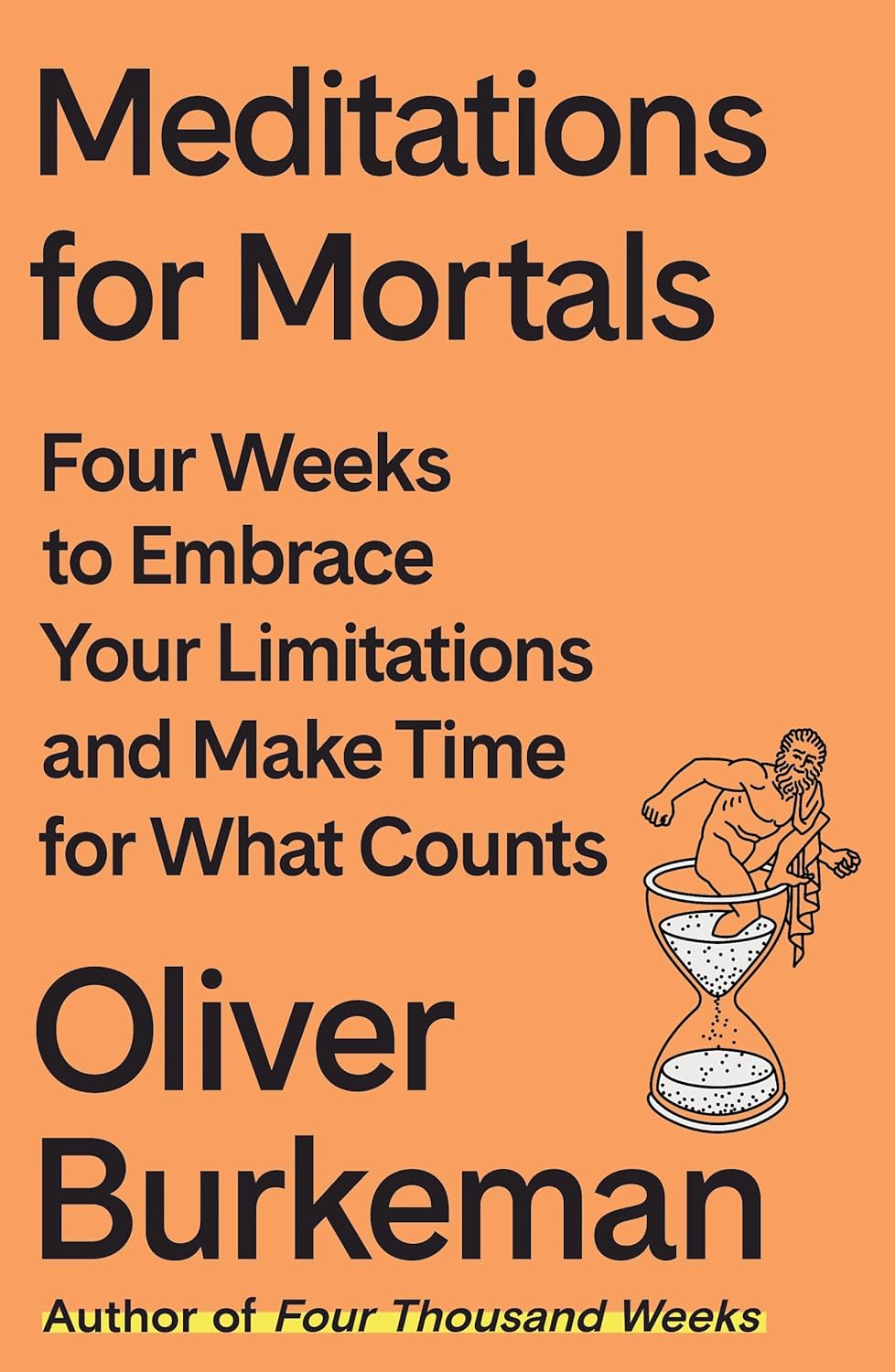
Meditations for Mortals - Oliver Burkeman

Meditations for Mortals - Oliver Burkeman

Oliver Burkeman

RECOMMENDED NONFICTION

Started: Jul 28, 2025

Finished: Aug 07, 2025

Review

This is an in progress read for book club. Scroll to the bottom to see the related posts.

Oliver Burkeman asks us to spend one day on each chapter, ideally, and evaluate how hard we are on ourselves. Instead of falling into the prouductivity porn culture surrounding us, where we rush through everything so we can get more done, he asks us to embrace our limitations and let a lot of our tasks go. We were never going to do them anyway so why are we feeling guilty about them.

We will always have lists of things to read accumulating faster than we could ever read them. There is always another chore around the house to do and another friend that feels we should visit.

Let yourself be mortal. Embrace the limitations on your time. Exist today and enjoy the life that you're living without putting of good things until some unknown time later.

Notes


> This is a book about how the world opens up once you realise you're never going to sort life out. It's about how marvellously productive you become when you give up the grim-faced quest to make yourself more and more productive, and how much easier it gets to do bold and important things once you accept that you'll never get around to more than a handful of them (and that, strictly speaking, you don't absolutely _need_ to do any of them at all). Pg XIII

- [[the efficiency trap]] Pg XVIII
- as you get faster at dealing with incoming tasks you don't have more time you get more tasks

> But this loss of aliveness also helps explain the epidemic of burnout, which isn't merely a matter of exhaustion, but of the emptiness that comes from years of pushing oneself, machine-like, to do more and more, without it ever feeling like enough. Pg XIX
- as if doing tasks can bring our lives internal value. [[productivity porn]] and [[productivity addiction]] tricks us into building the value we place on our own lives based on how much we get done

- being a limited human means the list of worthwhile things you could do will always exceed the time available. Regardless of system and discipline, you will never catch up. Pg XXI

### Week 1 - Being Finite
#### Day 1 - It's worse than you think

- the incoming supply of things to do that feel like you need to do is essentially infinite. Pg 4
- you will never finish them so don't think about even trying

- maybe you did marry the wrong person or do need a decade of therapy. It's also true that two people living together will always push each others buttons. Pg 5
- so don't think every day should be happy

- the problem isn't that you haven't found the right way to control your life. It's that you think it's possible to control it at all and waste so much time and effort trying to control anything but a microscopic portion of it. Pg 7

Once you realise that almost all of your life is beyond your control your control you're free to look at what is left and do the things that are possible and that are meaningful to you. Letting go of all the stuff you'll never get to and not beating yourself up over them is freedom.

I've said this about task managers before. It feels so good to switch because you finally so no to all that stuff you were never going to do in the first place.

#### Day 2 - Kayaks and Superyachts

- everyone looks for a new system but the answer is just do more of what you feel matters and skip the stuff that doesn't matter to you. Pg 10
- but we do still need to work so we can eat. You can't skip that
- he does acknowledge this later on but also says that you could skip work if you're willing to deal with the consequences of that skipping

- just do it without a system instead of becoming a person that gets lots of courses on how to do stuff, then does the courses without accomplishing anything of value. Well you did give value to course providers. Pg 11
- think about my two week rule for decisions. Give yourself 2 weeks to evaluate the options, then decide and forget about choosing a new software for a year
- or [this post](https://curtismchale.ca/2018/03/21/this-is-the-reason-your-personal-productivity-system-is-broken/) that talks about the problem not being your task manager, it's you

- what is one good thing you can do today that moves your ideas forward? Not the _best_ idea, down that road lies insanity as you waffle about the various merits of any task and never get anything done. Pg 12

#### Day 3 - You need only face the consequences

> At some point, as you seek to spend more existence in the ways that feel most meaningful to you, the thought will inevitably occur to you that you _can't_ make a certain choice about your time, however much you'd like to, because circumstances simply don't allow it. Pg 15
- but you can do whatever you want, you just have to face the consequences of your decision

Is there anything I'm doing simply because I don't want to face the consequences of that decision?

#### Day 4 - Against productivity debt

- you don't have to get enough done in the day to justify your existence on the planet. Pg 20 ^674579
- that's [[Puritan Work Ethic|Protestant Work Ethic]] killing you slowly

- [[Puritan Work Ethic|Protestant Work Ethic]] Pg 21, 22

- our default state is to measure our actual accomplishments against the world of possible things we could have done. Pg 24
- the list of possible things that are worthy of attention will always be bigger and continue to grow. It will always dwarf our capabilities, even if we make millions and can pay others to do parts of it, the list will grow faster than we can deal with it

#### Day 5 - Too much information

- it's a modern problem to have a stock of books to read, articles to comb through, TV shows and movies to watch, and video games to play if _only we had the time_. Pg 27

- at one point techno-optimists thought we'd get better filters to combat content overload, but it seems like [[Ai]] is contributing to the slop faster than it's producing meaningful filters. Pg 27

- all your TBR piles are like rivers. Grab some good stuff as it goes by and don't worry about what you miss. Pg 29

- it's okay to read whatever feels most fun. You don't always have to worry about maximising the personal and productive benefit of every moment so that you're always improving. Pg 30

#### Day 6 - You can't care about everything

- [[attention economy]] Pg 33

- due to all the information flowing at us we see more to care about weekly than any Saint would see in their lifetime. Pg 32, 33
- pick your battles and put all your effort into them which means you have to let some worthy causes be the problems that other people deal with. You have to let them go by unremarked

> In an age of attention scarcity, the greatest act of good citizenship may be learning to withdraw your attention from everything except the battle you've chosen to fight. [Meditations for Mortals](https://curtismchale.ca/book/meditations-for-mortals-oliver-burkeman/) Pg 36

^b3e657

This does mean you opt out of all the [[virtue signaling]] for topics online that many left leaning critiques want you to feel bad about.

#### Day 7 - Let the future be the future

- worry is over analysing all the future bridges and trying to find all possible ways to cross them. Pg 39
- let tomorrow's problems wait and deal with what's going on in front of you.

### Week 2 - Take Action
#### Day 8 - Decision hunting

- [[Time Warrior - Steve Chandler]] Pg 46
- when you look at your tasks it's either NOW or "not now" and if it's "not now" it's never

- indecision is comfortable because it postpones any sacrifices Pg 47
- if you still think about writing you don't have to do the work or skip other activities to have the time you want to write

- if you decide but take no action you haven't decided you're just fooling yourself. Pg 48

#### Day 9 - Finish Things

- completing tasks replenishes energy instead of sucking all your energy into many undone things and half finished piles. Pg 51
- leaving things unfinished means they can remain as successful as they could possibly be in your head and you never have to confront failure or your lack of skill

- not finishing means you never train yourself to do hard things you scurry off to another task or unfinished project as a way of hiding from the hard work of finishing a big project Pg 52, 53

#### Day 10 - Look for the life task

- honestly I read this twice and have no idea what the point was

#### Day 11 - Just go to the shed

- we often invest lots of energy towards avoiding hard tasks. Pg 60
- more effort than it would take to do the work in the first place
- clean the house as a way of avoiding the hard email

- [[Time Surfing - Paul Loomans]] Pg 61
- A zen monk's 7-step approach to help anyone create more time in their life
- I take exception with "creating" time because you can't do that, nor can you find it. Time passes by and you choose how you use it. What you choose reveals your priorities

#### Day 12 - Rules that serve life

- if you want to get good at something you need to do it lots. ado it more days than you skip it to get good. spg 66
- do the hard work as often as you can but don't worry about the [[Seinfield Strategy]] of never breaking the chain. Evidently that was a throwaway comment by Jerry never meant to be taken seriously

- the point isn't for your life to serve rules it's for the rules to serve your life so you get to live the type of life you want. Pg 69

#### Day 13 - Three hours

- you've only got 3-4 productive hours in the day for hard mental work. Do that and then be happy with what you got done. Do the lame stuff that doesn't take mental energy outside those focused hours. Pg 71

- [[Rest - Alex Pang]] Pg 71
- [see review](https://curtismchale.ca/book/rest-alex-pang/)

- do your best to focus for those 3-4 hours and don't stress about the interruptions or other random things in the remainder of the day. Pg 73
- getting this time with no interruptions or notifications is hard with the expectations for so many to be around at every minute
- I also think of Jeff getting a flip phone and Andrea finding it annoying that she can't text him anymore. It really means she finds it less convenient to get a second of his time, and it's not worth the extra effort on her part to do it

- [[The End of Burnout - Jonathan Malesic]] Pg 74
- traces the history and psychology of burnout while highlighting individuals resisting the current culture of working till you burnout

#### Day 14 - Develop a taste for problems

- we seem to live with the unconscious idea that at some point in life we will reach a point without problems or a list of things to do. Pg 76
- this reminds me of [[porcelain dolls]] from [[You Are Awesome - Neil Pasricha]]
- we will only get to this state of no problems when we're dead

### Week Three - Letting Go

#### Day 15 - What if this were easy?

- typical productivity advice talks about getting motivated to do things as if the meaningful work tasks are things you don't really want to do. Pg 82
- which could be true of your work and if so, does buy into how much businesses want you to work for them and generate profit

> By defining meaningful tasks as those that always require exertion, and you as the kind of person who needs pushing and prodding to do them, it turns daily life into an ongoing internal battle between the kind of person you'd like to be - energetic, productive - and the type of person you privately fear yourself to be at the core: prone to backsliding at the first opportunity. Pg 83
- we also seem to view the tasks as inherently more valuable so we lionize doing these tasks, we really don't want to do at all
- think of those articles [[The Cult of Hard Mode]]

- equating effort to value leads to the belief that whatever takes the most effort is the most valuable. Pg 84
- in truth there is some correlation between hard work that others won't do and monetary compensation
- but going to hard into the idea that hard tasks are valuable can lead us away from the things we enjoy doing because they feel too easy and fun to do. It can lead us away from good work

- [[Choosing Easy World - Julia Rogers Hamrick]] Pg 85
- Sounds like a woo-woo book on just "choosing" easy and life will bring easy to you

- what would my tasks/day/life look like if it was easy? Pg 85
- this question is a good one as you look to plan your day/life and what type of systems and processes you want
- it's also worth looking at the things you can't change easily, like getting rid of your kids. They're going to interrupt you and need you.
- but what steps can you take to make your daily experiences closer to this "easy" idea?

#### Day 16 - The reverse golden rule

- be as gracious to yourself as you are with the failings of others. Pg 88
- sometimes you have a bad day and that's okay

#### Day 17 - Don't stand in generosity's way

- don't get in the way of your naturally generous tendencies, go with them. spg 96
- so I give away my older bikes to the triathlon club or some up and coming racer

#### Day 18 - sallow other people their problems

- if you say no to something and that disappoints them, their negative emotions are their problem. Don't take on stress worrying about saying no and disappointing people. Pg 99
- like [[Boundaries - Cloud & Townsend]]

> Some tasks are legitimately time-sensitive, of course: but the unpleasant anxiety that attaches itself to tasks we've deemed 'urgent' is often a sign that someone else's priorities are in control. The sense of urgency is really the fear that someone else will get angry or anxious if you don't hurry up. Pg 100


#### Day 19 - A good time or a good story

- life and plans either go as planned and you have a good time, or they don't and you probably have a good story to tell later about what happened. Pg 104

- a relationship where you are always in control is no relationship at all. Pg 106
- more of a guard and prisoner situation

#### Day 20 - Set a quantity goal

- instead of aiming for quality and waiting for the "right" time aim for quantity. So just publish, instead of polishing. Take lots of photos and see what works. Critique your work and improve

- [[The Path of Least Resistance - Robert Fritz]] Pg 110
- the steps to creating what you truly love

#### Day 21 - What's an interruption anyway?

- are you defining everything as in interruption from what you should be doing? Pg 115
- like saying my job is in the way of reading and writing all the time. But my job has afforded me a life with time off to ride bikes and have books all around me

- it's easy to stop fertile creative wandering because it's an interruption from the time you blocked in your schedule for something else. Pg 116. 117
- [[timeblock|timeblocking]] is great, but can also feed into cultures idea that we should always be "productive" with every moment of our lives
### Week 4 - Showing Up

#### Day 22 - Stop being so kind to future you

- your life today isn't leading up to some future payoff when your "real life" starts because you're married or earn enough. Your life is now in your day to day and if you're always looking forward to the future "better" part then you're missing what's right in front of you. Pg 122
- it won't be as smooth as you expect in the future. You won't suddenly find the best productivity system that makes everything work.

> The commitment-phobe can't bear to enter time and space completely because letting himself be pinned down to one relationship or career path means renouncing the other ones. Pg 124
- this is similar to those that plan their novel but never write it because once you write it the perfection you saw in your head is met by the reality of your not as good as expected writing

#### Day 23 - How to start from sanity

- do a reset. Archive the inboxes of life and then don't let new ones build up. Either forget about the old ones or chip away at them slowly while not letting the new one build up.

#### Day 24 - Scruffy hospitality

- just invite people over in the state your house is in not the perfect version you think they expect to see, but only exists once you've spent a day cleaning with everyone. Pg 132

#### Day 25 - You can't hoard life

- you can't hoard good experiences for the future. Enjoy them for what they are and keep living your life. Pg 140
- we also shouldn't treat good things as a checklist to get through so we can move onto the next good thing. That diminishes the good thing that's happening right in front of us.
- this also means we rush through all the good stuff just so we can get more done

#### Day 26 - Inconceivable

> ...real wisdom doesn't lie in getting life figured out. It lies in grasping the sense in which you will never get it completely figured out. Pg 1144

> It's not a given, at any moment, that we'll ever be able to understand what's happening, or what a reasonable response might be. Pg 115
- and those around you also have no idea, they may look like they have it together but if you could see what's going on internally you'd realize they're winging it.

- what step can you take today despite not knowing how it all will turn out? Pg 147

#### Day 27 - C'est fait par du monde

> Once you stop struggling to get on top of everything, to stay in absolute control, or to make everything perfect, you're rewarded with time, energy and psychological freedom to accomplish the most of which anyone could be capable. Pg 149
- you step fretting about shit that doesn't matter and don't let it pile up on you


- [[Going Clear (Enhanced Edition) - Lawrence Wright]] Pg 150
- a look at [[scientology]] and [[L Ron Hubbard]]

- if [[L Ron Hubbard]] could be bold enough to come up with a whole religion involving aliens and all the other crazy stuff he invented, maybe we could write that book and be a bit bold. Pg 151, 152

#### Day 28 - What matters

- people look to productivity books for lists of what is meaningful to do. But you have to figure that out for yourself based on your life. Yes that's hard work and you may make mistakes but only you can decide what's important for your life. Pg 154

### Epilogue

- the work of embracing our limitations is more than a 4 week endeavour with prompts from a single book so don't stress, just try again to to be better at letting go. Pg 159
- some things you may never be able to change. I already have kids and won't be able to change that without just abdicating my life as dad.