Never Enough - Jennifer Breheny Wallace

Never Enough - Jennifer Breheny Wallace

Jennifer Brehney Wallace

MAYBE NONFICTION

Started: Mar 03, 2024

Finished: Mar 12, 2024

Review

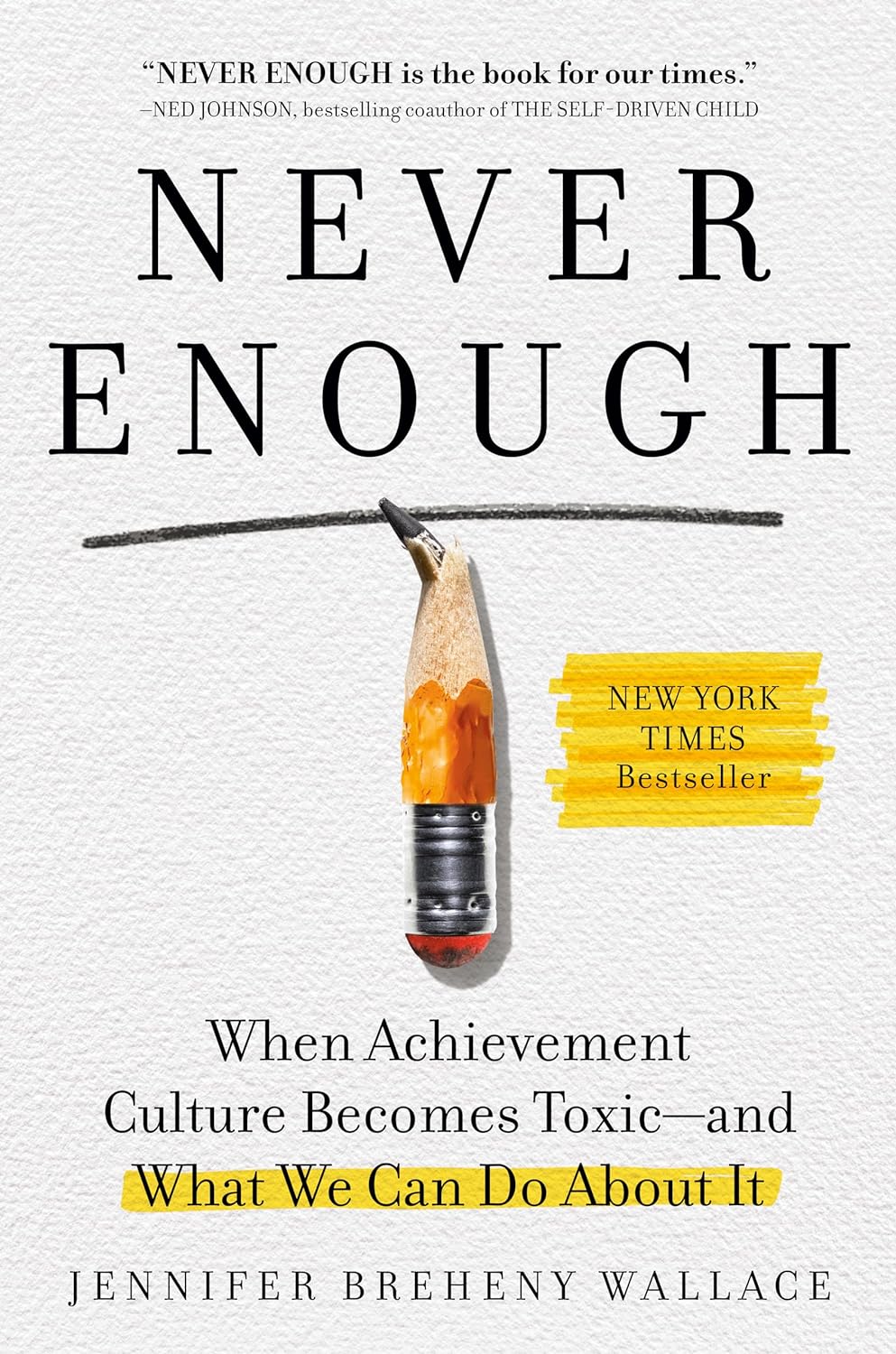
In Never Enough we take a look at how the achievement culture that is prevalent in society today is harming children as they are pushed to compete more, achieve more, all in a quest to get into the "best" education so they can be "set for life". Wallace analyses how this focus on achievement harms kids, sometimes as much as poverty can harm kids, and then finishes with what we can do about it as the adults that schedule kid's lives so full.

If there is one takeaway I'd impart to you, make sure the kids in your life know they matter to you. Give your children hugs and tell them that you value them. Give them something to do around the house so they know that the members of the house rely on them.

For those kids that are in your orbit, tell them how much you value them and be there when they have questions.

Purchase Never Enough on Amazon

Notes

- [[The Price of Privilege - Madeline Levine PhD]] Pg XV
- kids are learning that their worth is based on their performance, from [[GPA]] to how they do on the sports field they're learning that they only matter to adults if they perform well. Pg XVIII
- which is an extension of adults only mattering to society in terms of their economic contribution. You can do a bad job, but be paid well and be viewed as more valuable than an at home care worker providing dignity those that have little
- the book is aimed at parents that have the freedom to choose where they live and where their children go to school. Pg XX
- the author acknowledges that what these wealthy parents do can help widen the [[inequality]] in society as they outpace those without the options above

**Structure** Pg XX

- how did we get here and how does achievement pressure affect kids
- looks at solutions to attain an empathetic path towards raising happy healthy kids
- what can schools/communities do to help buffer against achievement culture

### 1 - Why Are Our Kids at Risk

- what puts kids at risk of [[anxiety]], [[depression]], and [[substance abuse]] is not [[wealth]] but growing up in an environment of unrelenting pressure. Pg 6
- this could be to get food because of poverty or because of the pressure to always be perfect in school, and in sports, and in how you look
- in most generations past parents watched their kids success from the sidelines. Today many parents feel the need to push their children to the front of the pack without regard to the financial cost, or the emotional cost it may have on the children. Pg 12
- [[Erik Erikson]] Pg 12
- a teen's most important task is attaining a sense of personal identity
- this process is undermined when a child feels they must be a high-performer to be loved. Teens become overly reliant on external measures of their worth instead of setting up their own measures
- [[Battle Hymn of the Tiger Mother - Amy Chua]] Pg 14
- [[At What Cost - Psy D David L Gleason]] Pg 15

### 2 - Name it to Tame It

- [[I Mammal - Loretta Graziano Breuning]] Pg 28
- we try to maintain our child's status based on the "old" wiring we have for ensuring reproductive success of our line. we don't even think about it, but the chemicals in our brain push us in the direction of achieving more status
- [[meritocracy]] Pg 29
- we're told we live in one, so children are pushed to show their merit
- [[Meritocracy is a Failure]]
- white [[middle class]] children born in 1940 had a 90% chance of out earning their parents. Pg 32
- children born in 1980 have a 50% chance
- [[millenial]]'s average the lowest earnings, and retain the least assets and have less wealth than older generations at the same age
- in societies where [[inequality]] is increasing, parents spend more time on getting their kids "ahead" to try an stop any economic slip in their child's future. Pg 37
- in countries like [[Norway]] where [[inequality]] isn't as pronounced, kids have less pressure put on them
- [[post-secondary]] education has become a positional good Pg 40, 41
- the valuing not lying so much in the type of education you got, but the fact that you have something few can afford
- see [[Sources/Books/The Case Against Education|The Case Against Education]] for more on how education after around grade 9 isn't all it's cracked up to be
- [[Playing to Win - Hilary Levey Friedman]] Pg 41

### 3 - The Power of Mattering

- there has been a 33% rise in unrealistic expectations put on students by society and well-meaning parents Pg 49
- this increasing push towards [[perfectionism]] is associated with adverse [[mental health]] outcomes
- this also pushes kids into believing that they aren't valued, unless they are performing to the level adults are told they should be performing to
- [[Family Matters - Gregory C Elliott]] Pg 53
- [[conditional regard]]
- Pg 60
- mattering to a child means greeting them like a puppy at least once a day. Pg 70
- greeting them with unabashed joy that you get to interact with them, including with some type of physical interaction and playing with them
- being physically affectionate with your kids is strongly associated with their well being

### 4 - You First - Your Child's Mattering Rests on your Own

- working mothers often spend more time taking care of children now than stay-at-home mothers did in the 1970s. Pg 84
- time fathers spend on child care has almost tripled from the 1970's Pg 85
- which often still puts them behind women
- while parenting inputs have increased the networks that were once relied on for support, family/extended family/committed neighbours, have shrunk Pg 86
- this would go with [[Research Dashboards/community|community]]
- [[All Joy and No Fun - Jennifer Senior]] Pg 87
- mothers who choose to stay at home, and parents that don't have any hobbies outside of "home" life are particularly vulnerable to [[mental health]] issues while parenting
- [[self care]] isn't that bubble bath, or the next [[meditation]] app that some company wants you to use, it's about having meaningful [[relationships]] that allow you to feel deeply loved and cared for. Pg 98
- as in this is what parents need, specifically if the primary caregiver is [[Tags/resilience|resilience]] then their kids are more likely to show resilience
- [[The Childhood Roots of Adult Happiness - Edward M Hallowell MD]] Pg 103

### 5 - Taking the Kettle off the Heat - Confronting Grind Culture

- [[hustle culture]] the chapter is about this starting Pg 109
- when many parents say they just want their kids to be happy what they mean is they want their kids to be living the same type of life with similar high-paying careers that they currently have. Pg 112
- they don't want their kid to be happy living with little but enjoying life doing art
- [[growth mindset]] Pg 118
- can be bad if it pushes [[perfectionism]] tendencies, especially in kids as they never stop and stress about being perfect
- [[The High Price of Materialism - Tim Kasser]] Pg 121
- when we chase [[materialism]] we typically do so at the expense of our basic needs to feel [[autonomy]], competent and connected to those around us
- so we just work to earn money and let go of the rest of life
- the more parents model that having material possessions, earning lots of money, and going to big important schools to get big important degrees, the more likely it is that their kids will do the same. Pg 124
- and stress over all the work that it takes to get these things
- [[The Inequality Machine - Paul Tough]] Pg 126
- but the expensive schools that only let in the best graduate more, because these people are more likely to be wealthy so this basis of ranking schools (which is factored into school rankings) is more a test of wealth than saying anything about the quality of the education
- [[Take Pride - Jessica L Tracy]] Pg 134
- what do your kids take pride in, as in things that make them feel authentically good about who they are as a person and what they can do
- their "best" is achieved when they have this type of pride in their work
- we should also remember that we need to cultivate activities where they feel this pride
- [[Outliers - Story of Success - Malcolm Gladwell]] Pg 135
- everyone focuses on 10,000 hours put in by people, but those same musicians that practiced so much also rested more than their peers

### 6 - Envy - Coping with Hyper Competition

- [[Race at the Top - Natasha Warikoo]] Pg 143
- kids are already winning a medal when they go to a high achieving school, but they easily fall into [[comparison trap]] against all the other high achievers and thus feel less competent than they really are
- when you feel the constant drive to succeed, you don't let yourself have downtime. Pg 144
- I've felt this when I try to sit down in the backyard and do nothing. I almost always feel like I should be reading non-fiction, or doing something instead of napping in the hammock or simply looking at the sky
- when you always view yourself in competition with the peers in school, its' hard to make friends because it's you against them and cooperation isn't so much a thing. Pg 146
- the more competitive students are the more likely they are to experience [[Scarcity 180920201044]] as they figure their position is always in jeopardy. Pg 164
- plus envy if someone else does well and jealousy because they may be taking your spot
- [[The Infinite Game - Simon Sinek]] Pg 169
- sinek talks about the "worthy rival". Someone who is a bit better than you at some things and inspires you to do better yourself

### 7 - Greater Expectations - Adding Value to the World Protects Them

- when we tell kids to focus on being exceptional all the time we are teaching them to be very [[selfishness]] and self centered. Pg 179
- how can we get them to be involved in their community so that they are valuable contributing members with a greater connection to the community?
- if you're worried about your own economic future then you have less mental bandwidth to have any [[empathy]] for others Pg 179
- [[scarcity trap 180920201111]]
- [[scarcity captures the mind 180920201045]]
- this is one thing I think contributes to the popular support for political candidates that want to remove rights from minority communities. People feel economic scarcity so their view of who matters is narrow
- this would go with [[Broaden-and-Build Theory of Positive Emotions]] talked about in [[Feel-Good Productivity - Ali Abdaal]]
- having regular [[chores]] lets kids feel like they matter to the family, like we need them and depend on them doing some of the work to keep the family going. Pg 186
- success metrics for kids often crowd out chores in favour of that extra activity for their application to some school
- [[The Path to Purpose]] Pg 199

### 8 - The Ripple Effect

- kids that feel they matter to their families have an easier time expressing how others mattered to them. Pg 212
- [[The Council of Dads - Bruce Feiler]] Pg 213
- kids with a wider network of adults they trust are less likely to exhibit risky behaviour because they don't want to disappoint the people that care about them. Pg 214
- [[Research Dashboards/community|community]]
- her citation is the National Longitudinal Study of Adolescents to Adult Health https://addhealth.cpc.unc.edu
- [[happiness]] and [[well-being]] are by products of knowing that we [[matter]] to others and bring them value Pg 226

BLOG POSTS ABOUT THIS BOOK

March 2024 Reading

Apr 23, 2024