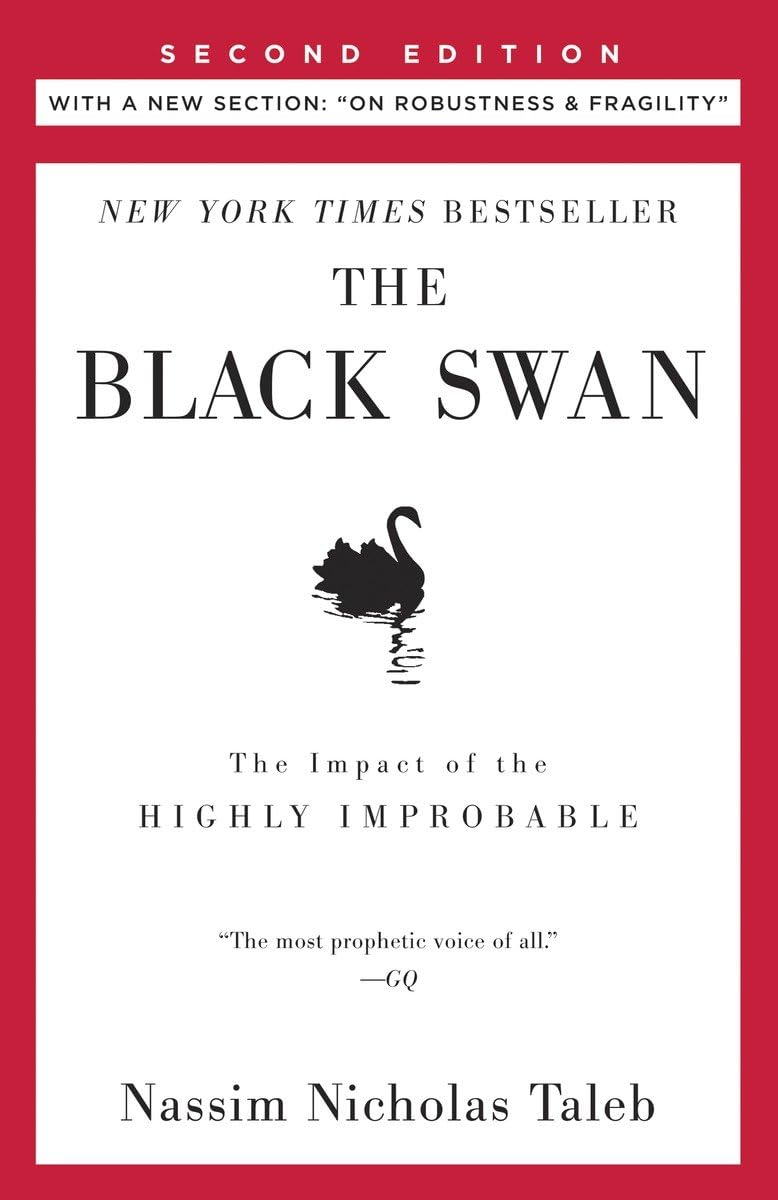
The Black Swan - Nassim Nicholas Taleb

The Black Swan - Nassim Nicholas Taleb

Nassim Nicholas Taleb

NOT RECOMMENDED NONFICTION

Started: Jan 18, 2025

Finished: Jan 29, 2025

Review

This is supposed to be some all fired amazing book about randomness. The title is derived from the idea that Europeans thought all swans were black until they visited Australia and suddenly found a black swan. They had no way of knowing that what they thought was true was untrue until confronted by the evidence.

Taleb tries to weave together how important randomness is and how bad we are at accounting for it in the future, while deluding ourselves in hindsight that we knew all along this random event would happen. He pulls 9/11 out as an example, which we “clearly” see in hindsight from intelligence reports was a possibility, but had no real way of knowing would happen as we looked forward into a world where we confidently asserted that we understood how it functioned.

Now for my confession, I couldn’t finish the book. I started skimming around 20% through and then skipped ahead from around 30% to 50% to his third section because I wondered if he’d finally do something to draw the book together. After that I tried a few more sections but continued to find the writing overly heavy and full of self-aggrandizing stories of his amazing life and the amazing people he knows while he threw barbs at those he seems to feel are beneath him. His mocking comments about the “new rich” at the Sydney Opera House is what finally got me to realize how Taleb’s view of himself is so elevated while others that don’t “get it” as he does are clearly inferior.

I’m glad I borrowed this book from the library because I don’t have to worry about money I wasted on an author with such an inflated opinion of himself that he must make up his own terms for widely accepted things like confirmation bias.

I don’t recommend this book, but would recommend Thinking in Systems as a book that covers many similar ideas without being written by someone wanting to show how smart they are with overfly flowery words and dumb stories.

Notes

- If you want to get an idea of a friend’s temperament, ethics, and personal elegance, you need to look at him under the tests of severe circumstances, not under the regular rosy glow of daily life.
- We like stories, we like to summarize, and we like to simplify, i.e., to reduce the dimension of matters. The first of the problems of human nature that we examine in this section, the one just illustrated above, is what I call the narrative fallacy
- Note: But most things involve large portions of it depends.
- People in the classroom, not having faced many true situations of decision making under uncertainty, do not realize what is important and what is not—even those who are scholars of uncertainty (or particularly those who are scholars of uncertainty
- Note: You have to live life to understand what matters.
- I also make the bolder (and more annoying) claim that in spite of our progress and the growth in knowledge, or perhaps because of such progress and growth, the future will be increasingly less predictable, while both human nature and social “science” seem to conspire to hide the idea from us.
- Note: Purpose 2
So called Black Swan events will become more common.
- Read books are far less valuable than unread ones. The library should contain as much of what you do not know as your financial means, mortgage rates, and the currently tight real-estate market allow you to put there
- Indeed, the more you know, the larger the rows of unread books. Let us call this collection of unread books an antilibrary
- Note: Becausr you know all the areas your knowledge doesnt reach
- We tend to treat our knowledge as personal property to be protected and defended. It is an ornament that allows us to rise in the pecking order. So this tendency to offend Eco’s library sensibility by focusing on the known is a human bias that extends to our mental operations.
- Note: We use our library to impress others with our knowledge.
- Let us call an antischolar—someone who focuses on the unread books, and makes an attempt not to treat his knowledge as a treasure, or even a possession, or even a self-esteem enhancement device—a skeptical empiricist
- It is one thing to be cosmetically defiant of authority by wearing unconventional clothes—what social scientists and economists call “cheap signaling”—and another to prove willingness to translate belief into action.
- Note: So much of teenage years are this cosmetic signalling. In fact much of the world is thi. How do i do more than cosmetic signaling?
- triplet of opacity. They are:
the illusion of understanding, or how everyone thinks he knows what is going on in a world that is more complicated (or random) than they realize;
the retrospective distortion, or how we can assess matters only after the fact, as if they were in a rearview mirror (history seems clearer and more organized in history books than in empirical reality); and
the overvaluation of factual information and the handicap of authoritative and learned people, particularly when they create categories—when they “Platonify.
- Note: B: matches with systems theory saying you can only affect the future with your actions.
- These events were unexplainable, but intelligent people thought they were capable of providing convincing explanations for them—after the fact. Furthermore, the more intelligent the person, the better sounding the explanation. What’s more worrisome is that all these beliefs and accounts appeared to be logically coherent and devoid of inconsistencies
- Note: Is this the expertise trap from Death of Expertise
- Consider the nature of information: of the millions, maybe even trillions, of small facts that prevail before an event occurs, only a few will turn out to be relevant later to your understanding of what happened. Because your memory is limited and filtered, you will be inclined to remember those data that subsequently match the facts,
- Note: You remember your confirmation bias.
- William Shirer’s Berlin Diary: The Journal of a Foreign Correspondent, 1934–1941.
- Note: ;book
- Some comments here and there were quite illuminating, particularly those concerning the French belief that Hitler was a transitory phenomenon, which explained their lack of preparation and subsequent rapid capitulation. At no time was the extent of the ultimate devastation deemed possible
- Note: Has Trump caught many left leaning people in a similar trap. Thinking there was no way je could be elected due to his criminal past amd other heinous acts so not enoigh was done to combat him.
- I noticed that very intelligent and informed persons were at no advantage over cabdrivers in their predictions, but there was a crucial difference. Cabdrivers did not believe that they understood as much as learned people—really, they were not the experts and they knew it. Nobody knew anything, but elite thinkers thought that they knew more than the rest because they were elite thinkers, and if you’re a member of the elite, you automatically know more than the nonelite.
- Note: Hence comments by experts on fields outside of their expertise.
- Categorizing always produces reduction in true complexity
- Note: Because you're on the Right po.itically doent mean you beleive all te points on tje Right.
- So I stayed in the quant and trading businesses (I’m still there), but organized myself to do minimal but intense (and entertaining) work, focus only on the most technical aspects, never attend business “meetings,” avoid the company of “achievers” and people in suits who don’t read books, and take a sabbatical year for every three on average to fill up gaps in my scientific and philosophical culture. To slowly distill my single idea, I wanted to become a flâneur, a professional meditator, sit in cafés, lounge, unglued to desks and organization structures, sleep as long as I needed, read voraciously, and not owe any explanation to anybody. I wanted to be left alone in order to build, small steps at a time, an entire system of thought based on my Black Swan idea.
- Note: Outside of tje trading floor this sounds wonderul. How much $ do I need to get here?
- Yevgenia Nikolayevna Krasnova
- Note: ;author i should look up
- If you are an idea person, you do not have to work hard, only think intensely. You do the same work whether you produce a hundred units or a thousand
- Note: We need far fewer idea people than people who work jard hoirly. This seems like a hole in hustle culture.
- So the distinction between writer and baker, speculator and doctor, fraudster and prostitute, is a helpful way to look at the world of activities. It separates those professions in which one can add zeroes of income with no greater labor from those in which one needs to add labor and time (both of which are in limited supply)—in other words, those subjected to gravity.
- A scalable profession is good only if you are successful; they are more competitive, produce monstrous inequalities, and are far more random, with huge disparities between efforts and rewards—a few can take a large share of the pie, leaving others out entirely at no fault of their own
- In the days of bards and troubadours, everyone had an audience. A storyteller, like a baker or a coppersmith, had a market, and the assurance that none from far away could dislodge him from his territory. Today, a few take almost everything; the rest, next to nothing.
- Note: Because the bard could only travel so far daily ad was a novelty. Now recordings go everywhere.
- Something has worked in the past, until—well, it unexpectedly no longer does, and what we have learned from the past turns out to be at best irrelevant or false, at worst viciously misleading
- Note: Is it possible to anticipate that change in how things work or at least be flexible enough to change quickly.
- The Federal Reserve bank protected them at our expense: when “conservative” bankers make profits, they get the benefits; when they are hurt, we pay the costs.
- Note: Private profits socialized losses.
- Huet, who lived into his nineties, had a servant follow him with a book to read aloud to him during meals and breaks and thus avoid lost time. He was deemed the most read person in his day
- Note: Should make the kids do this.
- Many people confuse the statement “almost all terrorists are Moslems” with “almost all Moslems are terrorists.” Assume that the first statement is true, that 99 percent of terrorists are Moslems. This would mean that only about .001 percent of Moslems are terrorists, since there are more than one billion Moslems and only, say, ten thousand terrorists, one in a hundred thousand. So the logical mistake makes you (unconsciously) overestimate the odds of a randomly drawn individual Moslem person (between the age of, say, fifteen and fifty) being a terrorist by close to fifty thousand times!
- Note: This type of failed assumption harms many in many different communities.
- By a mental mechanism I call naïve empiricism, we have a natural tendency to look for instances that confirm our story and our vision of the world—these instances are always easy to find
- Note: Which everyone else calls confirmation bias.

- Hence the same condition that makes us simplify pushes us to think that the world is less random than it actually is.
- Note: because we summarize
- Empirically, sex, social class, and profession seem to be better predictors of someone’s behavior than nationality
- Note: So Canadians arent nicer. maybe more of us are at the sweet spot economically that we have more empathy without the pride of wealth?
- The answer is that there are two varieties of rare events: a) the narrated Black Swans, those that are present in the current discourse and that you are likely to hear about on television, and b) those nobody talks about, since they escape models—those that you would feel ashamed discussing in public because they do not seem plausible
- Note: We talk about the possibleblack swans but have no way to talk about things we cant think of.
- After a Black Swan, such as September 11, 2001, people expect it to recur when in fact the odds of that happening have arguably been lowered
- You play tennis every day with no improvement, then suddenly you start beating the pro
- Note: Eden competes in nonlinear stuff. She trains for a long time with small improvement. The trick is not to give up before the flash of big gain.
## New highlights added January 29, 2025 at 2:32 PM
- Silent evidence
- Note: He is talking about sirvivorship bias and only taking te evidence of survivors.
- This bias has been rediscovered here and there throughout the past century across disciplines, often to be rapidly forgotten (like Cicero’s insight). As drowned worshippers do not write histories of their experiences (it is better to be alive for that), so it is with the losers in history, whether people or ideas
- Note: See survivorship bias.
- A successful person will try to convince you that his achievements could not possibly be accidental, just as a gambler who wins at roulette seven times in a row will explain to you that the odds against such a streak are one in several million, so you either have to believe some transcendental intervention is in play or accept his skills and insight in picking the winning numbers.
- Note: Just luck and survivor bias
- One evening I found myself at a cocktail party in Munich at the apartment of a former art historian who had more art books in its library than I thought existed. I stood drinking excellent Riesling in the spontaneously formed English-speaking corner of the apartment, in the hope of getting to a state where I would be able to start speaking my brand of fake German
- Note: So many repeated personal stories that seem to be imcluded to show off how fancy the author is.

#### Chapter Ten
THE SCANDAL OF PREDICTION

- More than a decade before Rosen, the sociologist of science Robert K. Merton presented his idea of the Matthew effect, by which people take from the poor to give to the rich.* He looked at the performance of scientists and showed how an initial advantage follows someone through life. Consider the following process
- Note: Thinking in Systems talked about this as well with winners compounding their advantage till they take it all.

BLOG POSTS ABOUT THIS BOOK