The Color of Law - Richard Rothstein

The Color of Law - Richard Rothstein

Richard Rothstein

RECOMMENDED NONFICTION

Started: Aug 02, 2021

Finished: Aug 12, 2021

Review

The Color of Law looks at how redlining affected the wealth of Black Americans after Word War 2. From not letting Black Vetrans get the financing that all Vetrans were supposed to be eligible for, to breaking up Black neighbourhoods for "public projects" this is a sobering look at how white people stole wealth from generations of Black Americans.
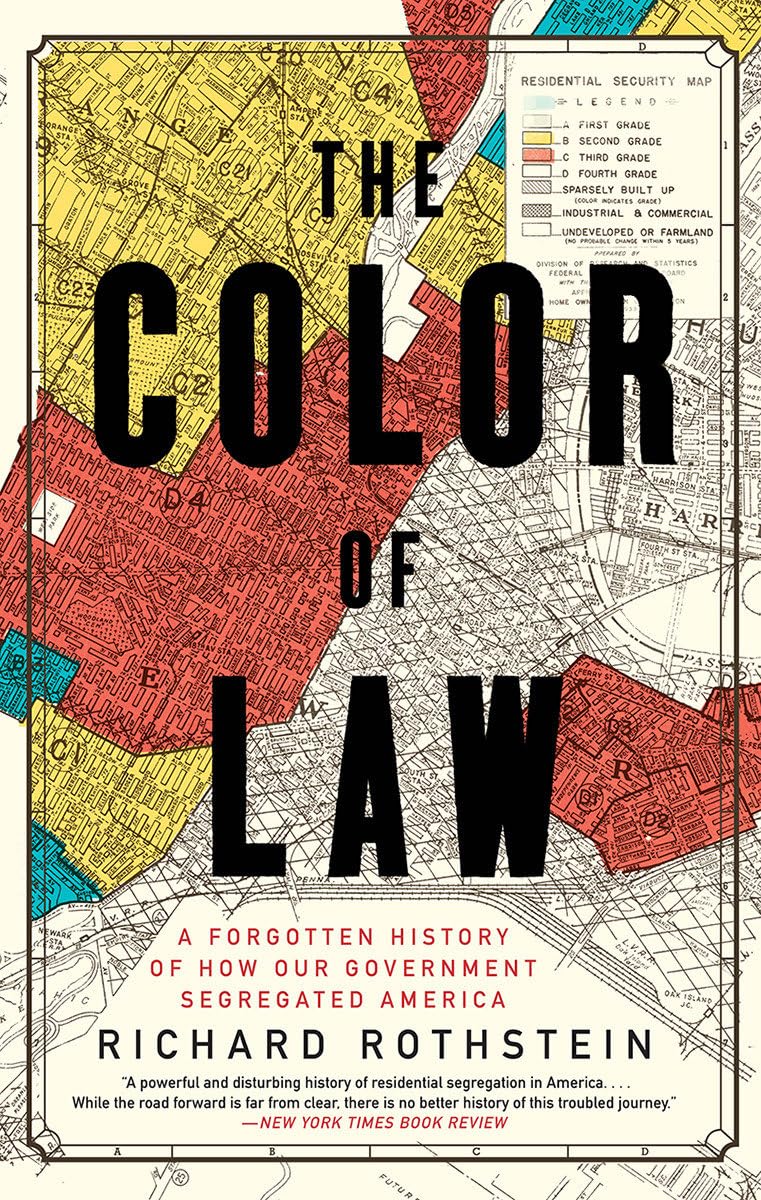
Purchase The Color of Law on Amazon

Notes

- [[Tags/white flight]] VIII
- [[redlining]] VIII
- many African American [[Tags/WWII]] veterans did not apply for the government guaranteed mortgages because they knew that the Veteran’s Administration would deny them based on their skin colour XI
- this meant less [[inherited wealth]] for their children, which white descendants didn’t suffer from
- the purpose of the book is to show that the [[de jure]] segregation found in neighbourhoods and schools is a result of racially explicit government policies XIV
- this is in contradiction to the court rulings
- so to show that even though you weren’t allowed to discriminate, it happened and thus resulted in school segregation. Yes a neighbourhood had more white citizens, but that is due to the redlining and other tactics used to keep [[BIPOC]] out of neighbourhoods
- the goal is **not** to show white people as the evil actors and black people as victims XV
- it’s to provide American’s with a history of what they’ve done and what they can do in the future regardless of colour

> We have created a caste system in this country, with African Americans kept exploited and geographically separate by racially explicit government policies. Although most of these policies are now off the books, they have never been remedied and their effects endure. XVII

### 1 If Sanfrancisco, then Everywhere?

- with the more inclusive and liberal bent of [[San Francisco]] it’s useful to look at it because if segregation happened here, then it’s a strong case that it happened everywhere. Page 3
- while black workers in the yards of Richmond for [[Tags/WWII]] were paid enough to afford and, but the [[US Federal Government]] wouldn’t insure loans to black people so they couldn’t build houses with the normal construction methods of the times. Page 7
- they ended up with makeshift homes, like I saw in Mexico
- ![[blockbusting]] Page 12

### 2 Public Housing, Black Ghettos

- the origin of [[public housing]] was not to provide homes to people that couldn’t afford it. It was designed to provide homes to those that couldn’t find them because there was lack of supply. People would still pay full rent and for all the amenities that were included in the public housing. Page 18
- even in previously integrated neighbourhoods, planners would designate an area white/black only and then use the public housing to make that come true. Because it was designated for white/black only, only those that the public housing was zoned for were allowed to move in. The government manufactured [[segregation]]. Page 21
- in many cases, they’d even evict black residents then demolish their housing for public housing which was designated white only. Black residents would be forced to move into already over-populated black areas and have lost their housing equity and [[generational wealth]] Page 22
- it was also more likely that white developments would include community centers, parks, playgrounds, and plentiful green space. These amenities were rarely afforded in black developments
- quite the history of demolishing black neighbourhoods, or integrated housing and then building nicer units but restricting them to whites only. Page 26
- [[yellow peril]] Page 28
- in this case it was moving [[Japanese]] origin families out of their houses into internment camps during [[Tags/WWII]] because of fear they’d be sabateurs
- when the Chicago Housing Authority was told by courts they could not deny [[public housing]] in predominantly white neighbourhoods, they just stopped building any housing projects so they could keep segregation going. This seems to be around 1971. Page 3535
-

### 3 Racial Zoning

- [[Reconstruction]] Page 39
- [[Jim Crow]] Page 40
- [[Red Shirts]] Page 40
- [[interracial marriage]] PAge 47
- for jurisdictions that did abide by the law that said you couldn’t stop black people from living near white people, they just started zoning in such a way that would exclude any housing a black person could afford at the time. The [[Tags/wages]] disparity was due to the racist job market at the time. Page 48
- this is zoning for [[single family dwellings ]] continues to this day and as discussed in [[Strong Towns - A Bottom-Up Revolution to Rebuild American Prosperity - Charles Marohn]] creates a monoculture that is not resistant to changes in the market or times
- cities would zone for industrial uses near black neighbourhoods but not near white neighbourhoods that were designated for [[single family dwellings]] Page 50
- this is a self-fulfilling prophecy where black land values are lower because you put all the least desirable stuff near them. Then you say that black people are the cause of low land values while [[generational wealth]] has been stolen from them
- studies done around 1983 by [[Greenpeace]] concluded that race was such a strong predictor of where hazardous waste facilities would be that there was only a 1 in 10,000 chance that this would happen randomly. Page 55
- so evidence of racially motivated zoning rules
- these racially motivated zoning laws also contributed to the perception that black neighbourhoods were bad. If you put all the bad stuff in a neighbourhood, of course it looks terrible

### 4 Own Your Own Home

- due to fear from the [[Russian Revolution of 1917]] that communism would spread the [[US Federal Government]] adopted a policy that wanted to put people in homes feeling that this would have them invested in [[capitalist|capitalism]] Page 60
- and this idea of the [[American Dream]] persists today over 100 years later the fear of [[communism]] haunts public policy
- in 1933 [[home ownership]] remained prohibitively expensive for [[working class]] and [[middle class]] families. Bank mortgage required 50% down and repayment in 5- 7 years. That was out of reach financially for most. Page 63
- as real estate agents were hired to assess risk for mortgages they would assess high risk to any neighbourhoods where black people lived which made it hard to get a mortgage and thus would assist in that neighbourhood becoming run down. This process was called [[redlining]] because high risk areas were red on the maps. Page 64
- in essence the [[US Federal Housing Administration]] insured mortgages after [[Tags/WWII]] based on the commitment that [[racial integration]] would not happen because houses wouldn’t be sold to black people, and black people didn’t live too close so [[racial integration]] was unlikely to happen in the future. Page 71
- yes, black people living too near a development meant you couldn’t get mortgage insurance because it might become [[racial integration]] at some point
- in some cases builders got rejected, but then built a 6 foot tall concrete wall to segregate from a black neighbourhood. The [[US Federal Housing Administration]] then approved the development. You can’t conclude anything but racially motivated [[segregation]] from that turn of events. PAge 74

### 5 Private Agreements, Government Enforcement

- housing developments would create [[restrictive covenants]] that were not law but contracts between home owners. Often a clause would be that they would only sell to people of the Caucasian Race. Page 80
- in 1948 the [[US Supreme Court]] ruled that state courts could not enforce [[restrictive covenants]] which meant that they mostly could not be enforced via the legal system. Page 81
- the [[US Federal Housing Administration]] continued to dance around the [[US Supreme Court]] rulings that didn’t allow denying insurance based on racial grounds by encouraging [[restrictive covenants]] of various forms that didn’t quite say no black people, but were clearly intended to bring that same effect. Page 88
- like a covenant that a board of people in the neighbourhood had to approve your sale and the explicit statement that individual discrimination was up to individuals and not a matter courts would settle
- in fact it took until 1962 when [[President John F. Kennedy]] issued an executive order to state that federal funds could not be used to support racial discrimination for the [[US Federal Housing Administration]] to finally put a stop to these types of practices. That’s from 1948 when the [[US Supreme Court]] made the ruling to 1962 where people tried to hide the racism in the housing market and years of lost [[generational wealth]] Page 88

### 6 [[Tags/white flight]]

- contrary to the assertion that black families moving into a neighbourhood would depress housing prices, the [[US Federal Housing Administration]] studies found that because black people would pay more for a house (because they had no choice) than a white person would that housing prices and home value increased when black families moved into a neighbourhood. Page 94
- this was in 1942, and yet they still took 20 years to be forced to stop the racial stand on black families moving into areas
- [[blockbusting]] tactics of real estate agents did depress housing values as they encouraged [[Tags/white flight]] by paying black people to be in a neighbourhood and then drumming up the fear of white residents to purchase their house at a discount. Then they’d sell it to black people at an inflated price. Page 95
- white people lost value and black people were charged extra for that privilege
- black people would be forced into contract sales. Basically if you rented the house for enough years you would own it. The prices were higher than what a white person would pay and if you were late once you lost the house right away. This way real estate agents who owned the contracts could sell the house many times. Page 98

### 7 IRS Support and Compliant Regulators

- the [[IRS]] was not supposed to grant tax exempt status to churches, neighbourhood boards that promoted segregation, but they did anyway. Page 102
- churches would preach about the terrible [[sexual black male]] who would jeopardize the virginity of any white girl near. Page 105
- this is similar to [[Boys & Sex]] where there is the barely unrestrained black man
- data on the [[Tags/subprime mortgage crisis]] shows that the lending of these mortgages were targeted towards African American homes with lower income African American’s twice as likely to have a subprime loan than comparable White Americans. Page 110

### 8 Local Tactics

- only as a result of a [[Quaker]] connection was the [[American Friends Service Committee]] able to get a loan financed to build [[desegregated]] housing. A vice-president of Metropolitan Life Insurance Company was a Quaker and the local group in California was able to get him to issue the loan due to the Quaker belief in desegregation. Page 117
- Then when the local boards found out it was going to be sold as a [[desegregated]] they reasoned the land to be industrial only. When the builder found other plots of land they were informed that the approvals would never be granted. They gave up after 4 tries were turned down in these manners.
- The Ford union was presented with an offer for segregated housing, because the next builder thought there was no other option. The predominately white union still decided that they would only support builders that served all their members and had [[desegregated]] housing. Page 118
- Good on the union
- further when another local builder started influencing city councils to charge more for the [[desegregated]] development hook up charges and approvals the Union staged a boycott of their homes and had it's members invade open houses to disrupt the buyers that were there. This left finished homes unsold and eventually the builder sold out their development tiring of the fight. Page 120
- highway construction was used as an end-run around the legal prohibitions from forcing [[segregation]] in neighbourhoods. They'd simply plan the highway to go through black neighbourhoods and move them all out while providing no option for housing to replace that which they stole. Page 128
- local [[school board]] would designate schools for black students and then put them where they wanted black people to live, near dumps and far away from white people. They would provide no bussing for black students. This served to force the moving of black families that wanted to education their children. Page 132 - 134
- they did the same to white students. Setup schools for white people where they wanted white people to live
- this also served to [[segregation]] previously [[desegregated]] areas by pulling the community apart across racial lines

### 9 State Sanctioned Violence

- this is the police not stepping in when white mobs decided to harass black families that moved into neighbourhoods. Page 140
- Of course they cited "manpower" issues, but the truth is they didn't care or want to deal with white people.
- many times because of the higher cost of housing, and higher interest rates, that were available to black families they were actually better off financially than much of the existing residents of the neighbourhood they were moving in to. This shows the lie in the worry that a neighbourhood would deteriorate when a black family moved in. Page 143
- with the [[US Federal Government]] spending effort to invade [[Tags/terrorism]] groups, it is all but complicit in race violence where it spent no effort in finding bombers and violent mob organizers who focused their violence against black families. Page 148

### 10 Suppressed Incomes

- it’s very rare for a persons income strata to be different than their parents. Page 153
- [[minimum wage]] protections in 1930 and now often exclude jobs that black people participate in heavily. Like domestic work or agricultural work. Page 155, 156
- there were many policies that only allowed the least skilled lowest paying jobs for African Americans and then they would often be paid less that white workers. Page 159
- This is one more way African American wages were depressed and thus we have theft of [[generational wealth]]
- city [[property tax]] assessors would over value black houses and this they were charged more. Then undervalue white houses. This left black families with less money than white families. Page 170
- because of [[segregation]] in neighborhoods there was less housing available to African Americans and thus they paid far more for less space that a white renter or purchaser would get. Page 173

### 11 Looking Forward and Looking Back

- because of all the factors discussed so far white houses gained more wealth than black neighborhoods thus making the wealth gap and segregation fairly permanent. Page 182
- kids who are exposed to neighborhood [[poverty]] are less likely to have role models that have been educationally or occupationally successful. Page 187
- there are fewer bookstores and libraries available
- School performance is comprised due to exposure to violence
- Fresh food and medical care is more expensive or scarce
- ### 12 Considering Fixes

- greater political unrest and [[polarized|polarization]] is in part a result of the lack of mingling with people that are different than we are. [[segregation]] increases this phenomenon. Page 195
- Experiments show that when we are in homogeneous groups we are less likely to challenge our beliefs and just go along with the flow instead of thinking for ourselves. Page 196
- I feel like this lines up with the creativity of teams as disucssed in [[Range]] and [[Late Bloomers - Rich Karlgaard]]
- the most popular US history text books praise the efforts undertaken to support low income workers and those returning from [[Tags/WWII]] without mentioning how they excluded African American's from this same benefit thus setting them up for lost [[generational wealth]] which we still see the ramifications of today. Page 200
- the author calls for a ban on zoning laws that prohibit multi-family dwellings in suburban areas. Page 204
- This lines up with [[Tags/Strong Towns]] thoughts on the subject of building cash positive cities
- Taking it a step further they suggest that we zone to ensure that there is a mix of incomes in suburbs and that we help lower income people get into suburbs in the multi-unit dwellings that would be zoned for. Page 206
- While the US doesn't limit tax grants for property owners based on the budget allotted for the year, they do deny housing subsidy based on budget. You get in for housing subsidy, or you wait forever to get it. Homeowners just get tax rebates no matter what if they file their taxes. Page 209
- Homeowners are more often white and those on housing subsidy are more often African American. This means that the system advantages further white peoples while disadvantaging African Americans who are in their current place in large part because of previous rules that disadvantaged the for racial reasons

### Frequently Asked Questions

- the thought that African American's don't want to integrate is [[white conceit]]. Yes people like to live near people that are like them, but African Americans' have already risked much over generations to try and gain integration and equal footing. Page 223 ^3f8d9c
- What says they wouldn't do it more for integrated neighbourhoods
-

## Resources Mentioned

- [[Slavery by Another Name - The Re-Enslavement of Black Americans from the Civil War to World War II]] Page 155
- [[Stuck in Place - Urban Neighborhoods and the End of Progress toward Racial Equality]] Page 186

BLOG POSTS ABOUT THIS BOOK