The Courage to Be Disliked - Kishimi & Koga

The Courage to Be Disliked - Kishimi & Koga

Fumitake Koga, Ichiro Kishimi

MAYBE NONFICTION

Started: Jan 31, 2025

Finished: Feb 08, 2025

Review

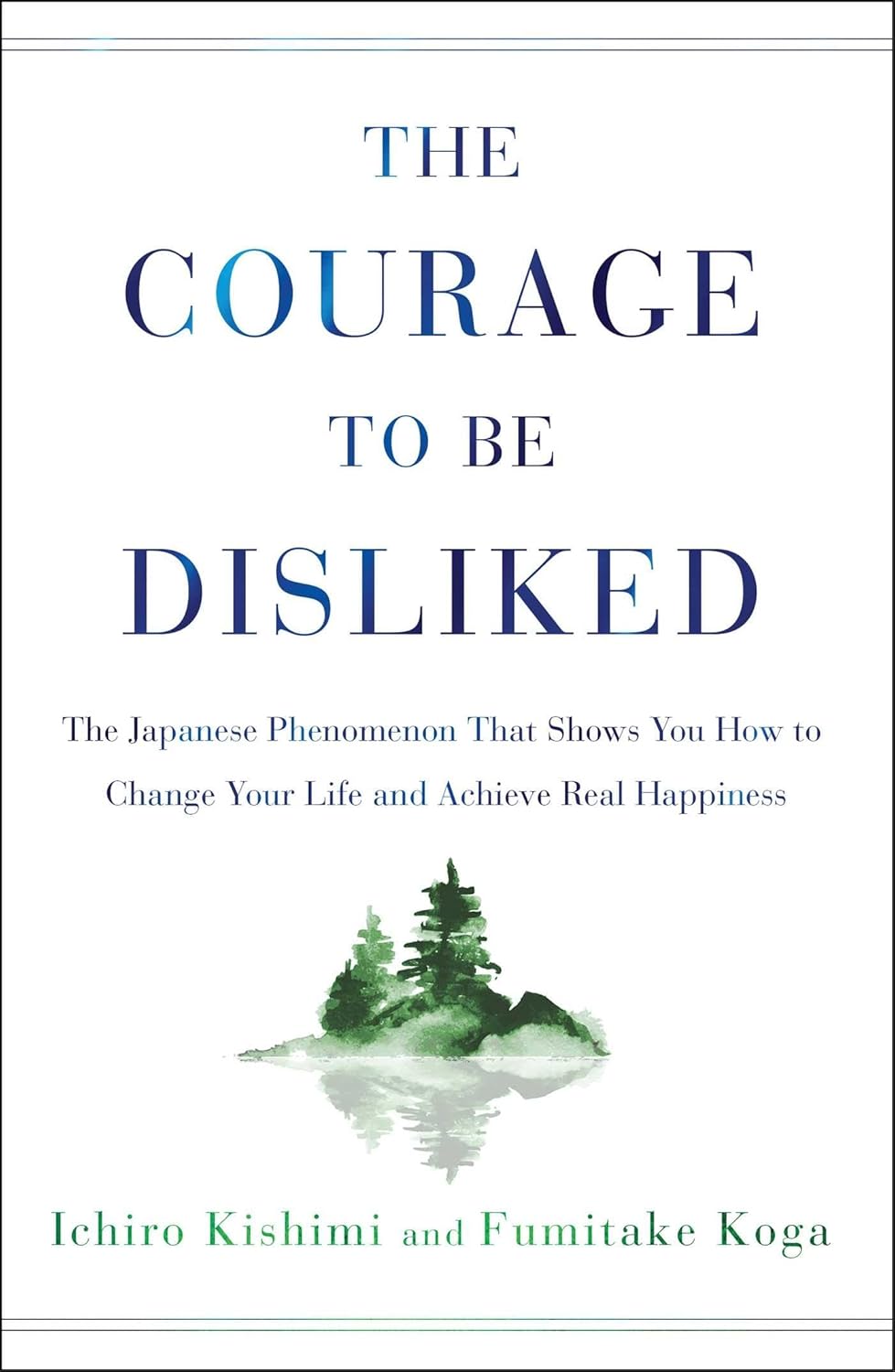
The Courage to be Disliked is a discussion between a philosopher and a young adult who comes to challenge the philosopher on the validity of their ideas. The philosopher has taken Alfred Adler's psychological theory of individual psychology to heart and spends the book teaching it to the visitor.

My favourite point to think about was the separation of tasks. This is the idea that you only worry about the tasks that are your responsibility. A parent doesn't force their child to study because that's the task of the child. You let your child study or not, and then pay the price if they didn't study, or earn the reward on their own if they did study.

This idea extends to all relationships, with you acting authentically to yourself and then leaving the responses of others to them. As I've often told my children, you're only responsible for your own behaviour. You're not responsible for the things others do or the reactions they have to your actions.

Alderian psychology doesn't absolve you though to act however you want without regard to others though. The guiding philosophy is that we gain meaning by being of service to our community, which can be as small as one other person or all the community around you in your city. When you are contributing to your community you have meaning in your life.

My biggest issue with the book is the dialogue between the philosopher and the youth which feels highly improbable much of the time. If you can get past that there are many sections that will have you evaluating your life and how you act towards others or what you take responsibility for.

Notes

- takes the form of a discussion between a philosopher and a younger adult coming to challenge the philosophy they think is faulty

### First Night - Deny Trauma

- [[How to Win Friends and Influence People]] Pg 6
- [[How to stop worrying start living - Dale Carnegie]] Pg 6
- [[7 Habits of Highly Effective People]] Pg 6

- anger is a tool that can be taken out as needed. Pg 18
- as in you get angry when you need a tool to make someone listen and you selectively apply it

- if your disposition towards life is something you choose then it can be changed. Pg 33
- we aren't born unhappy we choose it in the face of circumstances. We are responsible for our own actions and reactions

- the book says that trauma is a reaction because we want something. The recluse stays inside because they want attention and people to come convince them to come out. I have to disagree though, trauma is real and affects people at a deeper level than simply deciding to stop worrying about a rape, or some other horrific act

### Second Night - All Problems are Interpersonal Problems

- we often think we'll be happy if...but that comes and our happiness doesn't change for long and we pick some new event that will "fix" things. Pg 48
- this is a good point in the assertion last section that we choose our state of being and happiness

- to feel lonely we need to have other people around who aren't interacting with us Pg 52

- feeling inferior isn't bad. It can prompt us to push for things harder because we want to stop the feeling of inferiority. When it becomes a "complex" we stop trying to excel because we "wouldn't succeed anyway" which means we have a problem with our thought. Pg 63

> A healthy feeling of inferiority is not something that comes from comparing oneself to others; it comes from one's comparison with one's ideal self. Pg 73

- I feel like the dialogue is fairly strained and not believable overall. Pg 97

### The Third Night - Discard Other People's Tasks

- when you live a life hoping for the recognition of others you're not living your life, you're living the life others want for you thus you want to be recognized for serving their needs. Pg 118

- separating tasks. Pg 122
- it's my child's task to study or not so I should leave them to the job and let them reap the rewards or consequences of their effort. Forcing study time upon them makes it my task and then I suffer the consequences for them thus taking away their agency.
- be ready to help but otherwise stay out of the way
- you can tell whose task something is by noting who will suffer the consequences of the task not being done.
- this sounds a lot like [[Boundaries - Cloud & Townsend]]

- when a relationship is based on reward we notice how much we do and expect rewards in the form of others doing the things we desire. Pg 136

- if you intervene too often for your children and take care of all their challenges they never learn to deal with problems and are fragile.
- see [[porcelain dolls]] from [[You Are Awesome]]

- you are only responsible for your own behaviour. Pg 150
- not the reactions of others to your behaviour

### The Fourth Night - Where the Center of the World Is

- self-centered people see others merely as those who will do things for them. Pg 168
- others have no value outside of what they can do for you
- they view themselves as the center of the world

- a committment to [[Research Dashboards/community|community]] is thinking "What can I give to this person" Pg 171
- doing this without looking at the tally of actions is hard in a marriage. It's easy to feel like you spend your whole day doing stuff for others without any recognition. Parents serving children are especially prone to this
- the book does say that parent-child is often a vertical relationship with hierarchy and instead should be treated as a horizontal relationship of equals

- do some men stop thriving upon [[retirement]] simply because they have no community outside of work. Pg 172. 173
- thus they stop working and no longer have a community to connect with
- [[Men Have No Friends and Women Bear the Burden 100620201546]]

- if you live in fear of your relationships breaking down you are living for others instead of living freely as your own person without worry for the reactions of others. Pg 177
- so what do you do in a marriage/relationship? If you each only live for yourself without regard for the other?
- But I suppose this is where the living for serving the community and being of use in it comes in. A small community is that relationship so think about how you can be of service and useful in that community all the time.

- someone has to start serving to build a feeling of community. Pg 194
- just like dating, someone has to take the first step of expressing affection

### The Fifth Night - To Live in the Earnest Here and Now

- if you start wondering if your partner is cheating then you'll find reasons to believe this is true. Pg 216
- you'll read too much into their tone of voice or times you can't reach them and assume that the reason is the cheating.
- this goes for any assumption you make about others

- if you only feel part of a community when we are useful in it because we contribute how does that affect our withdrawal from community as we lead more individual lives. Pg 221
- [[Research Dashboards/community|community]]

- the North Star is being of service to your community and thus feeling a part of it and needed by it. Pg 260 - 264 ^30c963
- is this [[Cal Newport]]'s idea that [[social media]] gives us enough cues that it's "community" and being with others without the real payoff?
- is this why people interact online so much, because it's easier and still gives some feeling of being in community without all the other parts that enhance life by being around other people?