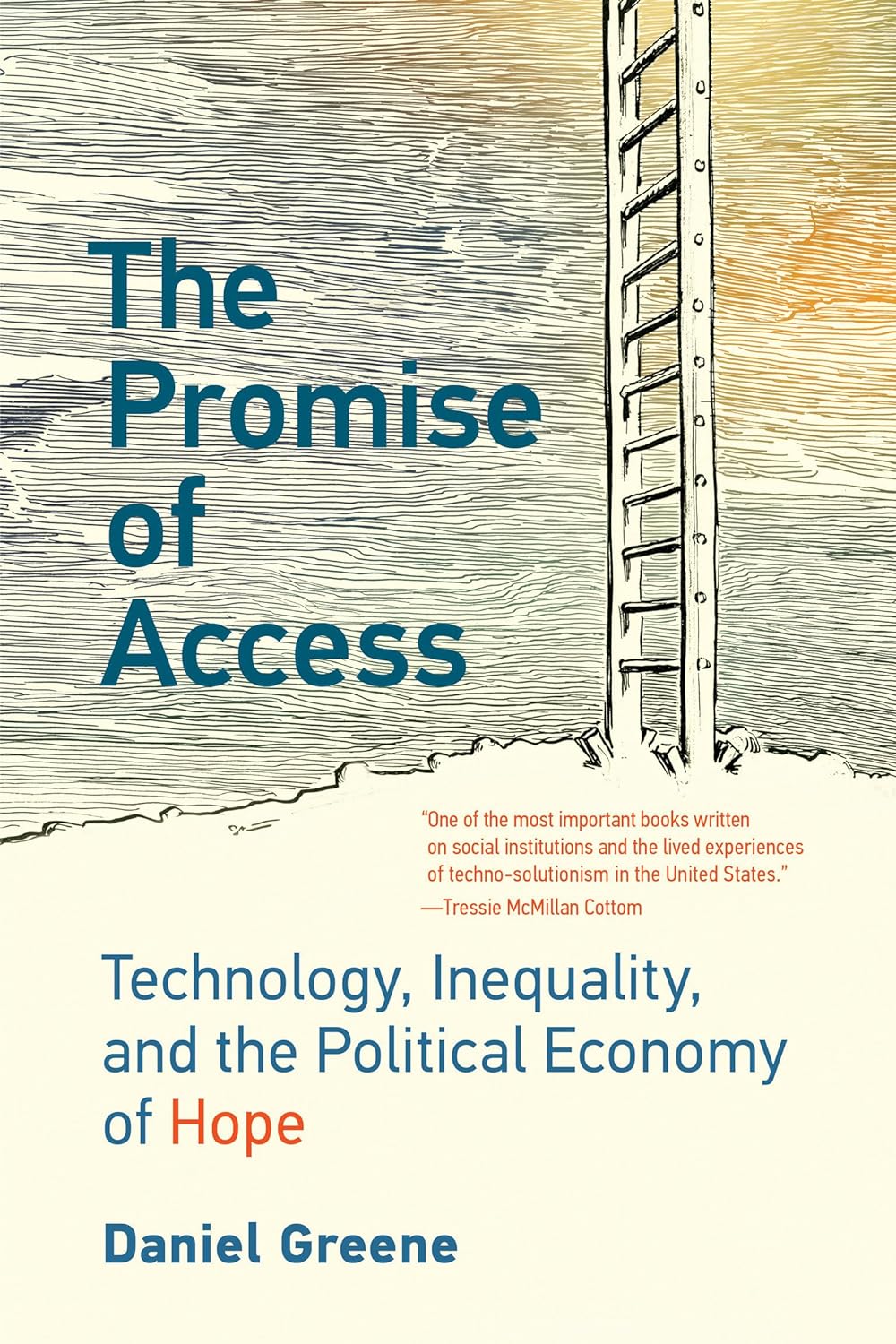
The Promise of Access - Daniel Greene

The Promise of Access - Daniel Greene

Daniel Greene

RECOMMENDED NONFICTION

Started: Apr 06, 2024

Finished: Apr 17, 2024

Review

Daniel Greene looks at the politically expedient idea that the problem with the workforce is that they don’t have access to computers (technology) and the skills to use said electronic devices. This lets politicians off the hook in addressing the structural problems (poverty, homelessness) that contributes to lack of work and skill development and simply stick computers in schools and libraries and say that their job is done because now people have access. This is a typical capitalist trope that says everything is there for you, so it’s your fault that you’re not succeeding.

I found Greene’s book interesting, if somewhat dense. It’s very suited to an academic or someone that deeply understands the economics and gentrification of Washington DC, parts of which were over my head as not an academic or US citizen or someone that’s deeply interested in the politics of another country. Still, there was much good in this book and I’d recommend reading it if you want to understand how libraries and schools (the two examples used by the author) are used as a vehicle to reduce public services and turn everything into “business”.

Purchase The Promise of Access on Amazon

Notes

## Introduction

- Shawn, a [[homelessness|homeless]] Black Washington DC resident, sees the internet as a place where he isn't judged but can express himself without people looking down on his appearance. Pg 3
- he didn't have to purchase anything to be welcome at the [[library]] or online
- he wasn't judged on his appearance of economic value
- this book investigates how the problem of [[poverty]] is transformed into a problem of technology Pg 5
- as in access to technology. if you can't fill out an online job form, you can't get a job
- [[access doctrine]] Pg 5
- that the problem of [[poverty]] can be solved via access to more technology
- I'm sure there is a frame that fits this from [[Dark PR - Grant Ennis]] because [[tech giants|big tech]] wants us to believe in what they're selling
- yup it's the one that makes access seem like a force of nature that just happens I believe that's normalisation See Pg 6 for more
- the author also refers to magical thinking which is a frame from Ennis Pg 13
- the fields projected for high job growth were not [[STEM]] jobs but [[health care]] and food preparation. Pg 9
- relatively low wage jobs that don't require coding or other STEM knowledge
- the [[skills gap]] narrative is about shifting the responsibility away from companies to train people on the job and to put it on people to put their own effort in and train themselves for a possible job. Pg 10
- a theoretical possible job
- many [[homelessness|homeless]] people have the skill needed to navigate the internet. What they need is not more skills, but a safe permanent space to live with some economic stability so she could use these skills to get work. Pg 12
- so we need to remove [[Scarcity 180920201044]] from her which could be done with [[universal basic income|ubi]]
- [[gentrification]] Pg 22
- Book **structure** is listed on Pg 24 and forward

### 1 - Discovering the Digital Divide - Technology and [[poverty]] in the New Economy

- **purpose**: To turn back the clock and see where the idea of [[access doctrine]] started Pg 30
- proponents of internet access say that it breaks down geographic restrictions to work and it doesn't matter who you are behind the computer screen. Thus it's your fault if you miss out on the opportunities present. Pg 32
- so it ignores the structural parts of society that have made the racial divide in employment and income happen, the internet wipes away generations of [[wealth concentration]] and theft of [[generational wealth]] so we should just ignore that and be happy about the opportunities in the internet
- [[neoliberalism]] Pg 34
- defined here as a political project where the state repurposes it's institutions to define and enforce citizenship around market demands
- this gets us more [[paternalistic]] attitudes towards lower classes, assuming that they can't decide what to do with their money or what's good for their neighbourhoods
- it also increases and glorifies the [[penal system]] as a thing that will bring safety
- but of course this in the view of the upper classes that have the time to lobby and lawyer and make laws
- [[Tags/stagflation]] Pg 35
- how can those in [[poverty]] on the fringes of employment train for the job of tomorrow if they can't put food on the table today? Pg 36
- they can't see [[Scarcity 180920201044]]
- while the [[Bill Clinton]] and [[Al Gore]] government said that it was the government responsibility to make sure everyone had access to the new connected world, that never included traditional [[John Maynard Keynes|keynesian]] public work responses Pg 41
- they didn't fund much of the build out of internet access but left it up to companies through [[deregulation]] which in theory gave them the "freedom" to serve their customers better. In practice from 2024, it let them consolidate and take more pieces of the pie on the backs of workers
- access was narrowly defined as having a computer and having the possibility to access the internet. It did not include any real world measure to say that a person could reasonably be expected to have the resources to make use of these tools. Pg 47
- so if you can get internet in your house, problem solved now it's your issue that you didn't take the effort, even if you're in poverty, it's your fault
- https://en.wikipedia.org/wiki/John_Maynard_Keynes[[capitalism wants you to believe you picked your life]]
- higher-status individuals engage in more “capital-enhancing” activities on the internet than lower-status individuals do Pg 47h
- is this similar to the studies that have shown that people with less money watch more TV than those with more money who are more likely to read a book?
- [[neoliberalism|neo-liberalism]] [[poverty]] policy got more cast for [[jail|prison]]s and [[police]] not [[job creation]] or cash based assistance programs to help people out of [[poverty]] and reduce their [[scarcity trap 180920201111]] Pg 48
- the lack of choice in [[internet]] providers, with most US households only having a single choice, means that there is no incentive for providers to upgrade their infrastructure to bring faster speeds to [[consumerism|consumers]] thus the [[United States]] lags behind many other countries in the speeds that people get, and in how much [[consumerism|consumers]] pay for their service. Pg 52, 53
- the US pays more for slower internet than many other countries in both line service to the home and mobile data service
- both [[library|libraries]] and [[public schools]] are funded by tax dollars, particularly [[municipal]] taxes. That means during a recession or other economic downturn their usage goes up as people have to cut home service, but their income goes down with the reduction in tax income Pg 54

### 2 - The Pivot and the Trouble with “Tech”


- [[pivot]] Pg 60
- [[The Lean Startup - Eric Ries]] Pg 60
- [[bootstrapping]] is used here to describe the rapid organizational restructuring in [[library|libraries]] and [[public schools]] to fit the new [[access doctrine]] Pg 61
- the doctrine being that [[poverty]] is a result of not having internet access and the skills to use the internet
- again, it doesn’t take into account any structural or racial issues with poverty that may be present which have led to the poverty in the first place
- [[WeWork]] Pg 64
- part of how the company justified it’s big office rents to consumers was workshops to help them with their business
- [[Startup Mixology - Frank Gruber]] Pg 65
- the author pitched this book as the 21st century update to [[How to Win Friends and Influence People]]
- startups say, especially to women, that if you're only doing the job in your description you're not doing enough. Pg 69
- you end up with a bunch of extra labour that's not really considered in your [[kpi]] metrics
- this may include unpaid "social" hours that someone is expected to plan and everyone is expected to attend
- startup offices, and thus spending, were concentrated in majority-White neighbourhoods in DC's Wards 1, 2 with a few scattered elsewhere and none in majority-Black neighbourhoods
- [[racism]]
- [[redlining]], [[The Color of Law - A Forgotten History of How Our Government Segregated America - Richard Rothstein]] seems applicable here

### 3 - More Thank Just a Building to Sit In for the Day

- the chapter seems to echo some of the stuff in [[The Library Book - Susan Orlean]] about how [[library|libraries]] have had to take on new roles as a spot for [[homelessness|homeless]] people to sleep and to sit during the day even though they're not funded for this role and don't receive funding for this rather large use of it's space
- [[United States|American]] [[library|libraries]] provide help, but only of the type they think is [[self-improvement]] according to whatever the political will is at the time. Pg 87
- currently that's adding technical skills according to [[access doctrine]]
- if you're just watching TV on the available computers then it is often judged as a poor use of the library
- if the librarian judged you were using the computers improperly they could monitor you, speaking specifically of the system used at the MLK library in Washington DC Pg 92, 93
- again this is policing of those in [[poverty]] judging they aren't equipped to use their time properly much as they're often judged incapable of using any funds properly.
- [[The Gates Foundation]] Pg 95
- their donations pushed certain ideologies about how a library should be used and the skills/stuff it should push. Which we saw in [[The Bill Gates Problem - Tim Schwab]]

### 4 - Flexible Classrooms

- wait the mission of the school is to get students into a school of "their choice" but that's crazy since admissions are crazy limited. Pg 111
- Ugh they're using SchoolForce (something like [[SalesForce]]) to track student behaviour and score them accordingly for their "effort" and the leadership team is not listening to the faculty on the ground. The students aren't even in the mix for what should happen. Pg 114
- they're only looking at academic performance, not digging into structural issues like [[poverty]] or [[homelessness]] that is the root cause of some of the performance dips
- there is little evidence that [[charter schools]] produce students that outperform [[public schools]] on standardized tests, but they do suspend and expel [[BIPOC]] students at a much increased rate compared to public schools. Pg 117
- the [[access doctrine]] promotes the [[pivot]] which means students are continually being experimented on and many of them were tired of stuff changing all the time. Pg 120
- none of the pivots dealt with structural issues either, just surface stuff that might let them score better on tests
- so teachers were docked if they closed their laptops between classes and had to log back in because that took too long. They were supposed to model fitting in an email or a small unit of work at any point to the students. Pg 124
- thus teachers could be seen walking with laptops open in one hand and coffee in another down the halls
- this is all about turning out good little workers not about what's best for students
- students and teachers are both expected to ask and answer questions at all hours thus extending work hours and breaking down any barrier between work and personal lives. Pg 128
- the more I read about this in school the angrier I get about grooming kids to be good little workers that won't object to crazy requirements from the boss

### 5 - Bootstrapping

- cited is the guy that oversaw the [[New Orleans]] school fix after [[Hurricane Katrina]] which we know from [[The Shock Doctrine - The Rise of Disaster Capitalism]] was mostly about taking away [[public schools]] in favour of [[charter schools]] that rich people wanted and then marginalizing [[BIPOC]] residents of the city Pg 142
- pathways to success under the [[access doctrine]] often rely on outside forces like wealth, so you can make many more tries at success, or plain old luck. Pg 145
- but these few winners are held up as proof that the pathway for reforming public institutions like libraries and schools works so we should keep going and ignore the many more students/patrons that have not succeeded
- organizations are not equally responsive to all stakeholders. [[library|libraries]] may respond to the concerns of the wealthy white donors over the concerns of the users of the library, who may be [[homelessness|homeless]]. In fact the book tells a story of needing to “clean up” the library when the Friends of the Library donors come so they don’t have to see the homeless people that frequent the building. Pg 146
- certain funding agencies like [[The Gates Foundation]], the Waltons, and others lead the way in defining the problem of [[poverty]] as a problem with access and use of technology. Pg 147
- [[The Bill Gates Problem - Tim Schwab]] was all about this idea focused on Bill Gates
- it's also good for them as companies they're involved in are the beneficiaries of the tech/services added to public services like schools and libraries so they get richer and thus can have more money to fund more things
- [[library]] workers and teachers are primed to believe the [[access doctrine]] because they got the right training and then found a job thus their own experience validates it. It's hard to put yourself in the shoes of [[poverty]] if you haven't experienced it. Pg 150
- businesses fund “innovation” in the [[library]] and [[schooling|school]] fields figuring that these institutions just need to run more like a successful business. Pg 158
- seems like a [[workification]] of all fields as if the business/work world is the ideal state for any functioning thing
- the irony of [[Google]] funding this as it engages in [[anticompetitive]] behaviours is not lost on me
- same with [[The Gates Foundation]] funding “reform”
- when we cut funding to [[schooling|school]] and [[library|libraries]] we put them on life-support where they need funds and will dance to the whims of any organization that is willing to provide funds so that they can keep going. Pg 162
- [[capitalist|capitalism]] likes this because when there is [[scarcity]] people with money can step in and exert far more power than they should be able to