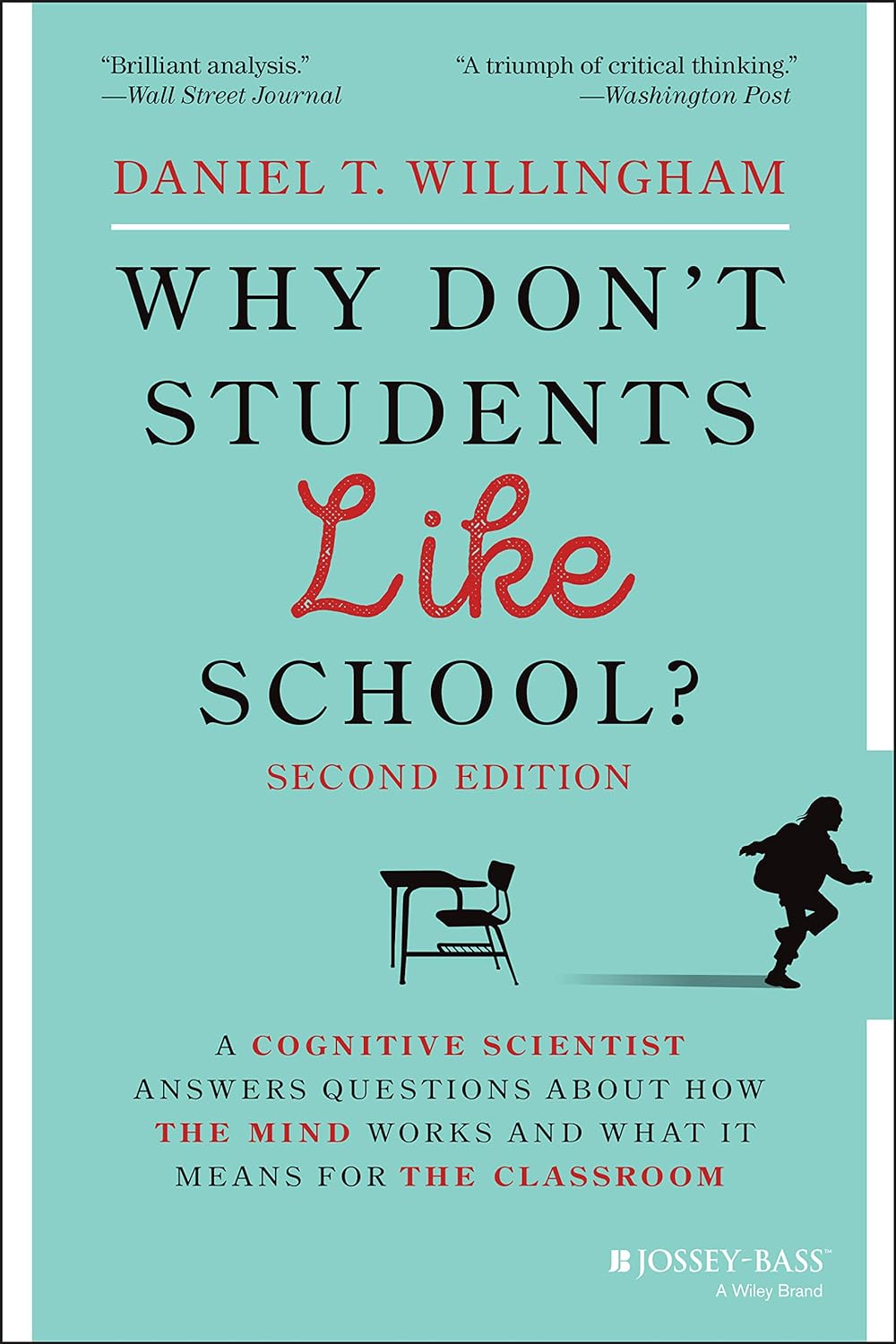
While the title is what drew me in, Why Don't Students Like School, really isn't about why students don't like school. It's actually about why students don't pay attention to lessons in school and why they don't retain information.
Despite the title that is a little misleading, there are some interesting points in the book.
Question Difficulty Matters
In my schooling career, I distinctly remember classes that had me deeply interested and some that I barely passed because I wasn't interested. English was one class in particular where I got high marks, but I barely did any work so my overall grade was barely there. It's not that I didn't love reading and writing, I did both of those things in my own time, I just didn't like what we were doing in class.
Turns out, question difficulty matters1, so maybe it wasn't me and maybe it was the classroom environment that wasn't asking me hard enough, or easy enough questions. According to Willingham, humans are lazy and we're only up for thinking if the question is hard enough that we have to, but not so hard that we feel we won't have any chance at getting the right answer2.
You Need Facts So You Have Something to Think About
One thing I have lamented in watching my kid's schooling is that it feels like they're being taught a bunch of stuff they can just look up. The book suggests that we have to do this because if we want to be critical thinkers, we need facts to think about3. If we don't have enough basic knowledge, we don't have the material to have any critical thoughts.
One of the most interesting points here was that the more facts you know the more facts you retain4. Since we relate what we're learning to things we already know, if we know more then we have more to relate new learning to and thus we retain more of that new information.
In a practical world, that has big effects on students that come from homes with fewer books or that engage in less conversation. A big question for me now is, what would it take to equalize the early lives of children? What can society do to ensure that there is little "headstart" for some kids?
These questions have been added to my long-term writing project, We Don't Care About the Children.
There is at best mixed support for Learning Styles
I'm sure most of us have heard about the different types of learners. Some learn "best" via audio, some via visual, and some while touching things. According to Willingham the research supporting these ideas is at best mixed5. Yes, some people may have stronger memories of things they hear vs things they've touched, but this memory does little in terms of helping students glean meaning from lessons.
Working to incorporate each learning style only serves to make more work for teachers for no measurable benefits for students.
Technology isn't the answer
In one of the final chapters, Willingham addresses whether technology is useful in the classroom. While things like digital whiteboards or one laptop/iPad per student are hailed as a school staying relevant, there is mixed support for these things improving the outcomes of students.
Yes, you can type faster than you can write, but that also means you have far more distractions at your fingertips6. You can open a web browser and shop, or play StarCraft II (which I did in college). There is also research supporting the idea that you do better synthesis of information when you have the constraint of handwriting because you slow down and think more about what's important7.
Overall, I'm mixed about how technology helps us in many realms. It seems more often that technology shows up with something fancy and then inserts it into life because surely it's obvious that it will solve a problem8. Instead, maybe we should start with the problem and then find a solution to it, which may not be more technology.
ORLY
ORLY - Oh Really....for spots I questioned a statement and should go back to it to do some more research.
One of the benefits of technology highlighted in the book is that students will learn hierarchical file structures and thus understand how information is organized in a computer system9. But that doesn't seem to be the experience of teachers in the real world according to this article that says they don't understand what a file is and just search for everything because that's what search engines have taught them to do10.
The second moment where I question the author's arguments is when he states:
If you want to be exposed to new vocabulary and new ideas, the places to go are books, magazines, and newspapers. Videos, gaming, social media, and texting friends offer less exposure to new ideas and vocabulary.11
At a number of points in the book, he brings up some idea that seems like it will be "obviously" successful in the classroom but has little support in scientific research for having a positive effect. This feels like one of those same types of statements. "Obviously" gaming, videos, and texting are inferior good12 and must result in inferior outcomes. While I have done other reading to support this, the author makes a throw-away statement here without any research citations to back it up. We're simply supposed to see the "obvious" and believe him.
I feel a more accurate statement may say that without careful choice these things can result in less exposure to new ideas, and new vocabulary. Watching videos from Not Just Bikes, or talking about books with morganeua exposes me to many new ideas and terms. Yes, I could get these with reading as well, but I can't read a book and ride my indoor trainer at the same time.
Should You Read Why Students Don't Like School by Daniel T. Willingham?
I'm mixed about the book. It's a fairly easy read, in that the author writes well and clearly, but I'm there were only a few moments in the book where I really thought the author presented me with some bigger new idea. If you're engaged in teaching then there may be more for you to glean from the book as it talks about how to do deliberate practice in the classroom. If you're not engaged in teaching...it's probably not a book I'd recommend.
Purchase Why Don't Students Like School?
Further Reading
-
Page 7 ↩
-
Page 10 ↩
-
Page 28 ↩
-
Page 46 ↩
-
Page 176 ↩
-
Page 230 ↩
-
Tech Won't Save Us is a podcast all about this idea ↩
-
Page 241 ↩
-
Students who grew up with search engines might change STEM education forever ↩
-
Page 46 ↩
-
In economic terms, this is defined as something whose demand drops as someone's income increases. So people with less money watch more TV than those with more money. ↩