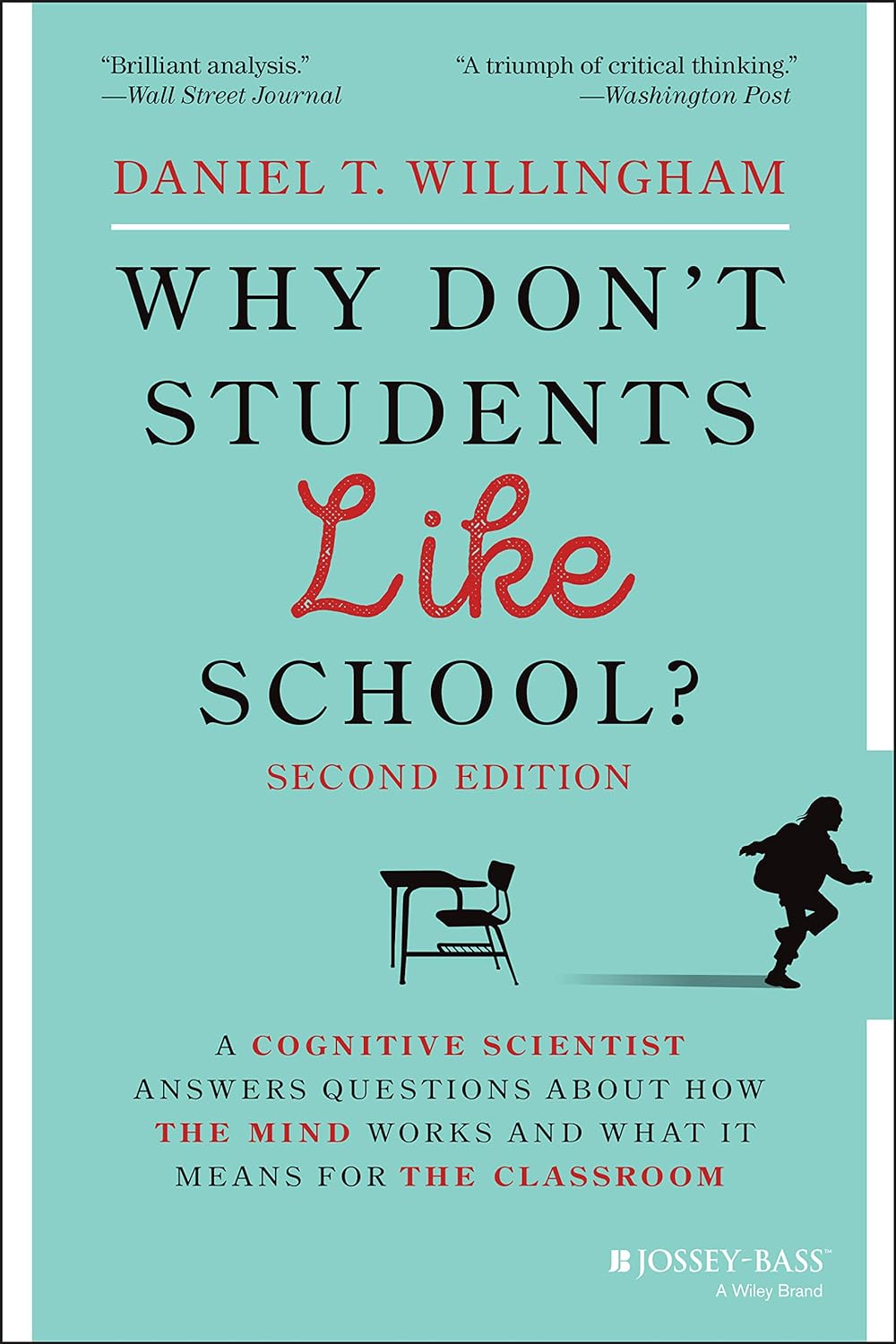
Why Don't Students Like School? - Daniel T Willingham

Why Don't Students Like School? - Daniel T Willingham

Daniel T Willingham

MAYBE NONFICTION

Started: Dec 05, 2022

Finished: Dec 21, 2022

Review

Students don't like school because of the range of difficulties that must be presented in class which means some students get the information right away and then are stuck repeating work that is boring, while others are struggling to keep up. They also aren't that into school because of some of the technology that is pushed on them, which often shows little benefit in learning outcomes.

I don't think that Willingham's solutions to boring school are that strong, he certainly doesn't bring much research to back up his ideas. He makes far too many assumptions that his ideas are "obvious" and would help students.

Read my longer review of Why Don't Students Like School.

Purchase Why Don't Students Like School on Amazon

Notes

- while much research claims to change the way we learn, in practice most teachers find the research all but useless on Monday morning in the classroom. Case in point, repetition is good for learning, but repeating long division is bad for motivation. This book is going to go through 9 points that hold true in cognitive science and the classroom

## 1 Why Don't Students Like School?

**Principle**
> People are naturally curious, but we are not naturally good thinkers; unless the cognitive conditions are right, we will avoid thinking.

Students need the right level of difficulty in the questions you ask them. Too hard, and they give up because they'll never get it. Too easy, and they don't bother because they know the answer. You need to ask more that mere fact retrieval questions to really get kids thinking, and you need different levels of questions to enage everyone in your classes.

### Notes

- ultimately we're lazy and without the right context/stimuli we will quit thinking hard as fast as possible. Page 7 ^91ae97
- so school needs to set the right context
- too many hints and we no longer feer satisfaction when we solve a problem. Page 8
- we're up for thinking when we think we'll learn, when the problem is at the right point of difficulty. Too hard and we'll drop it because we can't solve it. Too easy and it's just like brushing our teeth, not that interesting. Page 10
- so if students are getting work not just right for them, it's easy to check out.
- is that why I checked out of much of school? It was too easy for me so i didn't bother?
- don't just ask fact retrieval questions, ask questions that get students to think just a bit hard for the answer. Page 18
- what is the question that will engage the students and make them want to know the answer? Page 19
- and don't be quick to get to the answer just because it's obvious to you. Think hard about the question so that it's engaging to the students
- the author doesn't believe that some students are "less bright" than others. Some students have been prepared better for schooling and may have better supports at home for education. These students are going to be more resilient. Page 20
- this means that you can't give all students the same work as it will be to easy/hard depending on the life preparation of the student
- don't just expect to remember what worked, keep a note on it in some fashion that you can reference each year when you come back to your lesson plans. Page 21
- [[Flow]] Page 22

## 2 - How Can I Teach Students the Skill They Need When Standardized Tests Require Only facts?

^4eff47

**Principle**
> Thinking skill depend on factual knowledge. Page 25

If you want critical thinkers, then they need a large amount of facts so they have something to think about. Kids from families with less, have less facts and vocabulary and tend to get further behind because they remember less from each lesson as they have less to relate new facts to from their working knowledge of the world.

### Notes

- we want kids to think critically, but they must have something to think *about* which means they must have some long-term knowledge. Page 28
- factual knowledge makes it easier for us to use chunking because we tread PHD as a "chunk" instead of three random letters and this takes less working memory to recall than a set of random letters. Page 34
- or "good" readers with little knowlege about baseball will understand less than "bad" readers with lots of baseball knowledge when reading a baseball story. It's the base facts about baseball that matters more than the reading level. Page 36
- the fourth grade slump in reading may be attributed to students having less factual knowledge and smaller vocabularies from less priviledged homes. In 4th grade reading turns from simply decoding sounds to comprehending what was in the story and without the background knowledge you can't comprehend as much. Page 38
- we retain new information better if it relates to information we already know. Page 43
- so a programmer learning a new language already knows `if/else` and `while` and can relate the new language to ideas from what they already know. Wherease a beginner learning the language has little to relate the new information to.
- when you have more facts memorized, you retain more new information because you have more to relate it to. This means that you keep pulling "away" from those with less facts because you always retain more new knowledge. Page 46
- ORLY: Page 46 says that you are exposed to more new ideas from books/magazines than in video games, videos, TV but is this true?
- the way the author does the citations makes it hard to know if the claim is true because it doesn't specify which citation it's referring to
- in fact upon further investigation there is no specific citation for this. The author assumes that we accept and know this fact...but is it true? In what contexts is it true?
- [[Unequal Childhoods - Annette Lareau]] Page 55

## 3 - Why Do Students Remember Everything That's on Television and Forget Everything I Say?

**Principle**
> Memory is the residue of thought.

If you're memory is a product of what you think about, then students aren't thinking about the right thing...at least the thing you intend. The author highlights a lesson on the [[Underground Railroad]] where students baked biscuits as the people would have. The result, they knew more about the biscuits and still little about the railroad because they thought more about measuring the ingredients and eating the biscuits.

### Notes

- your memory is a product of what you think about, what you engage with Page 57
- stories require you to think of the extra context continually so you remember them. Page 73
- like understanding when Luke wants to put handcuffs on Chewbacca it's not because they're enemies, it's to pretend he's a prisoner and get to the jail
- spend time reviewing lessons and investigating what students will actually think about, not what you want them to think about. Page 85
- don't just show some flashy "hook" use the beginning of a lesson to define the conflict that the rest of the lesson will be spent resolving. Page 87
- [[Make It Stick - Peter C Brown Henry L Roediger III Mark A McDaniel]] Page 91
- [[Story - Robert McKee]] Page 91

## 4 - Why Is it So Hard For Students to Understand Abstract Ideas?

**Principle**
> We understand new things in the context of things we already know, and most of what we know is concrete. Page 96

Abstract deeper understanding is hard fought and hard to come by, especially by younger learners that live in a concrete world they can touch. It takes long repeating and effort to get learners to understand abstract ideas and then be able to apply them across different problems. You must remember to ask "why" something applied instead of just factual questions so that they think about the abstract ideas and it's relevance to multiple avenues.

### Notes

- We understand new things in relation to old things we know. This is why analogies help us undestand. Page 97
- until we have very broad experience, like adult levels of broad experience, our learning is specific to the situation at hand. Kids are going to have a hard time learning abstract ideas that apply broadly. Page 113
- if you only ask fact based questions, then only expect fact based understanding. Page 114
- this goes back to chapter 1 about remembering what you think about
- [[Surfaces and Essences - Douglas R Hofstadter Emmanuel Sander]] Page 115

## 5 - Is Drilling Worth It?

**Principle**
> It is virtually impossible to become proficient at a mental task without extended practice. Page 119

Yes, but it's going to be hard to drill all the time, especially when students feel they know the information because you're practicing all in one big lump. To get long term retention you need to drill in sessions spread out over time.

### Notes

- practice means you don't need as much "room" in your brain for all parts of an activity. Think of a child reading. At first it takes up all their mental capacity to simply decode words so they don't have any room to understand what is going on in a story. Page 120
- three years after an intro course your retention of information you're not still using is under half. It levels off at 7 years. Page 128
- so if you want to retain something...you must keep using it
- but say you took intro to Psych, then took 4 more years of psych courses. Because you did more overall practice, your retention is quite high, and fairly flat, because you did more practice in the field. Page 130
- spacing study out over time increases the long term retention of information. Page 132
- see [[spaced repetition]]
- ironically, cramming means you'll likely do better on the immediate test, but a week later the spaced repetition studier will retain more information

## 6 - What's the Secrete to Getting Students to Think Like Real Scientists, Mathematicians, and Historians

**Principle**
> Cognition early in training is fundamentally different from cognition late in training. Page 144

Students, non-experts, can't think like experts because they don't have the required practice time. Truly thinking like a scientist is beyond the ability they have.

## Note

- we want students to think like scientists early, when they don't have the cognitive capacity to do that type of thinking. Page 143
- we give highschool students experiments that have a predictible outcome based on the textbook and teacher. Real scientists don't do experiments where they know what will happen, they have a hypothesis only and then see what happens. Page 144
- so we don't even train them the same way scientists work
- we can't expect students (beginners) to think like experts because they don't have the mental muscles built up. The only way to do this is via extensive practice. Page 154
- [[Grit]] has been overused to overwork students in fields they don't care about. Those that have epic practice are doing it in fields they enjoy. Page 156
- [[Grit]] Page 163
- [[Peak - Anders Ericsson Robert Pool]] Page 163

## 7 - How Should I Adjust my Teaching for Different Types of Learners?

**Principle**
> Children are more alike than different in terms of how they think and learn. Page 167

There is no science supporting learning styles. At best we can say the results are mixed. Use different methods of presenting information as they suit the information. Learning about a national anthem, hear it. Learning about turbans, wear them.

### Notes

- dozens of studies have been done to test learning styles (auditory, visual, touch) and they don't support that matching teaching to a preferred style of a student has any benefit in information retention. Page 176
- when we say that every child is intelligent in some way, we equate their value/meaning with intelligence. They are valuable even if they lack all markers of traditional intelligence. Think of a disabled child, that would not be considered intelligent, but still brings joy and value. Page 187

## 8 - How Can I Help Slow Learners

**Principle**
> Children do differ in intelligence, but intelligence can be changed through sustained hard work. Page 192

The big way to help those that are slow is to teach them about [[growth mindset]] and help instill that in them. Praise them for the effort, and challenge them to do better. Teach them that hard work will pay off. It's a years long endeavour, but poor students can improve and catch up/surpass others if they put in the work.

### Notes

- [[flynn effect]] Page 201
- intelligence can be improved. It's the job of a teacher to help kids recognize that they can improve their intelligence if they're willing to do the work. Page 202
- so egender [[growth mindset]] in these students instead of [[fixed mindset]]
- slow learners are not dumb, they can improve. They may differ in learning resources, motivation, and the knowledge the come to school with. Page 207
- so going back to chapter 2, if they come with less information, they retain less information and will fall further behind students that already know more
- praise the effort not the outcome. Page 207. 208
- so not "you're good at..." but "you worked hard at...I'm proud of you"
- "catching up" will not be an overnight thing. It may take years of hard work. Page 212
- [[Mindset - The New Psychology of Success 270720212101]] Page 213
- [[Intelligence and How to Get It Why Schools and Cultures Count - Richard E Nisbett]] Page 214
- [[Intelligence - Stuart Ritchie]] Page 214
- [[What Intelligence Tests Miss - Keith E Stanovich]] Page 214

## 9 - How Can I Know Whether New Technology Will Improve Student Learning?

**Principle**
> Technology changes everything...but not the way you think. Page 217

One of the problems with technology in education, really in many fields, is that we start with the technology and then go looking for a problem it can solve. Instead we should be looking at the problems and then find things that solve the real problems in the classroom. Overall, technology is mixed in the classroom. It doesn't affect what you may think in the ways that seem obvious. [[Assistive technology]] does help [[disabled]] students have a more [[equity|equitable]] classroom experience though, we should push on those more.

### Notes

- the research doesn't support that kids born in the era of technology are [[Digital Native]], that the just speak the language of technology due to changes that tech brought in how they think. Page 220
- they're good with the tools they were interested in, like their phones because they spent time on them learning them
- [[multi-tasking|multitask]] Page 221
- music research is mixed on how it helps focus. On one hand it can energize you, on the other it can distract you causing you to switch between music and whatever you're doing. Page 223
- one thing holding tech in education back is that teachers are given a very short amount of training on how to use it well. They never get to expert status, so they don't use it. Technology may have changed but teaching methods barely changed. Page 225
- claims that [[eBook]] past print books in sales, but [[Book Wars - John B Thompson]] contradicts that statement saying that the eBook never got more than around 20% market penetration. Page 227
- sure you can type faster if you use a laptop or iPad, but you also have lots of distractions at your fingertips to interrupt your concentration. Page 230
- while some thought that the universal access to the [[internet]] would mean a learning explosion, teens do the same things they did before. They goof off, talking to friends, looking at videos, and gaming. Very little additional time, if any at all, is given to educational pursuits. Page 233
- the author worries that devices around all the time means teens can't get away from peer influences as they follow them on [[social media]]. Page 235
- in decades past, you may have come home and stewed on the day, but your world narrowed to your family and the people that lived on your street so peer pressure and comparison wasn't around in the same way
- ORLY - the author says that students learn hierarchical file structures, but I remember reading that at the college level students had no understanding what a file was. Page 241
- See this reporting from [[The Verge]] - [[Students who grew up with search engines might change STEM education forever 211220220706]]
- people think that smartphones and devices give instant gratification to kids, but really it gives instant gratification to parents in that they get a break from kids. Page 247
- think of the whiny kid in a restaurant that is given their parent's phone
- [[The Shallows 140920200718]] Page 247

## 10 - What About My Mind?

**Principle**
> Teaching, like any complex cognitive skill, must be practiced to improve. Page 251

The recommendation is to engage in deliberate practice for your teaching skills and the author provides a set of steps to do this.

### Notes

- to teach math well, you need more than to know math. You need to know how to teach as well. Page 253
- [[deliberate practice]] Page 255
- schools don't provide much time or support in terms of deliberate practice for teachers. You're expected to just be "good"
- [[self-serving bias]] Page 256
- so teachers interpret their own work in a way that views their actions in the best light
- recommends a method to do [[deliberate practice]] in the classroom by recording yourself and waching the videos. Start by yourself, but then bring in another teacher you can work with to give positive feedback/tips to each other. Page 262

## Conclusion

-

BLOG POSTS ABOUT THIS BOOK