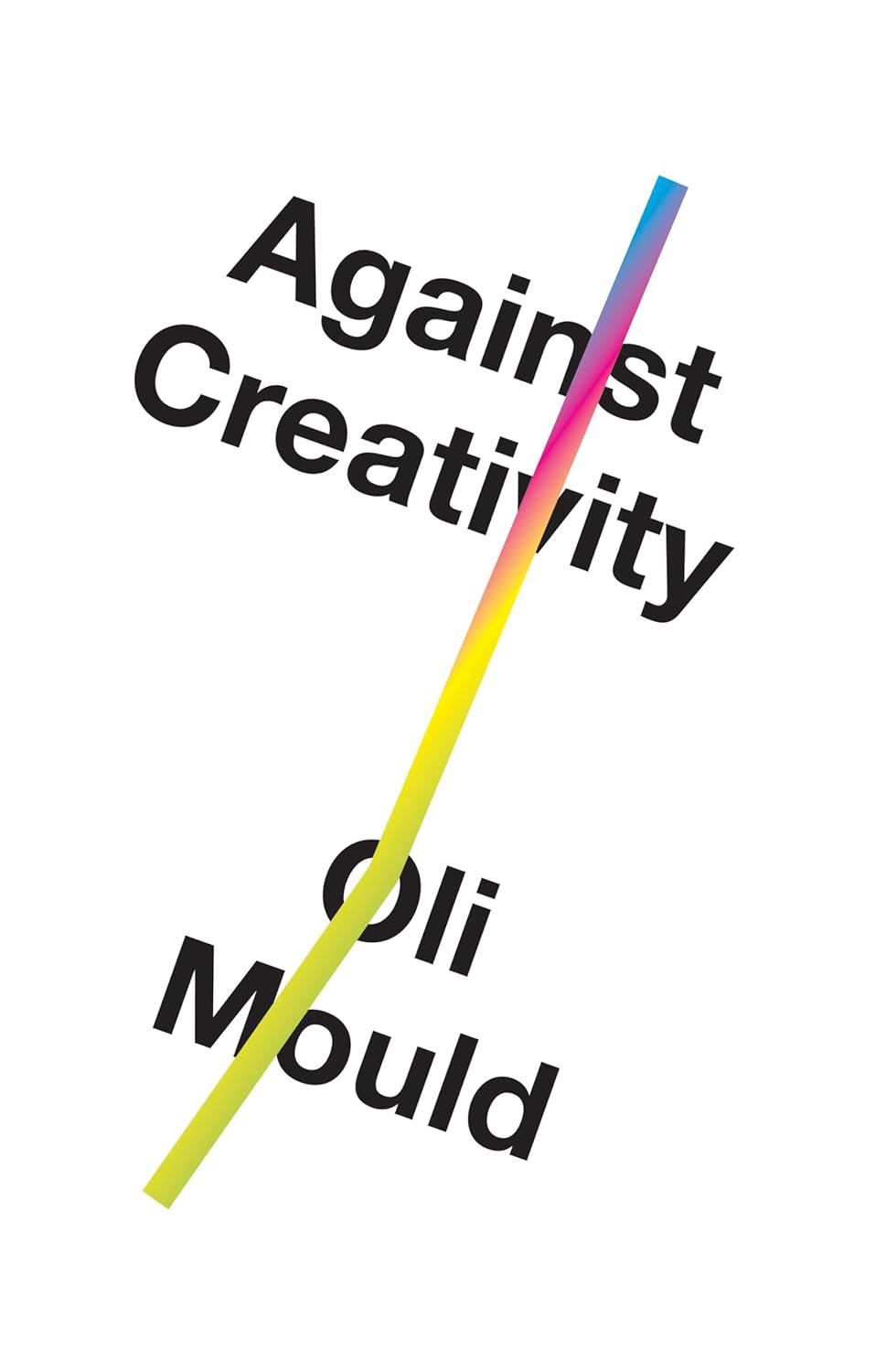
Against Creativity - Oli Mould

Against Creativity - Oli Mould

Oli Mould

RECOMMENDED NONFICTION

Started: Nov 29, 2024

Finished: Dec 04, 2024

Review

In Against Creativity, Oli Mould, takes a critical look at the creativity the world wants to push on us.

Your boss cuts funding and says that you need to be "creative" to provide the same level of service with half the employees. What they really mean is you should work extra hours for the same money while they reap extra profits.

Cities have "creative" murals downtown to attract the "right" type of people. It can be edgy, but not so edgy that anyone is challenged. Creativity needs to serve the needs of capitalism and business.

Purchase on Bookshop.org and support local bookstores

Purchase on Amazon

Notes


![cover|150](http://books.google.com/books/content?id=52_nDwAAQBAJ&printsec=frontcover&img=1&zoom=1&edge=curl&source=gbs_api)

- [See matt's article](https://birchtree.me/blog/art-doesnt-have-to-be-valuable-to-the-market/)
# Against Creativity

- [[capitalism]] tells us we must be creative to get by. We must have some unique thing so we can sell ourselves so we can feed ourselves and the capitalism machine. Pg 3

**Purpose**
- expose how creativity is weilded for profit in the [[capitalist]] machine Pg 3

- [[The Culture Industry - Theodor W Adorno]] Pg 7
- according to [[Against Creativity - Oli Mould]] this argues that tools like the [[printing press]] mass-produced culture and created a divide between popular culture which "numbed" the masses and "high" culture that elevated experience and the senses

- we defund public institutions then say they're failing because they lack creativity. Pg 10
- we say poor people lack creativity but ignore the fact that we have the finances to be more creative because we don't live in such [[scarcity]]
- [[Scarcity 180920201044]] and the [[scarcity trap 180920201111]] talk about this

- [[neoliberalism]] Pg 11

- capitalism captures creativity to make sure it's monetized. Pg 12
- and your side project is pumped back into the economy. You **must** have a side project to keep pushing your career forward and show how creative you are

- [[The New Spirit of Capitalism - Luc Boltanski Eve Chiapello]] Pg 12


### 1 - Work: Relentless Creativity

- [[The Rise of the Creative Class--Revisited - Richard Florida]] Pg 19
- [[Puritan Work Ethic|Protestant Work Ethic]] Pg 20

- pushing creativity comes with the idea that you are flexible which is good for business because they want you to adapt to any new thing they throw at you. Pg 23
- like the [[gig economy]] with its increase in precarity and worker financial [[scarcity]] but if you push back on this you're not flexible enough to get creative and find new income streams to make up for the single income stream that now doesn't provide a full income when it used to

- [[The New Urban Crisis - Richard Florida]] Pg 23

- a flexible schedule that comes with contract/freelance work is sold as a benefit because you can go for a run/ride in the middle of the day or pickup the kids. But it's also good for the company because they can stop the work and owe you nothing or play on your precarity to get a lower price without regard for your long-term health. Pg 32, 33
- you're just a part in the machine and another part could do it just as well

- take academics. There are a few [[tenure]] people at the top with real benefit from creative flexible work and a vast number of early career academics barely making a living that really fuel the system. Pg 34, 35
- you have to have $ or be supported by someone with money to make the flexibility of early stage academics not ruin your life

- "creative" job framing also puts training on the worker who is expected to use their own capital and time to train and increase their skills. Of course your employer wants to reap the benefits of training you do, without paying you more for it or paying for it at all. Pg 44

### 2 - People: Marginal Creativity

- including [[Shakespeare]] in student course material as an example of creativity is viewed in many countries as a [[British]] [[colonialism]] decision Pg 58, 59

- [[Originals - Adam Grant]] Pg 62
- called part of a genre of book purporting to show readers how to replicate billionaire success. A genre I was very much into at one point

- to be original and succeed you have to have a certain privilege or your just dumb and weird and don't have the support needed to get through the hard parts when you're making nothing with your crazy idea. Pg 64

- [[disability]] Pg 66, 67

- while we claim to value creativity yet most of us insulate ourselves from any real creativity because it doesn't conform to our society and the abled-bodied views of the world. Pg 73
- this could even be creative city design that didn't focus on [[car culture]] as a means of transportation. Many reject the notion that we could use walking and public transit

### 3 - Politics: Austere Creativity

- the creativity of politics is really just about performing for [[social media]] and having an army of people ready to clip the right gaffs to fan the flames against your opponent. Pg 92

- [[austerity]] has government selling public assets to be more "creative" because in theory private corporations can run former public assets "better" Pg 97
- is this true though? Do they just cut services to get money out of the system and then pass the costs on to people in the forms of lack of supports and then back to government because they need to find other ways to support people?

- corporate investment tends to centralize in [[Tags/urbanism|urban]] areas leaving [[rural]] areas lacking in [[library|libraries]] or arts as local budgets are cut via [[austerity]] measures. Thus we centralize the knowledge of art. Pg 100
- libraries renting all desks instead of making them free to anyone goes against the knowledge for all for free ethos that the library was founded on

- [[British]] government contract [Atos to asses if people or welfare were fit to work](https://www.disabilitynewsservice.com/atos-is-left-with-blood-on-its-hands-after-dwp-calls-time-on-its-20-years-of-assessments/) and paid them extra if they passed people. So they are incentivized to say people can work, not find what's best for the person and help them through it. Pg 103
- this is a sign of "creativity" in austerity

- the reward for bankers who caused the [[2008]] financial crisis was trillions in government bailout money taken directly out of taxpayers pockets. The same taxpayers that were loosing their houses due to the crisis. Pg 105

### 4 Technology: Algorithmic Creativity

- [[Close to the Machine - Ellen Ullman]] Pg 117
- about the interlinking of [[silicon valley]] firms via buyouts and employee moves between companies

- so much of our technological creativity goes into ads or now [[Ai]] which is vastly harmful to the environment yet we have governments going around saying it's going to save our cities and planets while it sucks up resources and pads the pockets of billionaires. Pg 128, 129

- these creative [[algorithm|algorithms]] also increase [[polarized|polarization]] via [[filter bubbles 090920200646]]. Is that good for society or just the engagement on a platform? Pg 130, 131

- [[Radical Technologies - Adam Greenfield]] Pg 131

- [[Uber]] Pg 133

- [[The Gift - Marcel Mauss]] Pg 139
- looks at how societies have exchanged gifts

- [[machine learning]] and [[Ai]] have all the inherent biases of the world but we ignore these biases when we view their responses because we mythologise computers and thus give their answers weight we wouldn't give if they came from people. Pg 143
- see [[Not with a Bug But with a Sticker - Ram Shankar Siva Kumar Hyrum Anderson]] for the overvaluing of AI

- ![[algocracy]] Pg 144

### 5 The City: Concrete Creativity

- when cities get graffiti artists for downtown murals it's all about creativity, as long as that creative expression increases property values and attracts the "right" kind of businesses and patrons. So not too creative, just enough that it doesn't challenge people. Pg 153

- a new creative city should feel edgy to attract bohemian styled workers but not so edgy that business have a hard time. A contained controlled edge. Pg 159

- companies like [[BP Oil]] sponsor art in a form of artwashing their terrible practices to try and get us to think that they're not that bad and to polish their image. Pg 162, 163

- why are there funds for a new art gallery to attract new types of people to a creative city but not funds for intervention that helps the existing local population like affordable housing, needle exchanges...Pg 177

### Conclusion: Impossibly Creativity

- industrialized creativity stops us from believing in impossible things, worlds that could exist but don't serve [[capitalist|capitalism]] and earning money for owners. Instead it funnels creativity into lanes that support capitalism. Pg 186

- many of the great creative thinkers we idolize like [[Steve Jobs]] were able to apply their creativity because they were white men and thus didn't have to expend that energy simply to survive daily injustice. Pg 193