Naomi Klien looks at how natural disasters, war and terrorism are used by government and business to further capitalism and take away benefits to poor people. Most often non-white Americans, or entire other countries, bear the brunt of the capitalist push to use a shock to reset what is normal.
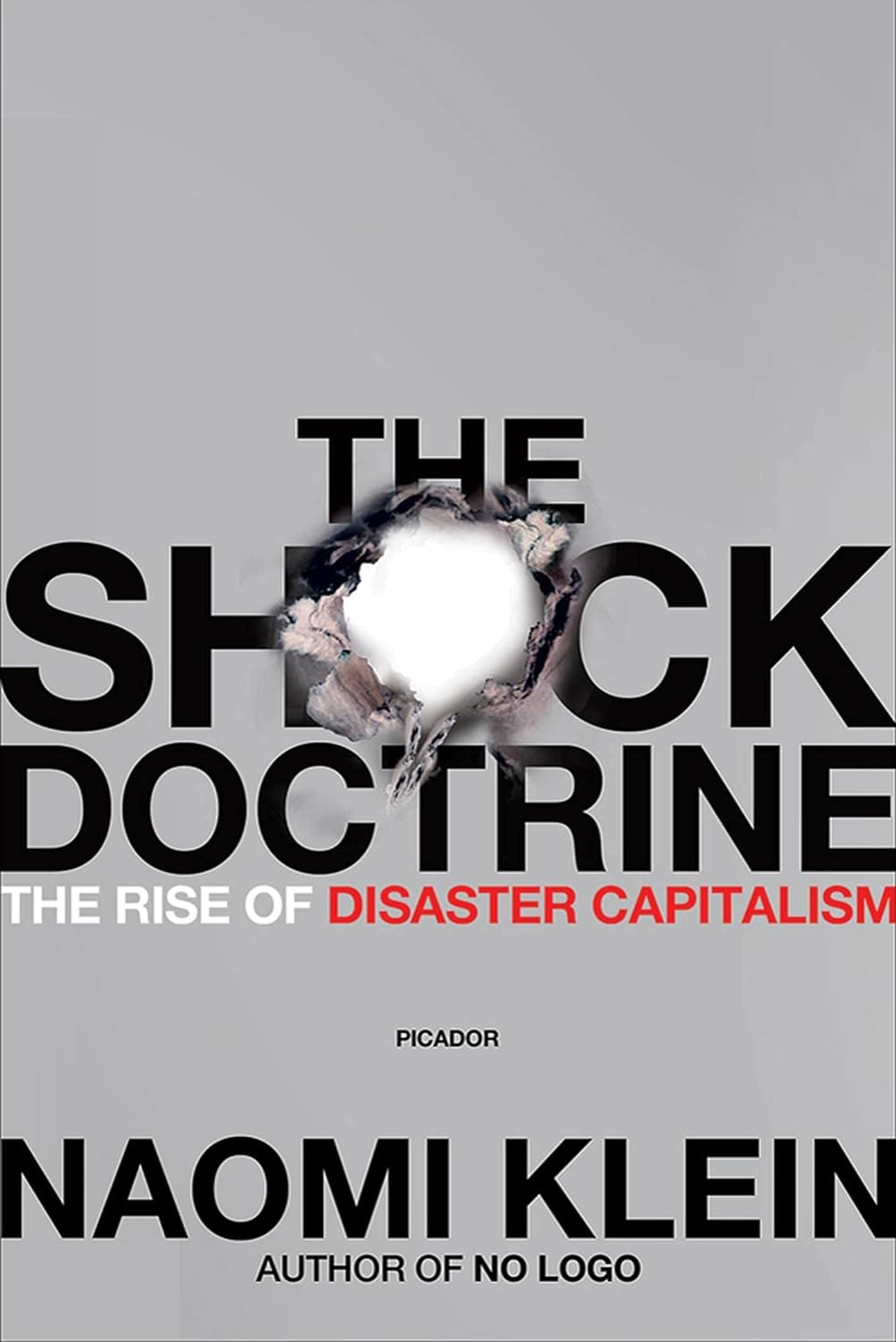
The Shock Doctrine - Naomi Klien
RECOMMENDED
NONFICTION
Started: Nov 21, 2021
Finished: Jan 21, 2022
Review
Notes
- [[Hurricane Katrina]] was used to remap [[New Orleans]] as mostly rich people talked about a clean slate and then never replaced [[affordable housing]] and turning [[public schools]] into private [[charter schools]]. Many saw this as reversing gains in [[civil rights]] as it left mostly the black population out of premium education. Page 5, 7
- These orchestrated raids on public institutions following catastrophic events is what the author calls [[disaster capitalism]]. An excuse to remake public institutions in a way that reduces access to all but those with lots of money
- [[Milton Friedman]] Page 6
- [[9-11]] seems to provide the [[United States]] an excuse to stop asking countries if they wanted the version of [[capitalist|capitalism]] the US had and the green light to bring it to them with military means. Page 10
- [[David Frum]] Page 13
**Purpose**
- to show that the migration of capitalism has not been the boon that many think. It has been preceded by huge shocks and brought by violence and coercion to break down the true desires of populations so democracy and capitalism could be enforced on them for private profit. Page 22
### Part 1 - Two Doctor Shocks - Research and Development
- [[McGill University]] Page 31
- [[electro shock therapy]] Page 31
- [[MKUltra]] Page 36
- [[sensory deprivation]] Page 38
- [[brainwashing]] Page 38
- [[Dr Ewen Cameron]] Page 31, and a bunch after
- [[Truth, Torture, and the American Way - The History and Consequences of U.S. Involvement in Torture 051120211638]] Page 47
- [[9-11]] Page 48
- [[Guantanamo Bay]] is really just a "leagalized" extension of the same torture methods that were started with [[MKUltra]]. By classifying people as enemy combatants they strip legal rights so they can be tortured. Even [[US Citizens]] have been subject to this stripping of rights and torture. Page 51 ^64d3d2
```
Chapter 1 talked about the "shock" of breaking people mentally which was used to study brainwashing. Really it gave North American 3 letter agencies a research department devoted to training them in effective torture. This torture training is still going on in Guantanamo Bay and is overlooked because people are designated as enemy combatants.
```
- [[Milton Friedman]] Page 57
- Friedman believed that perfect capitalism would produce the right amount of goods with the right pay for workers and we just get in the way. It was a perfect system that people just mess up. Page 58, 59
- [[capitalist|capitalism]] Page 58
- ideally Friedman and Chicago School economic thought would do away with fixed prices and [[minimum wage]] because that's just interference in capitalism which makes the system less effective. Page 61
- [[WWII]] Page 62
- [[John Maynard Keynes]], and the Keynes school of thought, said that a government should provide people with a minimum level of income and dignity. Hence [[minimum wage]] and other programs that put it in opposition with [[Milton Friedman]] and the Chicago School of thought. Page 62, 63
- In fact part of what [[Germany]] was rebelling against was all the economic measures they lived under after [[WWI]] combined with [[The Great Depression]] that had left them almost destitute. The population wanted some dignity and it's not to far from that to the [[WWII]]
- many [[United States]] national corporations looked askance at the strong [[unions]] in South America coming out of [[WWII]]. They didn't like being forced to distribute wealth to the working class instead of themselves and shareholders. Page 64
- [[robber baron]] Page 65
- [[Capitalism and Freedom 091120210933]] Page 65
- Government should stop regulation
- Government should sell off any part of their portfolio that business could run at a profit
- Government should cut back any type of funding for social programs
- Yeah that seems crazy to me. So no health care, no daycare. It would also have far more effect on [[women]] than [[men]] based on reading from [[Invisible Women - Criado Perez]]
- [[Stalinism]], [[Maoism]] Page 67
- [[Cold War]] Page 67
- [[United Fruit]] Page 68
- In 1954 the [[United States]] overthrew the government of [[Guatemala]] at the behest of [[United Fruit]] Page 68
- united was upset that the government had appropriated (and paid for) some of the land they had run because they were trying to gain economic independence for their country
- they even financed [[Chile]] students to go to the Chicago School and learn that basically everything their government did to protect it's people was a terrible idea. This was an end run around the government of [[Chile]] as their students that were qualified to advise on economics would come home to denounce and break down any [[social safety]] programs. Page 71
- [[Multinational corporations do not want countries to stop profits 091120211327]] Page 74, 75
```
After violent overthrow of governments with brutality you can use another shock to remodel the economy by selling off assets to businesses. It seems that the US was heavily involved in this and the went on to exploit the local resources without needing to contribute much to the national economy of the country they pilfered while paying as little as possible and having the ear of the rich ruling class to get the laws the wanted passed.
```
- [[exploitation]]
### Part 2 - The First Test
- [[Augusto Pinochet]] Page 87
- [[Chile]] Page 88
- [[Caravan of Death]] page 89
- so [[Chile]] was the first real wide test of [[Milton Friedman]] ideas and it was failing with inflation 2x that of the previous high. Of course those that supported the ideas kept saying it was the market's fault and you just needed to privatize more of it and take away more [[social safety]] nets so that the market could regulate itself. [[multinational corporations]] and a very small group of financiers were the only ones that were benefiting from the new [[capitalist|capitalism]] that was being brought to Chile. Page 94, 95
- by 1982 [[Augusto Pinochet]] had to nationalize a bunch of the stuff he had sold off because the economy was out of control due to corporations taking advantage of the rules. Page 99
- there are parallels between [[Chile]] as the richest got richer and many more people fell below the poverty line. Page 100
- The [[middle class]] shrunk substantially
- [[Roldolfo Walsh]] Page 110
- the language used by [[South America]] military revolutionists to justify killings and disappearance of citizens is similar to that used in todays [[war on terror]] Page 113
- [[Tags/terrorism]]
```
Summary of the military takeover in many South American countries and how the US backed them and how they benefitted the wealthy. The economic policy came from those that agreed with Friedman and crushed the middle class while making the rich more wealthy.
```
- originally the [[United Nations]] definition of [[genocide]] included wiping out people for *political* views. But in 1948 [[Joseph Stalin]] successfully lobbied to have *political* removed because he knew that if it was included his actions would be considered genocide. Page 120
- In [[Chile]] there is ample evidence of [[multinational corporations]] benefiting and supporting the regime. [[Ford]] took out a full page ad aligning itself with the regime in 1976. Page 127
- This was the same regime that would round up [[unions]] leaders in these coroporations which enabled them to still pay low wages, force long hours and poor treatment. The regimes also allowed money to flood home unhindered instead of keeping much of it local to serve the economy that the corporation was exploiting
- [[Ford]] also did this openly in [[Argentina]] with active [[unions]] members being pulled off the line by soldiers and a permenant garrison stationed at the factory. They also rolled back all worker rights that had been agreed to prior to the coup on the very day the coup happened. Page 129
```
Recapped some of the atrocities visited by the new "leaders" that capitalism put in place in South America. Strong correlation to [[residential schools 050120210620]] and [[Canada]] treatment of stealing [[first nations|first nation]] children to indoctrinate them in [[christianity]] and [[capitalist]] ways which were approved by the new government.
```
- despite disagreeing with the [[authoritarian]] and repressive policies of [[Chile]] [[Milton Friedman]] didn't think it was wrong to offer them economic advice. Page 139
- Yeah I just don't think I could stomach that. There are some things you do that simply are a bridge too far and you can't collaborate with people doing that crap
- This is very similar to continuing to talk with [[white supremist]] groups. You have to put your foot down sometimes and say "no further"
- they framed the [[human rights]] abuses as narrow in scop and over each instead of a system that was being employed specifically to undo connections and redo them so [[capitalist]] ideas would work and [[multinational corporations]] could flourish. Page 140
- [[Amnesty International]] Page 140
- Many international [[human rights]] groups didn't connect the atrocities in South America back to their sources of [[multinational corporations]] and [[capitalist]] ideas because the money to finance their work came from the same corporations. Page 144
- Denouncing capitalism at the time was also bad because it was the [[Cold War]] and you didn't want to be seen as pro-[[Russia]] or pro-[[communism]]
- when your [[economic policy]] is very unpopular with huge segments of your population it has to be enforced with violence. Page 148
- Those that aren't at the top of the monetary chain don't have money to lobby so they demonstrate and strike and you have to put that down with violence
```
Looked at how Friedman and the US abdicated any responsibility for the murders going on in South America.
```
### Part 3 - Surviving Democracy
- [[Margaret Thatcher]] Page 155
- While [[Richard Nixon]] has supported the economic policies of [[Milton Friedman]] in South America he didn't follow them in 1971 because he knew that if he didn't cap the price of necessitities he'd be voted out of a job by a population that couldn't afford to live. Page 157
- Funny how so many of these ideas are good for some other nation, but would never fly on home turf
- [[The Falkland's War]] Page 162
- [[The Enemy Within - Thatchers Secret War against the Miners 301120210634]] Page 164
- [[Bolivia]] Page 169
- [[Jeffery Sachs]] Page 170
- The rising economics star at [[Harvard]] that thought he knew everything he needed to know about [[inflation]] so he could dig [[Bolivia]] out of it's hyper-inflation
- Ultimately, it sounds like [[colonialism]] thinking. That white people have the smart ideas and everyone else is backwards to be helped.
- The [[United States]] ambassador [[Edwin Corr]] had made it clear that US aid would follow if [[Bolivia]] adopted the radical economic reform of dismantling state run organizations. Page 175
- It may have looked like a lifeline, but the US was complicit in starting the economic problem anyway.
- And of course many US companies were the beneficiaries of the dismantling of the state run assets. [[multinational corporations]] made a killing while the poor suffered
- sure the new economic plan reduced [[inflation]] to 10% in 2-years, which is amazing, but the brunt of the medicine is taken by the poor while the rich continue to get richer. Page 177
- The new plan in Bolivia increased unemployment to 25-30%
- Real wages were down 40% in two years
- Hundreds of thousands of good jobs with pensions were erased and replaced with precarious work at lower pay with no benefits of any sort. Page 178 ^bf5833
- That sounds much like the [[gig economy]] we have now.
- The change in Bolivia simply widened the gap between those at the lowest end of the economic spectrum and those at the highest end
- Many of the poor had to become coca growers because it paid 10x more. The irony of this is that the US stepped in to stop this growth because that plant turns into [[cocaine]] so look another failure of the [[war on drugs]] Page 179
- While [[Bolivia]] didn't resort to murder, they did take labour and union leaders away during transformation. They were in jails in the jungle with their movements restricted until the plans were in place and unions had signed agreements under duress of having their leaders kidnapped. Sure it was mostly bloodless, but it wasn't without the strong arm of police and military forcing it. Page 183
- New Democratic governments in South America were forced to take on the debts of the regimes that had spent years killing them. This is how the [[United States]] forced control on the regions. Page 187
- Many [[multinational corporations]] also had dictatorships agree to take on their debt. That meant they got to hold their assets but the people of the country they had [[exploitation]] had to pay the debt. Of course many of these companies have roots in [[United States]], [[Canada]], and [[Europe]]. Page 188
- Would we let that happen in our countries or is that only something good enough for our companies in other countries?
- Then the [[United States]] Federal Reserve, headed by [[Paul Volcker]] let [[interest rates]] rise to 21% which made these countries unable to pay just the interest payments that were required. They became involved in a debt spiral, borrowing to pay off the interest owed. Page 190
```
Institutions from the [[United States]] like [[World Bank]] and the [[International Monetary Fund]] tied any support of governments to their shock policy of deregulation and privatization. Forcing policies that countries didn't want on them.
```
- feels like [[white conceit]] that our way is the best way so we'll just force it on you
### Part 4 - Lost in Translation
- [[authoritarian]] regimes have a habit of embracing [[democracy]] just as their [[economics]] ambitions are about to implode. Page 210
- Evidenced here by the 1988 elections in [[Poland]] that [[communism|communist]] [[Moscow]] allowed due to a collapsing [[Poland|Polish]] economy that was further interrupted by the striking workers of [[Solidarity]]
- confident that the worse they let [[Poland]] get the more open they'd be to the type of open [[economic policy]] they preferred, the [[IMF]] didn't offer help. In fact the [[United States]] insistent on debt repayments that the previous regime had accrued. PAge 211, 212
- This is like having to pay for your rapists therapy bills. They abused you, why do you have to keep paying for it?
- The only way [[Poland]] would get support was if they sold off state assets and stopped price controls. This was in exact opposition to their desire to have factories and shipyards as worker controlled assets that the workers could gain value out of. Page 213
- This of course fit into outside [[multinational corporations]] purchasing the assets and then making people work for them without accruing any real value from their work
- [[Jeffery Sachs]] also failed to mention that the plan he outlined only worked in [[Bolivia]] because they kidnapped [[unions]] leaders and used [[Tags/violence]] to enforce the policies
- [[Tianamen Square]] Page 221
- As usual [[Milton Friedman]] didn't see any connection between his economic advice and the violent crackdown that enforced them a few months later. Page 229
- In the years after 1993 [[Poland]] reform under [[Solidarity]] was held up as a success, even though it was a myth that ignored the suppression of workers and the stopped [[privatization]] of state assets. Page 232
- [[South Africa Apartheid]] Page 234
- the world [[infantalized]] [[ANC]] and took away any real power they had to rule and improve the lives of common citizens through economic negotiations that ANC wasn't able to recognize for the power grab by [[American]] interests and [[multinational corporations]] that they were. Page 245 ^d58b8e
- While the South African Truth and Reconciliation Commition is often held Up as a successful model, those that served on it are more circumspect. The government did **not** hold business accountable for the benefits received due to oppression and instead pulled any money out of their own budgets, as the commission feared would happen. Page 253
- the commission largely dealt with only the outward dealings of oppression, [[torture]], and left the economic systems of oppression in place functionally continuing the oppression.
- It was up to the government to really make these changes though based on recommendations and they balked at the changes that may be anti-business.
- [[South Africa]] has ended up in a reverse [[repatriation]] as they continue to send payments to the white government employees that oppressed them and none of the oppressive elements are paying a penny in repatriation. Page 256
- [[Mikail Gorbachev]] Page 262
- [[Boris Yeltsin]] Page 265
- In 1991 Boris asked for, and was granted, special powers to bring in laws by decree bypassing parliament. He used this to create economic shock and privatize industry, to his cronies. In march 1993 parliament voted to revoke his powers and he declared a state of emergency, which granted him the same powers again. He seems to have become enamoured with the power. Page 271
- while [[communism]] may have collapsed without a shot fired Chicago style [[economics]] reform could only happen with violence. Page 275
- Back to [[Unpopular Economic Policy is Put Down with Violence]]
- [[The Tragedy of Russia's Reforms - Market Bolshevism Against Democracy 202201081040]] Page 275
- [[The End of Poverty - Economic Possibilities for Our Time 202201081044]] Page 276
- The only thing that [[Boris Yeltsin]] didn't do in his economic reforms was to open newly privatized [[Russia]] business to [[multinational corporations]] outside Russia. He kept the money in the Russian family creating [[oligarchs]] of russia. Page 278
- once you accept that profit and greed are a help to the economy pretty much any act that enriches you can be viewed as helping a failing economy regardless of the [[morality]] of your actions or the [[legality]] of them. Page 283
- [[George Soros]] Page 283
- As [[Boris Yeltsin]] exited power he demanded immunity from prosecution. [[Vladamir Putin]] signed that immunity as one of his first acts in office. This made Yeltsin immune to prosecution for the military murders he presided over or the corruption he furthered in the economy. Page 285
- under [[capitalist|capitalism]] Russians drink more than twice as much as they did under [[communism]] Page 286
- [[alcoholism]]
- There was no [[Marshal Plan]] available for [[Russia]] when the [[Soviet Union]] collapsed because they were the cause of it. With [[communism]] looming the west had to win over the people of [[Germany]] and thus the Marshal Plan did that without privatizing everything and making profits off the country. Without the "loaded gun" of [[communism]] this was no longer needed to keep people from leaning towards it away from [[capitalist|capitalism]]. Page 302
- [[Canada]], [[economics]], [[economic policy]] Page 309
- Specifically stuff around 1993 and [[Liberal]] election to office and cuts to [[social support]] programs. Banks and the media egged on dire news about Canadian debt, but it was all a lie to get the cuts put through under a "shock" because Canada had "too much debt." None of the true agencies that rated credit for countries had any concern about Canada.
- The [[Asian]] economic collapse of 1997 again seems like [[North American]] countries allowing an action to happen in another country, even encouraging it is a market correction, that they'd never allow in their own country. Page 321
- Similar to what we saw in [[The Devils Curve - Arno Kopecky]] and [[resource extraction]] by [[multinational corporations]]
- A continuation of [[Multinational corporations do not want countries to stop profits 091120211327]]
- [[China]] was the only Asian country to keep it's capital controls in place, ignoring advice from the west, and it was not being ravaged by the economic issues like the rest of Asia was. Page 323
- [[Alan Greenspan]] Page 322
- the [[IMF]] "help" during the [[Asian]] collapse only enforced that the area was in dire straights and even more people pulled out faster when they were through. Plus these countries were loosing their industry to privatization. Page 327
- the biggest price was paid by women an children. [[Child prostitution]] increased by around 20% and many rural families sold their daughters into the [[sex trade]] to be used in [[Australia]], [[Europe]] and [[North American]]. Page 328
- of course the [[United States]] then had people in the country scolding it for these practices, which was the end result of the [[economic policy]] that the US was pushing on the area
- but of course [[multinational corporations]] and [[Wall Street]] used the calamity to snap up firms in [[Asian]] at bargain prices so did the [[IMF]] really fail or did they just serve the interests they most closely interacted with back at home? Page 330
- all this while the [[United States]] still does protect it's own domestic industries. It just doesn't want that to happen in any other country Page 336
- much like we saw in [[The Devils Curve - Arno Kopecky]] with poor environmental policies pushed for by Canada that they would never allow in their own country.
- It's also [[white conceit]] that our practices are best and any other idea is wrong. [[Canada]] inflicts this on [[first nations|first nation]] all the time like in the [[Unpopular Economic Policy is Put Down with Violence]]
- and [[The Banana Massacre]] reinforces this idea
### Part 5 - Shocking Times - The Rise of the Disaster Capitalism Complex
Former US officials like [[Henry Kissinger]], [[Donald Rumsfeld]] and others failed to recuse themselves from their investments that would directly benefit them while in office. There seems to be a door between awarding contracts to companies US officials have stake in and those officials in office. This makes it hard to see anything but profit motive in the wars the [[United States]] has engaged in in [[Iraq]] and [[Afghanistan]] in recent decades.
#### Notes
- [[Donald Rumsfeld]] Page 339
- he used lots of fancy words, but really he changed the military into something that outsourced a bunch of it's work and made private companies rich. Page 341
- he [[privatization]] the [[United States]] military
- In [[1950]] with [[polio]] cases close to 60,000 parents were terrified that their children would get this disease. The polio vaccine was not [[patented]] by [[Jonas Salk]]. Page 348
- and that's far fewer cases than we have with [[COVID 19|COVID]] in a single province, yet we don't seem nearly as concerned about it
- so [[Dick Cheney]] had defense company [[Halliburton]] do an audit on aspects of the [[United States]] military that could be run by contractors. They found lots, and then there was a bid for a [[cost plus]] contract, which Halliburton won. Then Cheney left public office and started to help run the company and the loosely worded contract that he helped write alongside them was continually stretched to allow Halliburton to do more and more and always make a profit. Page 350
- if that's not some [[collusion]] I'm not sure what is
- [[9-11]] Page 354
- Was a shock to the world that means the [[United States]] was able to bring in [[mass surveillance]] and enhanced border control via [[Homeland Security]] which is a lot of outsourcing to the private sector. Page 363
- As of December 2006 of the 360 prisoners released from [[Guantanamo Bay]] 245 of them were entirely cleared of any charges when they returned to their home countries. Page 367
- pretty bad track record, but when you're offering decades of money to locals to turn someone in, they'll manufacture evidence so they can support their family.
- [[Overthrow - America's Century of Regime Change from Hawaii to Iraq 202201151145]] Page 372
- says there are 3 stages to the United States engaging in overthrowing a [[regime]]
1. US based [[multinational corporations]] faces some kind of threat to it's bottom line.
2. US policitians transform the motivation from an economic one by the country to a direct attack on the [[United States]]
- said country must be [[dictatorial]], and anti-American
3. Politicians sell the need for intervention to the public as a broad struggle of good vs evil.
- [[Saddam Hussein]] didn't pose a threat to [[United States]] security, he posed a threat to US energy companies due to his recently signed contract with [[Russia]] oil giant and [[France]]. This left US companies with nothing to profit from in the country. Page 376
- with [[Saddam Hussein]] out of power many US [[multinational corporations]] have purchased and profitted from the oil reserves they previously had no access to
### Part 6 - Iraq, Full Circle
Detailed the many failings of the [[war on terror]] in [[Iraq]] towards the people of the country. When the [[United States]] was confronted with a population that wanted democracy, but not [[privatization]] they called off [[democracy]] and [[election|elections]] that were run by the people and appointed the councils. The only thing the war seems to have done is enrich [[multinational corporations]] and [[torture]] the [[Iraq|Iraqis]] people in the name of profit. Much was spent, and little was left for the country to rebuild itself.
#### Notes
- in March 2004 the author had to argue that the economic angle was important to [[Iraq]] on the ground. Of course due to the shock doctrine most of the locals were simply worried about bombs and getting "disappeared" into [[United States]] run prisons. The shock doctrine was working because they didn't have the effort to worry about the long term economic sale of their private resources. Page 392
- the war in [[Iraq]] was sold as a hunt for [[weapons of mass destruction]] because that's something everyone could get behind. It allowed the political agenda to be right for the raping of Iraq's economy by [[multinational corporations]] Page 394
- after the bombing of the telephone systems and then the lights, the looting began. Many native [[Iraq]] people believe that it was intentional by the [[United States]] to steal their culture and any sense of self. This does line up with the [[interrogation]] methods used of stripping people and treating anything they hold sacred as worthless. Page 405
- [[Koran]] thousands of years old were stolen. Museums with national history were looting and bombed.
- The goal of the [[United States]] was to create a new nation, one modeled after what they thought was best. That ignores the long history that was in [[Iraq]]. Page 405
- Similar to how [[Canada]] has treated [[first nations|first nation]] as they assume whatever culture they had wasn't "white" so didn't count. [[white conceit]]
- The [[United States]] learned from [[Russia]] and didn't let most of the profits of [[privatization]] go to locals. They changed the laws to allow 100% ownership by [[multinational corporations]], cut corporate taxes and in general made it a favourable feeding ground for profits for their buddies. Page 614, 615
- contractors preferred to import their cement at 10x the price instead of suppling [[Iraq]] cement factories with generators to produce it locally. When you have a [[cost plus]] contract you don't care about the cost anyway, and why would you let any money stay in the local economy. Page 420
- With 186 million in hand to build 142 health clinics only 6 were built in [[Iraq]], some of which were so terrible they were entirely unusable. Page 430
- This is one big reason why [[Iraq]] people were unhappy with the reconstruction. Nothing got built while [[multinational corporations]] made millions and then blamed the locals when they stood up for themselves.
- if the reconstruction in [[Iraq]] had provided jobs and the social support that were promised then many of the men involved in [[militia]] would have been employed and not had a willing angry public ready to support their violence against reconstruction, which turned into violence on a larger scale in [[Iraq]] Page 432
- instead of being shocked into complacency [[Iraq]] nationals wanted a say in their own reconstruction and the [[United States]] wasn't ready prepared to do that. They were prepared to let their buddies make money off the backs of Iraq. Page 435
- The the [[United States]] said they would involve [[Iraq|Iraqis]] in decisions, they found that the locals didn't want to do things they way the US wanted. So they violently suppressed them and [[infantalized]] their ideas. This is [[white conceit]] in action. Page 437
- [[Cobra II - The Inside Story of the Invasion and Occupation of Iraq 202201181006]] Page 438
- [[Abu Ghraib]] page 443
### Part 7 - The Movable Green Zone
#### Notes
- [[Tamil Tigers]] Page 444
- the [[2004]] [[tsunami]] in [[Sri Lanka]] did what protests of expat hotel owners couldn't, it cleared the beach of the local fishing structures. Now the government is "building better" which means focused towards industry leaving the fishing locals who have been there for generations out in the cold looking for a way to support themselves. Page 445
- local fishing people are not allowed to build within 200m of the beach, but if a hotel says the work is "repairs" it doesn't matter how elaborate the work is they can do it.
- money was raised off the backs of the victims, the fishing people, but it wasn't used to improve their lives
- The [[United States]] back plan for rebuilding [[Sri Lanka]] was about improving [[tourism]] by keeping the fishing to industrial trawlers and away from locals. That way the beaches would be free for hotels and the undesirable locals wouldn't get in the way of rich tourists. Page 472
- As usual mass layoffs and increased prices were called for. This is fine for the rich tourists but means that the displaced locals can't afford to live and are driven into poverty
- this was 2 years before the Tsunami and the local people voted no, bringing in parties that stood specifically against it.
- Then after the tsunami the parties reversed course to get aid dollars and started with [[globalism]] while the locals were just thinking about the death that had happened and couldn't put up any resistance
- the commission to rebuild [[Sri Lanka]] was mostly hotel groups and business people. No one representing the local fishing people or from agriculture at all was there. Thus the hotels were exempted from the buffer zones and money went to deep water ports and industrial fishing. These industries were voted against by an overwhelming majority every time they were put forward as good. Page 478
- Of course the [[United States]] linked their relief to efforts that would yield profits for US companies regardless of how bad they were for locals
- [[terra nullius 1]]. Page 483
- [[Hurricane Katrina]] Page 489
- in the midst of this the author was in a car accident. She ended up at a very nice hospital that was not overwhelmed. The people she talked to didn't even see the overwhelming black population of [[New Orleans]] as prospective patients of their hospital
- despite proof that warming oceans contribute to stronger hurricane's [[George W Bush]] pushed through with more oil harvesting as a response to [[Hurricane Katrina]] at the prompting from [[Milton Friedman]] disciples recommended it. Page 491
- Along with taking away [[living wage]] requirements for government contractors
- In 2007 the [[American Society of Civil Engineers]] said that the [[United States]] had fallen so far behind in maintaining it's [[public infrastructure]] that it would take more than a trillion and a half dollars over 5 years to bring things back up to standards. Page 499
- Of course we also learn from [[Strong Towns - A Bottom-Up Revolution to Rebuild American Prosperity - Charles Marohn]] that the way cities are built in [[North American]] means there is never enough money to fund the infrastructure that a subdivision sits on
- [[Blackwater]] Page 500
- [[guns to caviar index]] Page 510
- with so many companies benefiting from [[Tags/terrorism]] and [[war on terror]] it's easy to see why [[conspiracy theory]] abounds and people think that these emergencies are engineered for profit. Page 513
- While [[Israel]] shook hands in 1993 for the [[Oslo Accords]] with [[Palestine]] they quickly realized they didn't need Economic integration with their Palestinian neighbours. They specialized in the disaster and military complex. This left them positioned well to take advantage of the aftermath of [[9-11]]. They could keep that work in house and walled off [[Palestine]] while their own businesses profited. Page 525 and before
- the decision to put [[counter-terrorism]] to the forefront as something to export by [[Israel]] has coincided with it's abandonment of peace negotiations. Page 528
- Why work for peace when war is so profitable for the economy?
- everywhere the ideas of [[Milton Friedman]] have triumphed we have seen the rich becoming super rich while the working class is turned into the disposable poor. Page 534
- See [[How this All Happened 202201241113#^bca76d]] to see groups that are pushing back against an economy that isn't what they want
- [[Conrad Black]] Page 536
- in the [[United States]] rage at the shrinking [[middle class]] has resulted in border fences to stop the [[illegal aliens]] stealing "our" jobs. Page 539
- It resulted in [[Donald Trump]], who really didn't care about those people anyway and just used his time as president to enrich himself
- while people say that [[socialism]] was "defeated" what really happened was that when people groups tried to push towards any type of socialism [[democracy]] was enforced with violence. See [[Solidarity]] and [[Poland]], where people were violently put down for trying to stick with the worker's rights they voted for. Page 542
- [[Open Veins of Latin America - Five Centuries of the Pillage of a Continent 202201310634]] Page 545
BLOG POSTS ABOUT THIS BOOK
Democracy for Me, Poverty and Exploitation for Thee
Nov 09, 2025
The Smart Home, Dumb Trade-offs, and Tunnelling Tax
Oct 25, 2025
Technology Access does not mean success - 3 Threads
Apr 20, 2024
Some Books that Show how Lame AI Is
Dec 09, 2023