This was our book club book for April. Next month we're reading Subtract by Leidy Klotz.
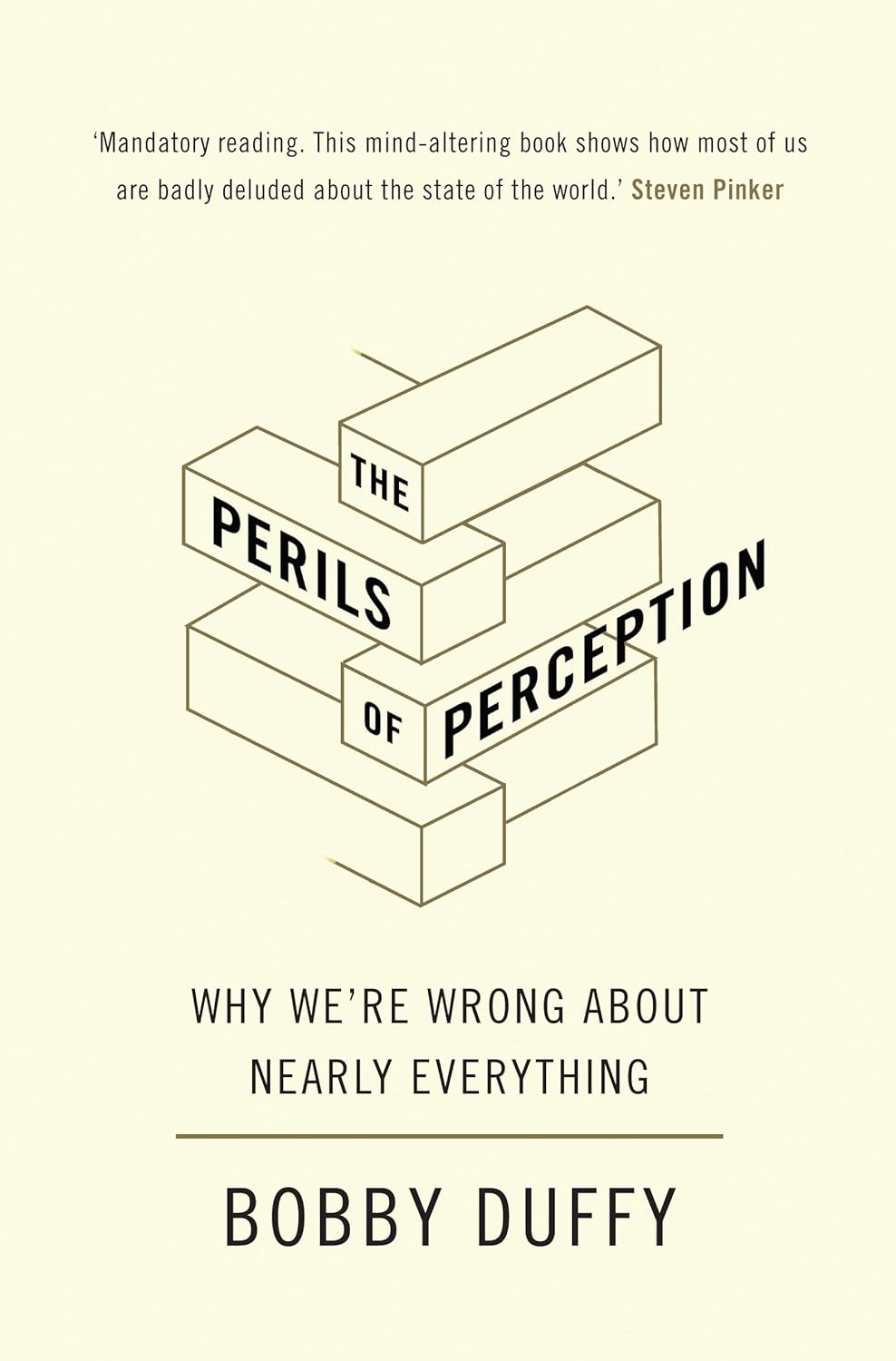
When I started this book I was hopeful that it would help further my understanding of cognitive biases and how to talk with people with divergent opinions. Unfortunately, Duffy's book is heavy on a bunch of trivia about our misperceptions and light on what we do about it at a societal level. In this regard books like The Data Detective and Think Again offer a much better read. The Data Detective goes far deeper into how to combat our cognitive biases and see a path through to rigorous thinking about statistical matters. Think Again is far better for showing us how to converse with those we don't agree with.
Duffy works to help us frame our conversations and our perceptions around reality, but does little to show us how this is used in the real world to influence perception. Here Dark PR does a far better job at showing us how cognitive biases are used by companies to influence how we frame the conversation around their, sometimes appalling, products.
Duffy's book has a few points that I can see myself continuing to reference though. First, we tie ourselves too closely to the opinions we hold, often defining our identity as a human by an idea1. Once we've tied our identity to an idea, changing our mind feels like turning our backs on something fundamental inside ourselves, thus we're far less likely to be willing to investigate opinions that dissent from our identity. This also ties into work done in Think Again, because trying to convince someone of a different opinion may in fact be asking them to turn their backs on a crucial part of the identity they've given themselves.
Second, it's interesting to note that we figure most people agree with the beliefs we have2. That means that those you differ from, figure that most people agree with them just as you assume that most people agree with you. This false-consensus bias can mean you're less likely to evaluate your stance because you figure you're on the correct side and most people would agree with you.
While I said that Duffy doesn't spend much time telling us what to do about misperceptions, he does actually devote the last chapter to it. Unfortunately, the 10 rules3 he provides us are mostly just chapter title recaps with little in the way of actionable advice the reader can take away. His last rule is really just an encouragement that we can engage deeper, without much in the way of how one would go about doing that.
Should you read The Perils of Perception by Bobby Duffy? No, I think that any of the three books I cited above are a far more complete look at the topic of how to deal with our misperceptions, and talk with those that we disagree with.
Footnotes
1 The Perils of Perception Pg 65
2 The Perils of Perception Pg 191
3 Starting on The Perils of Perception Pg 238