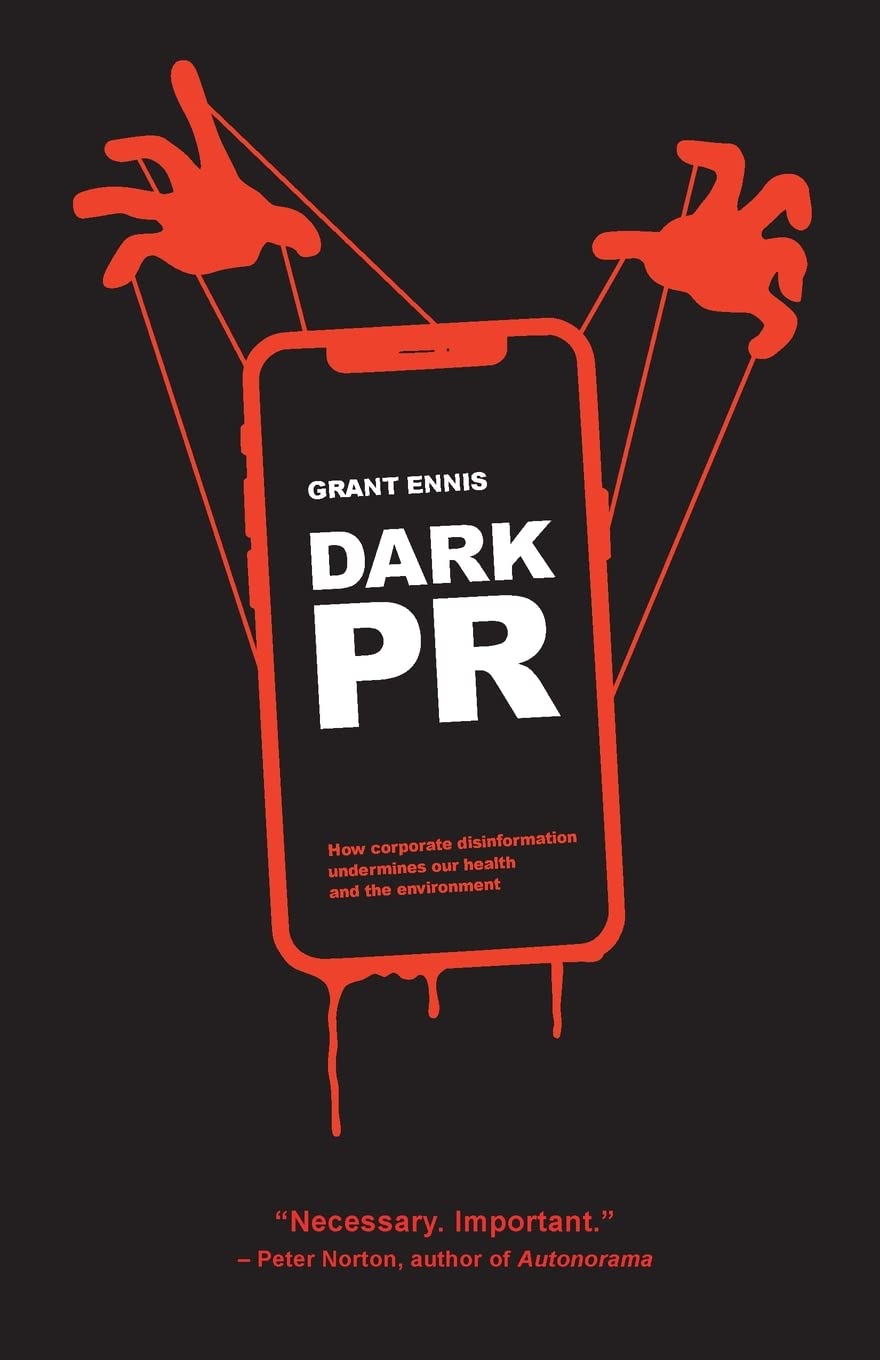
Dark PR - Grant Ennis

Dark PR - Grant Ennis

Grant Ennis

RECOMMENDED NONFICTION

Started: Feb 08, 2024

Finished: Feb 11, 2024

Review

Dark PR walks readers through all the "framing" companies do to minimize their responsibility so that they can keep doing the terrible shit they are doing. From car companies showing us all their "magic" features that will save lives, to blaming some random person walking on the street for not being visible enough (victim blaming) and giving them some part of the blame in their own death instead of putting it squarely on the car centric culture we have in North America, Grant Ennis walks us through many ways that media is framed so that we can see through the bullshit.

I'm going to add all the frames that Ennis gives us to my list of mental models I use to filter the content I take in.

Purchase on Bookshop.org

Purchase Dark PR on Amazon

Notes

> Industry pollutes the scientific literature on purpose so they can argue the data is inconclusive. Pg XVII
- [[manufactured doubt]]
- in regards to the food industry funding studies to put off the scent of highly processed sugar foods being "bad" for you

- one way of lying is normalization, like calling [[COVID 19|COVID]] just "the flue" Pg 3

**Purpose**
- to help us identify and understand the ways in which corporations frame the narrative to their benefit. Pg 6

**Structure** Pg 7
- Part 1: showing us cross-industry playbook for 9 devious frames used to divert attention and undermine citizens
- Part 2: Shows what the global reform movements are up against in the industry

## Intro

- personalizing stories of heroes and victims obscures the political structures that have created the need for a hero in the first place. Pg 9

- when you hear about a [[tax break]] or favourable land use codes think [[government subsidy]] Pg 10
- the money is just not coming into the government so they're still giving away income that should be their's. It simply looks better and gets less questions if they stop it from coming in the backdoor instead of spending it out the front door. There really is very little difference

- [[crony capitalism]] Pg 13
- [[Smart Growth - Jon Reeds]] Pg 16
- [[climate change|climate crisis]] Pg 18, 19

- by subsidising the oil and gas industry we are funding the [[climate change|climate crisis]] Pg 19
- [[Triumph of the City - Edward L Glaeser]] Pg 20

## Part 1 - The Nine Devious Frames

- [[Don't Think of an Elephant! - George Lakoff]] Pg 25
- the father of how to "frame" your message so it's received as you want it, regardless of what the message really is
- [[The Press Effect - Kathleen Hall Jamieson Paul Waldman]] Pg 25
- on Pg 28 he summarises the 9 frames in a chart

### CH 1 - Big Lies

#### Frame 1 - Denialism Pg 30

- when studies say that [[sugar]] causes [[diabetes]], corporations fund studies to produce counter conclusions. Pg 30
- this is [[manufactured doubt]] or as it's called now, fake news
- all they need is one or two studies to gain some traction and they'll hold them up, even if 95% of the scientific work doesn't support the conclusions they like

- relentless calls for scientists to provide more evidence about the [[climate change|climate crisis]] is pure performance to sew doubt and make it seem like the issue is unsettled so it can be denied and any action can be delayed. Pg 31

#### Frame 2 - Post-Denialism

- like when [[Ron DeSantis]] said slavery was "good" for black people because they learned skills at the expense of their owners. It reframes bad as good

- people are willing to commute for an hour by any means so as speed goes up they travel further and [[sprawl]] happens. Pg 34

- [[Sprawl Kills - Joel S Hirschhorn]] Pg 35

#### Frame 3 - Normalization Pg 36

- [[Biased - Jennifer L Eberhardt PhD]] Pg 36

- we need to [[destigmatize]] without normalizing. Pg 36
- destigmatize is to remove the negative attitude to something like [[obesity]]
- normalization is used by food companies to imply obesity is inevitable and thus not the fault of their products

- we normalize [[cars]] crashes by calling them accidents which makes them feel like just a part of life. Pg 39
- accident was adopted and pushed on purpose by auto interests in the 1920s due to the outrage of people at being killed by cars on roads.

### CH 2 - Panacea Frames

- these generate the appearance of sufficient action while at best doing nothing and at worst doing the opposite of what we think they're doing. Pg 45

#### Frame 4 - Silver Boomerangs Pg 45

^321ca5

- like [[smoking|cigarette]] filters giving the appearance of better health in smoking but they cause deeper inhaling so do nothing to make smoking safer. Pg 45
- they provide the illusion of a solution but "boomerang" back to diminish any gains

- [[compensatory health belief]] Pg 47
- After a workout we eat more than we burned figuring we "earned" it

- car companies tout their safety features, which have no evidence to support a drop in car crashes because it makes us feel their tech will save us instead of us getting policy that reduces car dependence which would hurt their bottom line Pg 52, 53
- we trust [[self-driving vehicle]] features and thus pay less attention to the road and crashes stay at the same rate or increase

- we leave "energy efficient" LED lights on longer because it's not a bit cost thus usign the same or more energy Pg 55

#### Frame 5 - Magic

^7b06ac

> Corporate framing preys on our collective desire to abdicate responsibility by deflecting blame and pinning our hopes on fanciful notions. Pg 56

- like "magical carbon capture" as a solution to the [[climate change|climate crisis]], which has dubious efficacy at best

- sugar companies say genetics are the leading cause of diabetes so a magical future gene therapy will fix stuff and they don't have to do anything about the product they sell and people shouldn't change anything about their consumption because it's part of their genes anyway. Pg 58, 59

- [[carbon capture]] doesn't work but appears to kick the can down the road so we can keep consuming now and let others worry about it. Pg 61, 62

#### Frame 6 - The Treatment Trap

- companies support treatment because it allows them to keep selling their products. Prevention would mean they have nothing to sell and would hurt their bottom line since they can't sell us the treatment medication/products. Pg 63
- Nestle even sell their diabetes treatment products while selling the sugar products that create the problem

- [[McKeown Thesis]] Pg 64
- that prevention and stuff like good food and water access has done more for human longevity and health than new medical treatments for issues.

- [[Unsafe at Any Speed 300120211407]] Pg 65

#### Frame 7 - Victim Blaming

^89f307

- corporations benefit when they transfer attention and responsibility from the political landscape that enables their bad practices and harm and point towards your personal responsibility and will-power. They make it an individual problem. Pg 71
- think about the invention of your [[personal carbon footprint]] making it our fault even though most carbon is not produced by individuals but corporations

- the more women were exposed to the ideas from [[Lean In - Sheryl Sandberg]] the less likely they were to support political changes that would help gender equality. Pg 73
- should read this again [[Opinion | Enough Leaning In. Let’s Tell Men to Lean Out. 202007040808]]


- [[No Local - Greg Sharzer]] Pg 74
- local efforts like farmers markets have a limited effect and do little to change the corporate environments that immiserate so many lives.

- food corporations support campaigns that say it is our choice to eat healthy while selling us crap food because it diverts any blame for our food supply from their supply to our choices. Pg 78
- [[social media]] is the same as it makes it our own choice to scroll while encouraging us to scroll

- [[Blaming the Victim - William Ryan]] Pg 79

- [[jaywalk]]ing is an invention of car companies to shift the blame from cars which were newly taking up the road space to walkers who were using a right to space they had always had. Pg 84

- [[There Are No Accidents - Jessie Singer]] Pg 85

### 4 - Complicated Frames

#### Frame 8 - Knotted Web Pg 105

- they say it's complex so you can't draw any cause conclusions and it certainly couldn't be oil companies at fault for the [[climate change|climate crisis]] issues because there are other factors to consider. Pg 105
- they mask the origin of the problem under layers they want you to consider

- [[Farnham Street]] site reference Pg 105
- [[complexity bias]] Pg 105
- our tendency to look for complex solutions where a simple solution is the answer. We use this to not even bother trying to understand things because "it's too complex"
- see [[Complexity Bias - Why we Prefer Complicated to Simple - Farnham Street]]

#### Frame 9 - Multifactorial Pg 107

- blame other factors as having an impact even if it's a small impact thus diverting attention from the main issue. Pg 108

##### Form 1 - Bad is the Bad

- suggest a mix of other devious frames without any suggestion of evidence based action to be taken. Pg 109
- mix [[Dark PR - Grant Ennis#^7b06ac|magical frame]] with [[Dark PR - Grant Ennis#^321ca5|silver boomerangs]] and if we do those it should solve the issue, but we present no evidence for that working

- the idea that solutions which do nothing on their own will somehow combine to fix things

##### Form 2 - The Good in the Bad Pg 112

- toss in some good stuff, like reducing car dependence but mostly focus on other devious frames like education (so you make better choices) and victim blaming
- so it's throwing a small bone in a large pile of crap

##### Form 3 - The Big with the Small Pg 113

- think global, but act local Pg 113
- so don't act global because in truth that would harm the prospects of the companies and local action doesn't do that much

- Kraft foods acknowledges obesity and diabetes epidemics world wide but says the focus in on your personal diet and lifestyle not stopping their shit food. Pg 114

- [[Hidden Arguments - Sylvia Noble Tesh]] Pg 114

- political will is a zero sum game. You just need to convince the right people at the right time. Pg 116
- like politicians right before a vote or enough people to muddy the waters

## Part II - Citizen Activism and Its Enemies

### 5 - Atomisation of Dissent Pg 123

- make it about singular heroes because organised citizens have real power which is feared by authority. Pg 124
- organised citizens can get stuff done. Singular heroes just show up in the news and little happens

- what is atomised action?
- how you vote
- the purchases you make
- instead of making a wider change so that the only purchases available are responsible ones
- individual protests

- organised
- [[unions]], group alliances

- [[Arab Spring]] Pg 124

- [[voting]] is only the start. You also have to hold politicians to account for their actions. Your political involvement needs to go past the ballot box. Pg 125
- corporations lobby all the time not just at the time of voting

- [[Inventing the Future - Nick Srnicek Alex Williams]] Pg 127
- [[Cascades How to Create a Movement that Drives Transformational Change - Greg Satell]] Pg 128

- consumer action to purchase ethically or boycott on average have no financial impact on firms. Pg 131
- it absolves government of doing anything because we blame people for their choices and if people are "choosing" to make a purchase it must be fine

### 6 - Infrastructure of Dissent

- [[Thoughts on the Cause of the Present Discontents By Edmund Burke - THOUGHTS]] Pg 134

- this is why [[government]] ban gatherings of too many people, so they can't organise for common cause. Pg 135

- our reduction in group activities like club sports and church also reduces our political activism. Pg 135
- [[Bowling Alone - Robert D Putnam]] Pg 135
- [[Research Dashboards/community|community]]

- [[Trade Unionism - Mark Starr]] Pg 136
- this book describes the draconian measures [[British]] corporations used to stop [[unions]] from forming

- [[We Are Indivisible - Leah Greenberg Ezra Levin]] Pg 137
- low density living increases car dependence and makes it harder to organise because we don't know each other. Pg 138
- [[Protest Inc - Peter Dauvergne Genevieve LeBaron]] Pg 140

- long commutes fracture [[Research Dashboards/community|community]] because we don't have time to do anything but commute to work and back. Pg 140
- thus you don't have time to get to know your neighbours

- single use [[zoning]] means we don't have a close easy place to meet so we do less organising. Pg 141
- there is not a local pub/coffee shop within walking distance of most [[Tags/suburb]] neighbourhoods

- [[charity]] organisations that do basic things like feeding the [[homelessness|homeless]] are a sign of a failed state. Pg 148
- a state that can't take care of it's citizens
- see [[Quill and Still - Aaron Sofaer]] for a city that realises that it shouldn't exist if it can't take care of the basic needs of it's population

### 7 - False Targets

- stop protesting corporations, protest the laws and government systems that allow corporations to exploit the population without repercussions. Pg 151

- business only acts socially responsible when it's profitable. Pg 153

- focusing on individual leaders like [[Donald Trump]] means we miss the structures that let them succeed. Pg 156
- especially noteworthy on Nov 14th 2024 when [[Donald Trump]] won again
- like wealth hoarding and [[wage stagnation]] that reduces the opportunity and narrows the view of groups giving rise to zero-sum [[populism]].
- weakening political accountability that allows corruption to flourish

- [[Winners Take All - Anand Giridharadas]] Pg 158

- corporations push multistakeholderism saying government can't do it without the help of their companies...which stand to make a tidy profit on any effort and government contract. Pg 159
- and we should focus on getting all the stakeholders going at once. Don't advocate for small moves that make a difference because that would actually get something done. Corps push for some big thing they can say they lead instead of local action

- food companies support healthy eating to create conflicts of interest so organizations are beholden to the suppliers of the money instead of being fully true to taking them down because of the bad food they supply. Pg 161
- see [[The Bill Gates Problem - Tim Schwab]] for more about how you can focus the outcomes for your own profit when you control the money, specifically the [[Bill chill]]

- spreading responsibility for car crashes "equally" says a child is as responsible as the driver is. Pg 163

- [[Short Circuiting Policy - Leah Cardamore Stokes]] Pg 163

### Conclusion - Organizing

- [[The Tyranny of Stuctureless]] Pg 169
- [[The End of the Road - Robert J Golten Oliver A Houck Richard Munson]] Pg 174
- [[Earth Tool Kit - Environmental Action (Organization) Sam Love Peter Harnik Avery Taylor]] Pg 174
- [[No Shortcuts - Jane McAlevey]] Pg 175