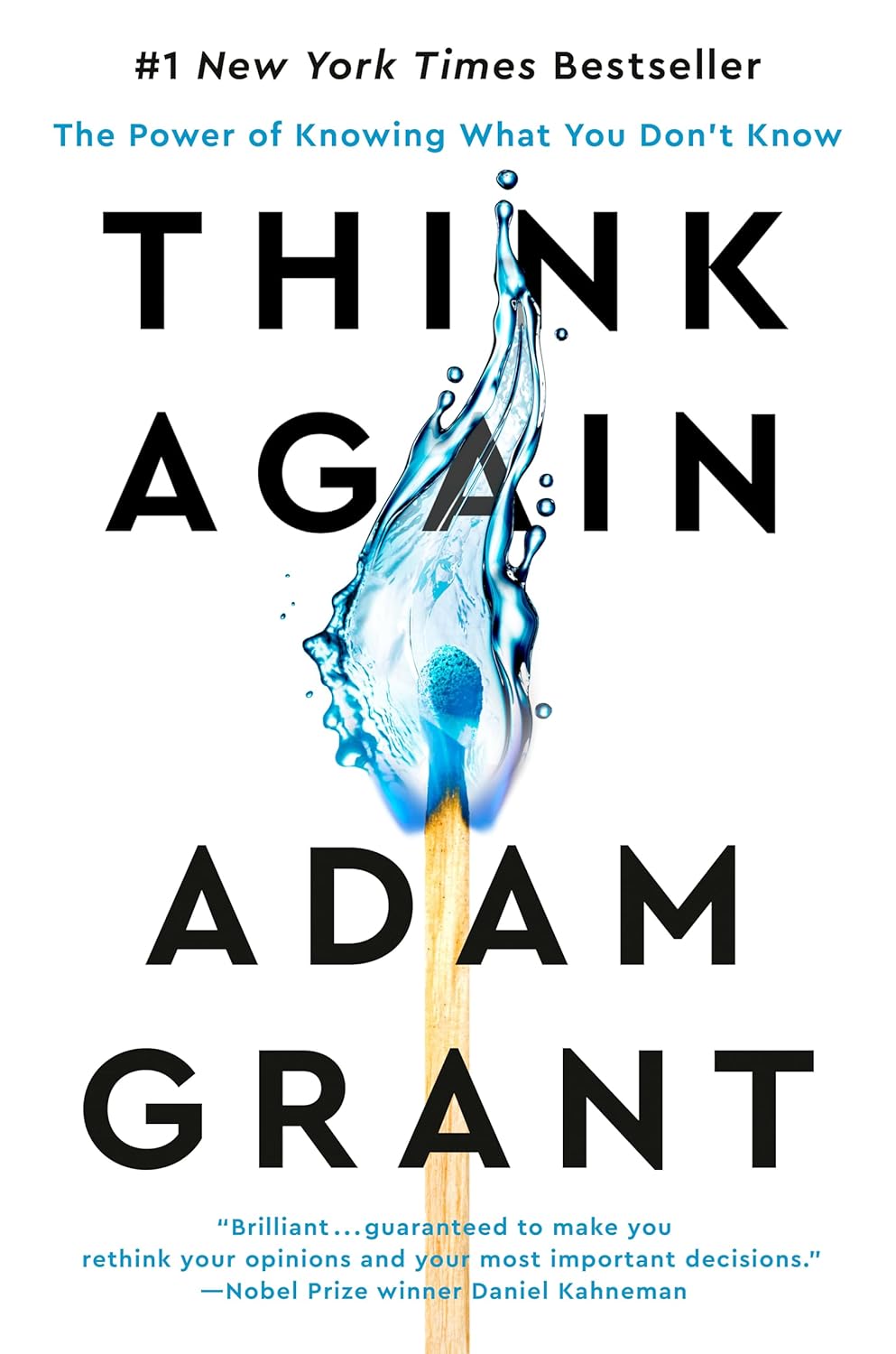
In a world that seems to be going to hell in a hand basket maybe we need to stop valuing pure intelligence or money as a goal and instead look towards the ability to abandon ideas that are no longer valid and relearn when presented with new information. That is the goal of Adam Grant's book Think Again, to help us learn to rethink our opinions and then later in the book to give us the tools to engage constructively with others that have differing opinions in a quest to bring consensus to the conversation.
My favourite quote is probably this:
We're swift to recognize when other people need to think again. We question the judgement of experts whenever we seek out a second opinion on a medical diagnosis. Unfortunately, when it comes to our knowledge and opinions, we often favor feeling right over being right. In everyday life, we make diagnoses of our own, ranging from whom we hire to when we marry. We need to develop the habit of forming our own second opinions. Pg 18
Next time you think someone is wrong on the internet, stop and think about where you may need to relearn instead of just spreading vitriol.
> Intelligence is traditionally viewed as the ability to think and learn. Yet in a turbulent world there's another set of cognitive skills that might matter more: the ability to rethink and unlearn. Pg 2
- its always easy to point the finger at others and say they need to rethink their ideas while ours are solid. Instead, focus on yourself and what you can learn
**Purpose** Pg 8
- to teach us to rethink and unlearn and to help foster that ability in others
### Part 1 - Individual Rethinking - Updating Our Own Views
> We're swift to recognize when other people need to think again. We question the judgement of experts whenever we seek out a second opinion on a medical diagnosis. Unfortunately, when it comes to our knowledge and opinions, we often favor _feeling_ right over _being_ right. In everyday life, we make diagnoses of our own, ranging from whom we hire to when we marry. We need to develop the habit of forming our own second opinions. Pg 18
^018fb4
- doesn't matter how smart you are if you lack the motivation to change you'll miss the chances to think again and update your faulty assumptions. Pg 24
- the smarter you are means it's harder to rethink because you don't see your own limitations and assume you have correct opinions. Pg 25
> The less intelligent we are in a particular domain, the more we seem to overestimate our actual intelligence in that domain. Pg 39
- [[Dunning-Kruger Effect]]
- Reminds me of H (the skating coach) who assumes they know everything in most fields from physio, to audio systems, to...whatever comes up
- when we start we rarely fall into [[Dunning-Kruger Effect]]. It's when we gain amateur level knowledge that we start to overestimate how much we know and how much skill we have. Pg 44
> You can be confident in your ability to achieve a goal in the future while maintaining the humility to question whether you have the right tools in the present. Pg 46
- confidence and humility are not mutually exclusive
- you can know that you don't have the skills, but feel confident that you'll be able to gain them like myself and the new dashboard I'm building in a language I don't currently know
> Arrogance leaves us blind to our weaknesses. Pg 54
- [[totalitarian ego]] Pg 59
- the little dictator in our heads that screens out the information which contradicts our core beliefs. It does this in an effort to preserve our sense of self.
> Everytime we encounter new information, we have a choice. We can attach our opinions to our identities and stand our ground in the stubbornness of preaching and prosecuting. Or we can operate more like scientists, defining ourselves as people committed to the pursuit of truth - even if it means proving our own views wrong. Pg 76
> The problem starts early: parents disagree behind closed doors, fearing conflict will make children anxious or somehow damage their character. Yet research shows that how often parents argue has no bearing on their children's academic, social, or emotional development. What matters is how respectfully parents argue, not how frequently. Kids whose parents clash constructively feel more emotionally safe in elementary school, and over the next few years they actually demonstrate more helpfulness and compassion toward their classmates. Pg 80
### Part 2 - Interpersonal Rethinking - Opening Other People's Minds
> A good debate is not a war. It's not even a tug-of-war, where you can drag your opponent to your side if you pull hard enough on the rope. Pg 104
- yet this is often how we treat things. My facts and logic will pull you to my ideas which are clearly correct. Then I win.
- you can't stand still and expect the other person to make all the moves. Some of their ideas are likely correct and you don't loose by agreeing with ideas that are correct.
- whit young men have seen a loss of stature and prospects, many just put the blame for this on the obvious "other" which turns into [[racism]] and [[misogyny]] then in turn these guys harm people that have nothing to do with their loss of prospects. In fact they have far more in common with those they persecute than the rich "leaders" they follow
- instead of [[straw man|strawmanning]] your oponents weakest argument, [[steel man|steelman]] their strongest point. Learn from this strong point and seek common ground on the parts where they're right. Pg 109
> When someone becomes hostile, if you respond by viewing the argument as a war, you can either attack or retreat. If instead you treat it as a dance you have another option-you can sidestep. Pg 115
- when we ask questions instead of telling someone what to think we invite them to dance with the ideas we're trying to communicate. Pg 119
> A rivalry exists whenever we reserve the special animosity for a group we see as competing with us for resources or threatening our identities. Pg 124
- young men see women and non-white in this type of light when it more rightly sits with the [[billionaire]] [[capitalist]]s class and [[politicians]] that have been influenced (and done the influencing) to allow the hoarding of profits away from the [[middle class]] so that it all accrues to them
> [[polarized|Polarization]] is reinforced by conformity: peripheral members fit in and gain status by following the lead of the most prototypical member of the group, who often holds the most intense views. Pg 128
- this is how [[Andrew Tate]] and his ilk drum up followers, by making those that feel on the fringes feel important as they dive into [[misogyny]] and are praised for their broken views
> As a general rule, it's those with greater power who need to do more of the rethinking, both because they're more likely to privilege their own perspectives and because their perspectives are more likely to go unquestioned. In most cases, the oppressed and marginalized have already done a great deal of contortion to f it in. Pg 140
- those with more power are also more likely to live in relative comfort and thus be unwilling to confront the hard questions they'd need to so that they can rethink their damaging beliefs.
- Is it worth noting the things they're giving up? It often seems like when you try and get understanding for doing any personal work those with less power tell you it barely counts because they've done so much already and you should do way more.
- I know I'm a white guy and have huge privilege, I also give up stuff/status when I do my personal work. I'm never asking for a prize, or even any acknowledgement, but I'd love to **not** get answers that amount to "yeah well that doesn't really count you need to do more"
- a common problem in persuasion tactics is that if they fail the act of resisting acts as an inoculation to future attempts at persuading making the person more resistant and set in their beliefs. Pg 145
> Listening well is more than a matter of talking less. It's a set of skills in asking and responding. It starts with showing more interest in other people's interests rather than trying to judge their status or prove your own. Pg 156
- it's being curious about **why** people believe what they do
- listening well shows respect for the ideas of the person you're listening to. It also shows respect for them as an individual who has valid beliefs. Pg 159
> Listening is a way of offering others our sacred, most valuable gift: our attention. Once we've demonstrated that we car about them and their goals, they're more willing to listen to us. Pg 159, 160
- and someone has to take the first step in listening we can't always be waiting for someone else to do this.
### Part 3 - Collective Rethinking - Creating Communities of lifelong learners
- showing people an article which gave lots of shades of grey to the [[gun control]] argument made it highly likely they'd find common ground on another divisive topic like [[abortion]]. Pg 164
- not just about busting bubbles but showing each side and the merits of their arguments so that we acknowledge that they have valid points
- [[binary bias]] Pg 164
- Our tendency to simplify arguments to two opposing views instead of living in the messy "it depends" middle that is most reflective of the truth. We often prefer simple but incomplete, or plain wrong, answers over the complexity that reality brings us.
> Psychologists find that people will ignore or even deny the existence of a problem if they're not fond of the solution. Pg 173
- so what solutions do I not like that has me ignoring problems I simply don't want to face?
> The greater the distance between us and an adversary, the more likely we are to oversimplify their actual motives and invent explanations that stray far from their reality. Pg 178
- so we need to close that gap by asking questions to help understand them more and get the nuance of their ideas
- but, is there a line? Do we really need to dig into the deep thoughts of [[white supremist|white supremacy]]? Though this book does talk about a black man that does this and when confronted with their beliefs they often realize how bad they are and leave the movement.
- while students say they enjoy dynamic lectures more than active self-investigation, they learn the subject better from the latter. It's just that the latter requires hard work instead of passive consumption. Pg 191
- we generally don't like hard work and we want to be entertained
- this is partially why people have flocked to the easy answers of [[Donald Trump]] and [[Elon Musk]]. They don't have to do any hard work and they're told that the problems they experience aren't their fault but they should point their fury at some "other" that can be weeded out of society
> The sage-on-stage often preaches new thoughts, but rarely teaches us to think for ourselves. Pg 192
> The students who struggled the most were the straight-A students - the perfectionists. It turns out that although perfectionists are more likely than their peers to ace school, they don't perform any better than their colleagues at work. Pg 195
- yet another point for [[Sources/Books/The Case Against Education|The Case Against Education]] because further education doesn't do as much as we like to believe
- the "good" students struggle with an assignment that had no clear answers and only hard to answer questions
- they're scared of being wrong so they don't make decisions. Much of their self identity is perched on being right
> Rethinking is more likely to happen in a learning culture, where growth is the core value and rethinking cycles are routine. In learning cultures, the norm is for people to know what they don't know, doubt their existing practices and stay curious about new routines to try out. Pg 208
- makes me think of the idea that a good employee has made mistakes and learned from them. Don't fire them because they're unlikely to make that mistake again and you're only letting go of institutional knowledge.
> In performance cultures, the emphasis on results undermines [[psychological safety]]. When we see people get punish for failures and mistakes we become worried about proving our competence and protecting our careers. Pg 209
- so we don't take risks and self-report errors early. This gives the errors opportunity to grow into grave business threatening issues. This also means that no other person on the team gets to learn from our mistakes and thus similar ones will be repeated across the organization.
> In performance cultures, people often become attached to best practices. The risk is that once we've declared a routine the best, it becomes frozen in time. We preach its virtues and stop questioning its vices, no longer curious about where it's imperfect and where it could improve. Pg 216
- we should always be willing to ask questions and defend our ideas and processes and if a better ways is found, adopt it
### Part V - Conclusion
- [[escalation of commitment]] Pg 229
- When we stick to a plan that isn't working, or we double down on that plan. It's the idea of throwing good money after bad because we just can't bear the idea that maybe we were wrong and need to change course.
> Escalation of commitment happens because we're rationalizing creatures, constantly searching for self-justifications for our prior beliefs as a way to soothe our egos, shield our images, and validate our past decisions. Pg 229
- we don't like being wrong
- those that focus on happiness often end up less happy. Instead of savouring the good moments they have they ask whey their life isn't more happy. Pg 238
## 2022 Notes
- ![[maybe a measure of intelligence should be how you rethink your ideas]] Pg 2
- [[first-instinct fallacy]] Page 3 ^f4fbd7
- we'd rather stick with our first instinct that admit we may be wrong and change our mind even when there are considerable performance gains for changing your mind
**purpose**
- to teach us the value of rethinking our beliefs and to help us have the tools to make that step of rethinking Page 8
- to give us the freedom to rethink ideas that are no longer serving us well Page 12
## Part 1 - Individual Rethinking
![[we value feeling right over being right]]
- [[Social Functionalist Frameworks for Judgment and Choice - Intuitive Politicians, Theologians, And Prosecutors 091220221211]] Page 18
- the smarter you are the harder it may be to update your beliefs Page 24
- because you know you're smart and figure you're just right
- you'll look for reasons to hang on to your beliefs
- [[Dunning-Kruger Effect]] PAGE 38
- is the [[Dunning-Kruger Effect]] at the heart of increasing [[polarized|polarization]] as people overestimate what they know and with low [[emotional intelligence]] they can't even see it. Page 43
- ![[if you don't think you last year was stupid you haven't learned much]]
- the key to rethinking is humility and acknowledgement of your weaknesses. Page 48
- in part this requires confidence and an environment where it's safe to be wrong so it requires a good manager
- when one of our core beliefs is questions we tend to shut down and stick to our idea like a petulant [[dictatorial]] leader. Page 59
- while you can gain more trust from your peers for admitting that you were wrong, does it harm you in the eyes of the [[armchair quarterbacks]] of the world who can't concieve of a time and place they'd admit they were wrong and use this information to put down any other ideas you come forth with no matter how well supported because "they were wrong once". Page 73
- productive disagreement is good. We can disagree and still be respectful and friends. Parents start this trend of not showing disagreement when they argue beind closed doors for fear of damaging their children. There is no evidence that the frequence of arguments has an impact on the success of children. Page 80
- clearly the children must have an otherwise healthy environment to grow up in and disagreements don't lead to [[abuse]]
- [[parenting]]
- good [[disagreements]] are about cognitive consensus not social harmony. You can seek social harmony by disagreeing in reasonable ways. Page 89
- so attacking [[anti-vacination]] beliefs in a non-constructive way isn't the path forward
- [[illusion of explanatory depth]] Page 92
## Part 2 - Interpersonal Thinking
- good negotiators acknowledge there will be disagreement, and know where those areas may be. They head into a [[negotiation]] with steps mapped out how to overcome these problem areas to mutual benefit. Page 105
- so they think about the other side with [[empathy]]
- instead of working to poke holes in the [[straw man]] arguments of the other side look at their [[steel man]] arguments. Accepting the strong points they have allows you to [[empathy]] with the person. Page 109
- when you ask more questions as you try to persuade people to your point, it allows the people you're talking to to choose the best information you have given them to agree with your questions. Page 112
- people are motivated to belong to a group and we've lost so many [[rituals of belonging]] in society. We no longer take a boy to hunt to become a man, or celebrate the first period as a sign of womanhood. Page 126
- so people find this belonging in [[conspiracy theory]] groups and outlandish actions to prove that you're a member of the group
- [[stereotypes]] are sticky because we interact with people who share our opinions. This is called [[group polarization]] Page 127
- when we meet group members who defy our [[stereotypes|stereotype]] we don't rethink it, we figure they must be the exception and continue with our stereotype. Page 131
- [[Social Categorization and Behavioral Episodes - A Cognitive Analysis of the Effects of Intergroup Contact 091220221242]] Page 131
- in general, people with more power and influence are the ones that need to spend more time rethinking their beliefs, simply because the beliefs they hold are less likely to be questioned. Page 140
- so white men are the most in need of questioning their beliefs
- the marginalized and those not in power have already done lots of work to fit into the ideas
- [[anti-vacination]] Page 144
- [[motivational interviewing]] Page 146
- listening isn't just talking less, it's showing more interest in investigation of their ideas than proving your own point. Page 156
## Part 3 - Collective Rethinking
- the lack of showing any shades of grey in ideas is part of the contributing factor of [[polarized|polarization]]. This is happening because people "hate read" things that make them angry and that drives views which drives advertising dollars based on views. Page 164 ^47e0db
- [[binary bias]] Page 164
- this likely relates to [[The Death of Expertise - Tom Nichols]] where we don't give experts their due and figure everyone must know as much as an expert just because they searched, even though [[searching makes people think they learned 110920201038]] when they really just skimmed headlines
- if you find yourself using the word always, you may be part of an [[idea cult]] Page 177
- because "always" is the one thing that can never be true
- there is either an easy but very simple and wrong answer or a highly complex answer that has caveats
- active classes, that force us to work hard and rethink our assumptions get ranked lower because they're hard work. A dynamic lecturer will get higher student rankings, even though when tested you retain more information from the active class. Page 192
- [[schooling|school]], [[Learning]]
- [[business wants you to take risks while they want to reap the benefits of those risks]] Page 219
## Part 4 - Conclusion
- the dark side of [[Grit]] is [[sunk cost fallacy]] where you keep going telling yourself that you're gritty, but you're just throwing good after bad. P$age 239 ^7f591e
- [[match fit 201020200723]] Page 233
-