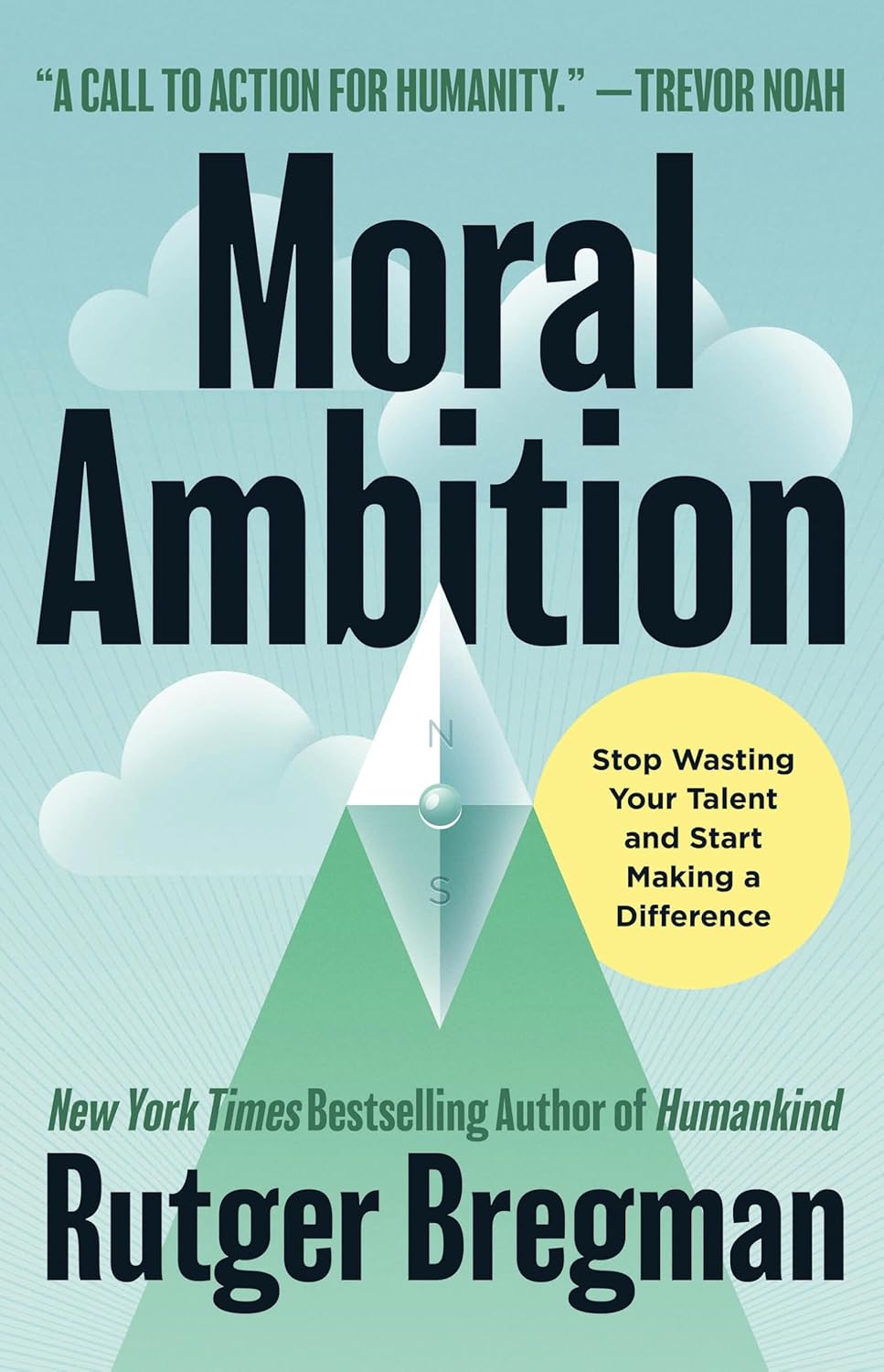
Moral Ambition - Rutger Bregman

Moral Ambition - Rutger Bregman

Rutger Bregman

NOT RECOMMENDED NONFICTION

Started: Aug 17, 2025

Finished: Aug 29, 2025

Review

This is Rutger Bregman’s treatise to get you to do more with your life than simply get a job to earn lots of money and find a position of power. He says that you have a deep moral obligation to make a change in the world with your work and that far too many people work just to earn a company more money, or get landlords out of treating tenants well.

None of this means that you need to be the one that’s out on the ground wildly protesting, in fact more change often comes from that lawyer who consistently challenges laws and quietly helps draft new ones. More may get done by a writer who boldly challenges the world of power with their prose.

While the book started off strong, a number of the later chapter were really just stories about people doing good stuff so that readers become inspired to also do more good stuff.

Chapter 8 was the most problematic for me as Bregman looked at effective altruism and ignored most of the strongest critiques of it coming down mostly on the positive side. Effective altruism is used regularly by rich people to say that they have money so they should decide how things run and earning money so they can “do good” is the best thing they can do with their lives. Put aside all the nice things these rich people get out of the deal, they’r rich “for the people” to “do good” in the world.

I had high hopes for the book, but it’s only okay. I am thinking about how I can use my writing to do more good in the world, combating the manosphere keeps coming to mind, but I think you can safely skip this book.

Notes


- this book is supposed to push you so that you do so much more than just find happiness or earn money. Do something that impacts the world with your life. Pg XIIII

### 1 - No, you’re not fine just the way you are

- how many Einsteins have we lost because they never had a chance to do anything but barely subsist. Pg 3
- same for most sports out there. The best athletes are likely never found because they never have the chance to be found with the hand they’ve been dealt.

> Moral ambition is the will to make the world a wildly better place. Pg 3

- Category 1 jobs = bullshit jobs Pg 5
- writing reports no one reads
- managing people that don’t need to be managed
- all influencers could strike and the world would continue without a worry, in fact the world may be better off if they stopped existing

- Category 2 jobs - ambitious but not idealistic Pg 8
- want to reach the top of a souless metric like fancy titles or salaries
- the startups offering us solutions to problems that we didn’t know we had until they found a market for it.

- Category 3 jobs = Idealistic but not ambitious Pg 11
- work in a moral job, but only part time so you have lots of time to be happy and find “fulfillment”
- often defined by what you don’t do. Don’t fly, eat meat, use non-recyclable products
- words matter, but what you do matters more
- going viral and getting likes for some online [[social media]] post doesn’t mean anything. Run for office instead and put your head down to have a real impact

- Category 4 jobs = Idealistic and ambitious Pg 14
- [[Thomas Clarkson]] gave his life to the ambitious ideal of ending [[slavery]]. This is the type of job the whole book wants us to take on

- [[The Honor Code How Moral Revolutions Happen - Kwame Anthony Appiah]] Pg 19
- examines the power of honor in shaping social movements like the emancipation of women and ending of slavery

### 2 - Lower your threshold for taking action

- [[August Landmeser]] Pg 23, 25
- [German shipyard worker and anti-Nazi protestor](https://en.wikipedia.org/wiki/August_Landmesser)

- with some effort you can prove the [[pareto principle]] and make a difference. Pg 26
- most people are just living their lives, not doing something worthwhile

> You can know something and then do something about it. Or you can know something and look away, afraid to face the consequences of what you know to be true. Pg 31
- there are two types of knowing. You can know bad things are happening, like the [[holocaust]] of the [[Jews]] in [[WWII]] and do something about it or not

- heroes that save [[Jews]] from [[Nazi]]’s have a strong [[internal locus of control]] Pg 35

- once you start resisting you generally don’t stop and do more than you originally planned. Pg 38

### 3 - Join a cult or start your own

- [[Radical Nerds]] Pg 44
- Group formed my [[Ralph Nader]] to make a change in the world

- [[Benjamin Lay]] Pg 51
- [[Quaker]] [[abolitionist]]
- [Wikipedia](https://en.wikipedia.org/wiki/Benjamin_Lay)

- you don’t have to be the bold tie yourself to the mast in public revolutionary. The lawyer that challenges laws or the writer that calls out evil may do more to effect real change than those whose acts are the focus of all the news. Pg 52
- that’s the thrust of the whole chapter

- many of the highest educated throw away their smarts to work on “lucrative trivia” for landlords, massive companies, and polluters just so they can have a fancy car and house. Pg 58, 59
- this was [[Ralph Nader]]’s thought

### 4 - See winning as your moral duty

- [[Jospeh Overton]] Pg 63
- over time radical dreams become reality
- [[overton window]]

- just because we know an injustice is happening doesn’t mean anything will be done about it. Pg 68

> …it’s not what you think is right that counts, but what you’re prepared to do about it. Pg 69
- show me your schedule and I’ll tell you what you care about

- the author posits that [[intersectionality]] is why it’s harder to form coalitions for causes now. We can’t just agree and fight for [[climate change]] or any other single cause, we must align on all causes and ideas of the most ardent and loudest person in the room. Pg 77
- you must be virtuous in every point to join any cause

- [[Twitter and Tear Gas - Zeynep Tufekci]] Pg 81
- A look at the power and the weaknesses of using new technologies to organize social movements

### 5 - Learn to week over spreadsheets

- a story about [[Rob Maher]] and his founding of the [[Against Malaria]] foundation. I guess this is supposed to inspire us with the affect our actions can have

### 6 - Enroll at Hogwarts for do gooders

- a story about a school teaching people to start Non-Profit Organizations the “Tesla” of charities. Ones that are innovative and such. Pg 109
- do we need more charities or do charities need more resources to accomplish their missions?

### 7 - Find out what the world needs and make it happen

- we have lots of tech that can change the world in good ways we just need people to invest in it so that change happens.
- this is just stories proving that point

### 8 - Save a life, now only $4999

- don’t ask what your passion is ask how you can have the biggest impact with your time and resources. Pg 146

> Our lives, after all, are one long succession of luxury goods. Well-off people in well-off lands buy heaps of clothing, food, toys, furnishings, jewelery, cosmetics, and electronic goods that bring little joy and mostly end up on the trash heap. Pg 150

- [[effective altruism]] Pg 154
- he mostly seems to praise this movement. Sure he mentions [[SBF]] and a few bad parts of the movement, but spends far more time on how good the idea is.

### 9 - Expand your moral circle

> Throughout history, people seen as enlightened or progressive often upheld practices we now consider absolutely abhorrent. Makes you wonder: what practices of ours will future generations think barbaric. Pg 172

- how do you figure out the things we do today that will be looked back on as terrible? Pg 174
- if you say “That’s the way it’s always been”
- what are the radicals of today protesting

- [[The Neurotic's Notebook - Mignon McLaughlin]] Pg 176
- we revere live conformists and dead troublemakers

- can you explain a current practice to a child without them looking at you like you’re crazy? They are often good at spotting hypocrisy. Pg 176

- [[The Expanding Circle - Peter Singer]] Pg 177
- the first book about [[circles of moral concern]] where we continue to expand those we consider like us and ensure that they have the same rights we do

### 10 - Make future historians proud

- people are more than tools for getting things done, we have value outside of our productivity. Pg 222
- so it’s not a waste to do other things outside of your cause. Spend time with your kids, watch a good movie, read a book. Don’t feel guilty about this.