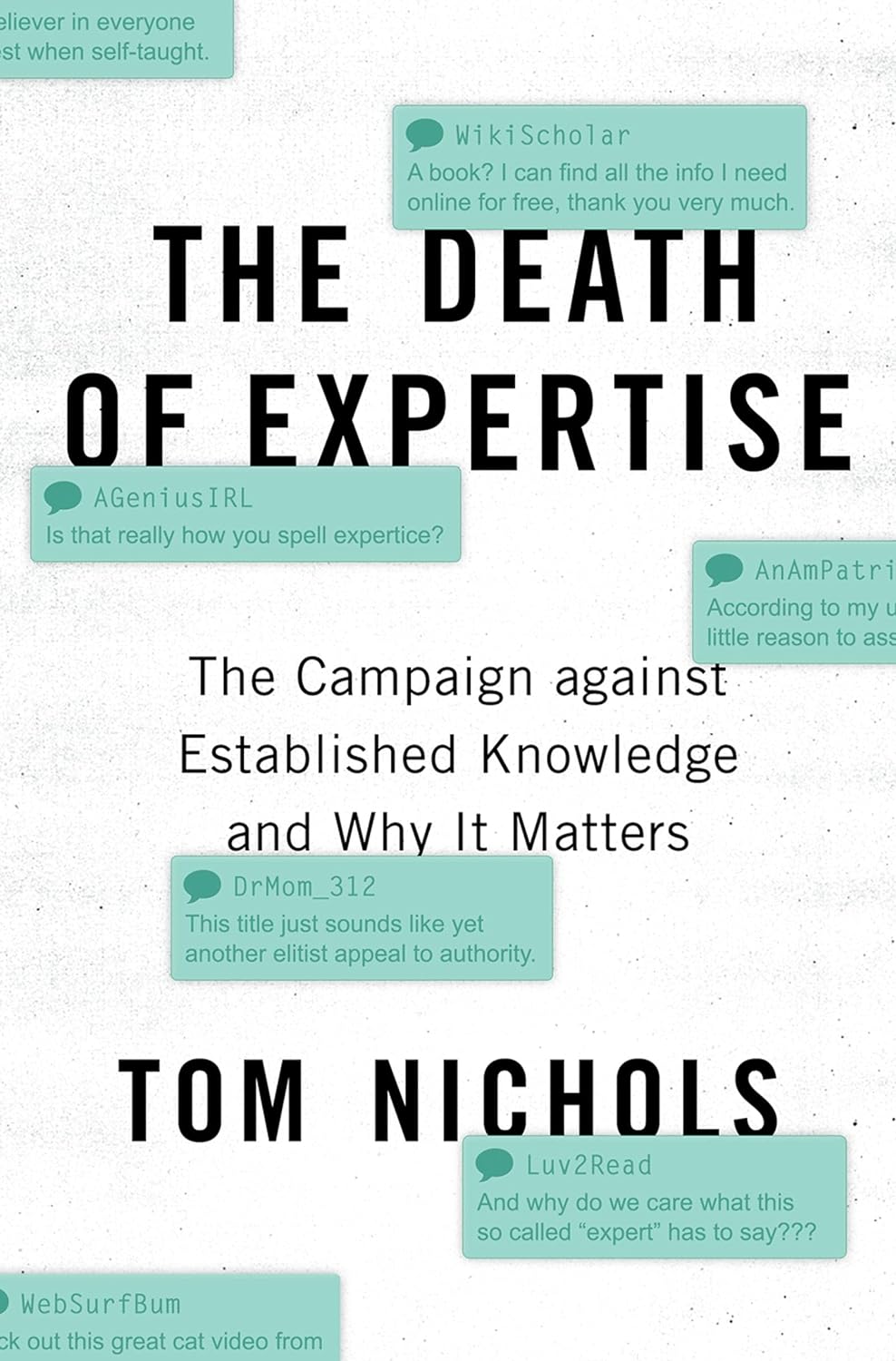
The Death of Expertise - Tom Nichols

The Death of Expertise - Tom Nichols

Tom Nichols

RECOMMENDED NONFICTION

Started: Dec 19, 2019

Finished: Dec 24, 2019

Review

Are there any experts anymore? If there are experts, do we even listen to them? How many experts take their domain-specific expertise and parlay that into getting to comment on fields that they know nothing about?

In this excellent book Tom Nichols explores how we treat experts today. From ignoring them when we don't like what they have to say, to allowing experts in physics space to comment about world politics, a field they are not experts in, Nichols addresses the whole spectrum.

Purchase The Death of Expertise on Amazon

Notes

> These are dangerous times. Never have so many people had so much access to knowledge and yet have been so resistant to learning anything. Page 2

- tied in with this is the propensity for online disinhibition effect 300120211506 where you are free to be an ass about the things you believe because online interaction can have less empathy

Confirmation Bias, Disconfirmation Bias, manufactured doubt


**Purpose**

- why the relationship between experts and citizens is collapsing

**Structure**

- the titles of the chapters describe the main point being discussed in the book about why experts aren't trusted as much as they once were

The Death of Expertise

- we are in a time when misinformation pushes aside knowledge Page 14
- # QANON is not an alternate reality 050220211635

The Walrus - Quitting America 050220211629 Page 33

- We like to think Tags/QANON is some alternative reality that we don’t have to deal with, but it is in the people around us at our kids schools and we all have to learn how to deal with this Tags/misinformation
- People are vulnerable to it in part due to systems that continue to promote Tags/economic inequality
- As scarcity captures the mind 180920201045 we look for answers and Tags/meaning


Tags/QANON, Tags/misinformation


# reversing knowledge gains 110920200950

The Death of Expertise

- the death of expertise may reverse the gains in knowledge as people assume they know more than they actually do. Then they are unwilling to dig any deeper at all Page 20
- "lay" people always assume they know more than they do about a subject. It's experts that understand how much they don't know.

#tagnote

The less you know about something the more you think you know about it. You **overestimate** your skills on a topic or area of practice.

Once you truly have expertise in the field you are more likely to see the holes you have in your knowledge.

url: [https://en.wikipedia.org/wiki/Dunning–Kruger_effect](https://en.wikipedia.org/wiki/Dunning%E2%80%93Kruger_effect)


The Death of Expertise

> Americans no longer distinguish the phrase "you're wrong" from the phrase "you're stupid". To disagree is to disrespect. To correct another is to insult. And to refuse to acknowledge all views as worthy of consideration, no matter how fantastic or inane they are, is to be closed-minded. Page 25


# mark of a true expert 110920200956

The Death of Expertise

- the making of a true expert. is their acceptance of evaluation and correction by others. Page 35
- because they're willing to learn something new and not just staking everything on "being right"
# expertise


# unskill people don't step back 110920201003

The Death of Expertise

- unskilled people lack the ability to step back and see the errors in their efforts. They lack metacognition 110920201004 Page 45
- and of course we're all subject to confirmation bias


# conspiracy theorists manipulate evidence and non-evidence 110920201005

The Death of Expertise

> Conspiracy theorists manipulate all tangible evidence to fit their explanation,but wrose they will also point to the *absence* of evidence as even stronger confirmation. Page 55

- which means you can't talk to them because everything supports their opinions

Reminds me of the god shaped hole in The God Delusion. Any time a christian see a hole in science they say "see god". The lack of evidence is...evidence.


The Death of Expertise

> Stereotypes are not *predictions*, they're *conclusions*. That's why it's called "prejudice": it relies on pre-judging. Page 62


The Death of Expertise

> When two people were involved in repeated discussions and decision making - and establishing a bond between the participants was a key part of the study - researchers found that the less capable people advocated for their views more than might have been expected, and that the more competent member of the conversation deferred to those points of view even when they were demonstrably wrong. Page 64

- this happens in part because the more capable person doesn't want to be seen as "squashing" the less capable. It's about them going for social harmony instead of correctness.
- this is a bad way to make decisions
- # unskill people don't step back 110920201003

The Death of Expertise

- unskilled people lack the ability to step back and see the errors in their efforts. They lack metacognition 110920201004 Page 45
- and of course we're all subject to confirmation bias


Dunning-Kruger Effect as you can see the less skilled people pushing harder believing that they are "right"

#writingidea


# the internet helps us think we're all right 110920201016

The Death of Expertise

- because Internet and overall easy access to information we all assume we know something. When faced with a true expert we rarely defer, but make and stick to invalid and sometimes demonstrably false statements.
- ?? so how do I overcome that in my life?
- ?? how do I make sure I say I don't know instead of guessing crap?

\#writingidea

#tagnote

Tags: cognitive bias


The Death of Expertise

> College is no longer a passage to educational maturity and instead is only a delaying tactic against the onset of adulthood - in some cases, for the faculty as well as for the students.Page 73-74

- but Kids These Days talks about the fact that more people are graduating then being treated as junior instead of accomplished. This seems to be leading to saying the current College model is lacking and more like a party.
- The Case Against Education went for signaling theory of education which says that school is mostly about showing you will conform to the norms of society. Not as much about what you learn though. If that's true then of course you're treated a junior. Your job doesn't think you have the required knowledge, they have to train you. They are looking at school as saying "you'll do what you're told" and conform to the norms at work.
- # education is about signaling conformity

![cover|150](http://books.google.com/books/content?id=3gacDwAAQBAJ&printsec=frontcover&img=1&zoom=1&edge=curl&source=gbs_api)

# The Case against Education

# The Case Against Education

Author: Tags/Bryan Caplan Notebook: 2020R1 136
Review:

## Summary

**Purpose**: to argue that our education system is a big wast of time and money. It's mostly about showing you will conform to what society wants and very little about what you learn, especially past grade school. LOC 146

- most learning isn't useful because you never use it once you're out of school, unless you teach it. LOC 199

#tagnote

Sources/Books/The Case Against Education

- most of school is about showing you conform to society and will work on whatever stuff your employer wants because that's conforming. LOC 215


- signaling also leads to credential inflation as those that can afford it run a longer race to outrun the easy access to education LOC 248
- Kids These Days talked about the same idea of racing from pre-school all the way through college so that you can get a job at a coffee shop
- employers use grades and graduation to judge fitness for employment even though it bears almost not measurable correlation to your performance at a job. LOC 362
- Gladwell showed this in his podcast on the LSAT
- Revisionist History - The Tortoise and the Hare is that episode that shows the LSAT only demonstrates who takes the LSAT well

> The labor market doesn't pay you for the useless subjects you master; it pays you for the preexisting traits you reveal by mastering them. LOC 378
- does blogging and writing books and video work show my work? Does it signal how well I work or is it a counter signal that I'm out there and weird

education is about signaling conformity

# the most important thing about education is what society believes 210820201015

Sources/Books/The Case Against Education

- the most important thing about education is that society believes it is special LOC 511
- it’s the moral ecologies we live in


# education reinforcing fallacy 210820201017

Sources/Books/The Case Against Education

- it's a reinforcing fallacy LOC 518
1. Employers see some link between education and good work. Good uncredentialed workers are rare and thus ignored.
2. People notice and get credentials
3. The frequency of strong motivated people without credentials fall, which tightens the link and increases the need for credentials.
4. Step 1, but with a longer race for more credentials for jobs that have no need of any credentials.


Sources/Books/The Case Against Education

- school does a bad job teaching you how to think well. LOC 1236
- outside of your narrow interest of study, you don't apply your learning to novel problems because you miss entirely how to apply your knowledge
- so it didn't improve your thinking, it trained you on a set of specific problems
- how does this idea mesh with Range
- range said that people with diverse experience in teams came to good novel ideas faster
- that means they applied their leaning in new situations

#writingidea


- headstart and elite preschool has no measurable difference into grade 1. It's all about parents signaling they care about their kids LOC 1399

> If school teaches few job skills, transfer of learning is mostly wishful thinking, and the effect of education on intelligence is largely hollow, ow on earth do human beings get good at their job? The same way you get into Carnegie hall: practice. LOC 1416

- so you get good at your job by doing the job. Earlier on the job training and experience would mean you get good earlier compared to the alternative of staying in school and learning about the job. LOC 1447


Sources/Books/The Case Against Education

- school keeps customers happy with good GPA's for work that would have failed in previous generations. LOC 1482
- this maps to feelings matter more than rationality 110920201028 talking about the student as the customer and the customer is always right so when they have an issue with the school the school caves instead of challenging the views of students.


# graduation is a milestone of norms 210820201028

Sources/Books/The Case Against Education

- graduation is a milestone that tells employers you take societal norms seriously and thus are a safe bet. LOC 2083


Sources/Books/The Case Against Education

- stop teaching useless subjects that have no bearing on what someone will do at work. Instead give kids time to read, or play, or investigate whatever it is that they want to learn.
- This is Unschooled in a nut shell


Sources/Books/The Case Against Education

- if we "level" the playing field and provide grants to people who can't afford school it only creates a bigger gap at the bottom. The rich run further, past what the grants allow, and the others that couldn't afford it are now so far out of "norms" in education (maybe only high school) that they can't get anything but terrible jobs LOC 4106, 4129

[[social justice]], [[student loans]]


Sources/Books/The Case Against Education

- the fact that most people don't use the internet and their own free time to learn new stuff shows how few are the go getters in society. Yet we force kids to do stuff that we as adults would never do. We want them to "put in their time" just like we did LOC 4637
- i think about reaching for my iPad but not letting the kids have the same amount of screentime. I'm showing them it's the perfect diversion, they're just not allowed to use it.
- how would we combine this idea with those that show too much screentime is bad for kids?

[[Learning]], [[Tags/screentime]]


Sources/Books/The Case Against Education

- one reason we don't reform education is that in younger grades school is free child care so that adults can work LOC 4995
- When explored this with school start times as well


- students forget most stuff because it's not needed in real life LOC 5597
- this was a big issue for me and I couldn't get past how useless so much was so I never did it

## Key Ideas

## Further Lines of Inquiry

- Sources/Books/The Case Against Education

> The labor market doesn't pay you for the useless subjects you master; it pays you for the preexisting traits you reveal by mastering them. LOC 378

- does blogging and writing books and video work show my work? Does it signal how well I work or is it a counter signal that I'm out there and weird

education is about signaling conformity

#writingidea


## Quotes

## TODO

- [x] signaling models 180820200855
- [x] fadeout 180820200908

## Tags

- deliberate practice Chapter 2 14
- Social Desirability Bias 44%
- \#vocational-education 44%

## Resources Mentioned

- Academically Adrift 15%
- Does Education Matter 39%
- The Problem of Political Authority 42%


- education is about signaling conformity to cultural expectations. The only way employers have any idea about this is school. They outsource the decision and vetting to college or university. LOC 464

The War on Normal People 130920201110 page 51 says that most of the training a doctor, dentist, lawyer, gets is about training people to sit in the same spot quietly and do the same tasks over and over. This is something that AI/robots can do better.


-
![cover|150](http://books.google.com/books/content?id=3gacDwAAQBAJ&printsec=frontcover&img=1&zoom=1&edge=curl&source=gbs_api)

# The Case against Education

# The Case Against Education

Author: Tags/Bryan Caplan Notebook: 2020R1 136
Review:

## Summary

**Purpose**: to argue that our education system is a big wast of time and money. It's mostly about showing you will conform to what society wants and very little about what you learn, especially past grade school. LOC 146

- most learning isn't useful because you never use it once you're out of school, unless you teach it. LOC 199

#tagnote

Sources/Books/The Case Against Education

- most of school is about showing you conform to society and will work on whatever stuff your employer wants because that's conforming. LOC 215


- signaling also leads to credential inflation as those that can afford it run a longer race to outrun the easy access to education LOC 248
- Kids These Days talked about the same idea of racing from pre-school all the way through college so that you can get a job at a coffee shop
- employers use grades and graduation to judge fitness for employment even though it bears almost not measurable correlation to your performance at a job. LOC 362
- Gladwell showed this in his podcast on the LSAT
- Revisionist History - The Tortoise and the Hare is that episode that shows the LSAT only demonstrates who takes the LSAT well

> The labor market doesn't pay you for the useless subjects you master; it pays you for the preexisting traits you reveal by mastering them. LOC 378
- does blogging and writing books and video work show my work? Does it signal how well I work or is it a counter signal that I'm out there and weird

# education is about signaling conformity

Sources/Books/The Case Against Education

- education is about signaling conformity to cultural expectations. The only way employers have any idea about this is school. They outsource the decision and vetting to college or university. LOC 464

The War on Normal People 130920201110 page 51 says that most of the training a doctor, dentist, lawyer, gets is about training people to sit in the same spot quietly and do the same tasks over and over. This is something that AI/robots can do better.


# the most important thing about education is what society believes 210820201015

Sources/Books/The Case Against Education

- the most important thing about education is that society believes it is special LOC 511
- it’s the moral ecologies we live in


# education reinforcing fallacy 210820201017

Sources/Books/The Case Against Education

- it's a reinforcing fallacy LOC 518
1. Employers see some link between education and good work. Good uncredentialed workers are rare and thus ignored.
2. People notice and get credentials
3. The frequency of strong motivated people without credentials fall, which tightens the link and increases the need for credentials.
4. Step 1, but with a longer race for more credentials for jobs that have no need of any credentials.


Sources/Books/The Case Against Education

- school does a bad job teaching you how to think well. LOC 1236
- outside of your narrow interest of study, you don't apply your learning to novel problems because you miss entirely how to apply your knowledge
- so it didn't improve your thinking, it trained you on a set of specific problems
- how does this idea mesh with Range
- range said that people with diverse experience in teams came to good novel ideas faster
- that means they applied their leaning in new situations

#writingidea


- headstart and elite preschool has no measurable difference into grade 1. It's all about parents signaling they care about their kids LOC 1399

> If school teaches few job skills, transfer of learning is mostly wishful thinking, and the effect of education on intelligence is largely hollow, ow on earth do human beings get good at their job? The same way you get into Carnegie hall: practice. LOC 1416

- so you get good at your job by doing the job. Earlier on the job training and experience would mean you get good earlier compared to the alternative of staying in school and learning about the job. LOC 1447

school keeps customers happy 210820201027

# graduation is a milestone of norms 210820201028

Sources/Books/The Case Against Education

- graduation is a milestone that tells employers you take societal norms seriously and thus are a safe bet. LOC 2083


Sources/Books/The Case Against Education

- stop teaching useless subjects that have no bearing on what someone will do at work. Instead give kids time to read, or play, or investigate whatever it is that they want to learn.
- This is Unschooled in a nut shell


Sources/Books/The Case Against Education

- if we "level" the playing field and provide grants to people who can't afford school it only creates a bigger gap at the bottom. The rich run further, past what the grants allow, and the others that couldn't afford it are now so far out of "norms" in education (maybe only high school) that they can't get anything but terrible jobs LOC 4106, 4129

[[social justice]], [[student loans]]


Sources/Books/The Case Against Education

- the fact that most people don't use the internet and their own free time to learn new stuff shows how few are the go getters in society. Yet we force kids to do stuff that we as adults would never do. We want them to "put in their time" just like we did LOC 4637
- i think about reaching for my iPad but not letting the kids have the same amount of screentime. I'm showing them it's the perfect diversion, they're just not allowed to use it.
- how would we combine this idea with those that show too much screentime is bad for kids?

[[Learning]], [[Tags/screentime]]


Sources/Books/The Case Against Education

- one reason we don't reform education is that in younger grades school is free child care so that adults can work LOC 4995
- When explored this with school start times as well


- students forget most stuff because it's not needed in real life LOC 5597
- this was a big issue for me and I couldn't get past how useless so much was so I never did it

## Key Ideas

## Further Lines of Inquiry

- Sources/Books/The Case Against Education

> The labor market doesn't pay you for the useless subjects you master; it pays you for the preexisting traits you reveal by mastering them. LOC 378

- does blogging and writing books and video work show my work? Does it signal how well I work or is it a counter signal that I'm out there and weird

# education is about signaling conformity

Sources/Books/The Case Against Education

- education is about signaling conformity to cultural expectations. The only way employers have any idea about this is school. They outsource the decision and vetting to college or university. LOC 464

The War on Normal People 130920201110 page 51 says that most of the training a doctor, dentist, lawyer, gets is about training people to sit in the same spot quietly and do the same tasks over and over. This is something that AI/robots can do better.


#writingidea


## Quotes

## TODO

- [x] signaling models 180820200855
- [x] fadeout 180820200908

## Tags

- deliberate practice Chapter 2 14
- Social Desirability Bias 44%
- \#vocational-education 44%

## Resources Mentioned

- Academically Adrift 15%
- Does Education Matter 39%
- The Problem of Political Authority 42%


- school keeps customers happy with good GPA's for work that would have failed in previous generations. LOC 1482
- this maps to feelings matter more than rationality 110920201028 talking about the student as the customer and the customer is always right so when they have an issue with the school the school caves instead of challenging the views of students.


#writingidea


The Death of Expertise

- safe spaces harm free inquiry which is part of higher education, or at leash should be Page 99
- this coddles them from any argument or idea they don't like
- in the world outside school there are few safe spaces so we're not even preparing people for what they're getting into

[[Tags/safe spaces]]

# feelings matter more than rationality 110920201028

The Death of Expertise

> When feelings matter mare than rationality or facts, education is a doomed enterprise. Emotion is an unassailable defense against expertise, a moat of anger and resentment in which reason and knowledge quickly drown. Page 99

- students don't like something and since they're the consumers and the customer is always right the school gives into them instead of challenging their beliefs.
-
![cover|150](http://books.google.com/books/content?id=3gacDwAAQBAJ&printsec=frontcover&img=1&zoom=1&edge=curl&source=gbs_api)

# The Case against Education

# The Case Against Education

Author: Tags/Bryan Caplan Notebook: 2020R1 136
Review:

## Summary

**Purpose**: to argue that our education system is a big wast of time and money. It's mostly about showing you will conform to what society wants and very little about what you learn, especially past grade school. LOC 146

- most learning isn't useful because you never use it once you're out of school, unless you teach it. LOC 199

#tagnote

Sources/Books/The Case Against Education

- most of school is about showing you conform to society and will work on whatever stuff your employer wants because that's conforming. LOC 215


- signaling also leads to credential inflation as those that can afford it run a longer race to outrun the easy access to education LOC 248
- Kids These Days talked about the same idea of racing from pre-school all the way through college so that you can get a job at a coffee shop
- employers use grades and graduation to judge fitness for employment even though it bears almost not measurable correlation to your performance at a job. LOC 362
- Gladwell showed this in his podcast on the LSAT
- Revisionist History - The Tortoise and the Hare is that episode that shows the LSAT only demonstrates who takes the LSAT well

> The labor market doesn't pay you for the useless subjects you master; it pays you for the preexisting traits you reveal by mastering them. LOC 378
- does blogging and writing books and video work show my work? Does it signal how well I work or is it a counter signal that I'm out there and weird

# education is about signaling conformity

Sources/Books/The Case Against Education

- education is about signaling conformity to cultural expectations. The only way employers have any idea about this is school. They outsource the decision and vetting to college or university. LOC 464

The War on Normal People 130920201110 page 51 says that most of the training a doctor, dentist, lawyer, gets is about training people to sit in the same spot quietly and do the same tasks over and over. This is something that AI/robots can do better.


# the most important thing about education is what society believes 210820201015

Sources/Books/The Case Against Education

- the most important thing about education is that society believes it is special LOC 511
- it’s the moral ecologies we live in


# education reinforcing fallacy 210820201017

Sources/Books/The Case Against Education

- it's a reinforcing fallacy LOC 518
1. Employers see some link between education and good work. Good uncredentialed workers are rare and thus ignored.
2. People notice and get credentials
3. The frequency of strong motivated people without credentials fall, which tightens the link and increases the need for credentials.
4. Step 1, but with a longer race for more credentials for jobs that have no need of any credentials.


Sources/Books/The Case Against Education

- school does a bad job teaching you how to think well. LOC 1236
- outside of your narrow interest of study, you don't apply your learning to novel problems because you miss entirely how to apply your knowledge
- so it didn't improve your thinking, it trained you on a set of specific problems
- how does this idea mesh with Range
- range said that people with diverse experience in teams came to good novel ideas faster
- that means they applied their leaning in new situations

#writingidea


- headstart and elite preschool has no measurable difference into grade 1. It's all about parents signaling they care about their kids LOC 1399

> If school teaches few job skills, transfer of learning is mostly wishful thinking, and the effect of education on intelligence is largely hollow, ow on earth do human beings get good at their job? The same way you get into Carnegie hall: practice. LOC 1416

- so you get good at your job by doing the job. Earlier on the job training and experience would mean you get good earlier compared to the alternative of staying in school and learning about the job. LOC 1447

school keeps customers happy 210820201027

# graduation is a milestone of norms 210820201028

Sources/Books/The Case Against Education

- graduation is a milestone that tells employers you take societal norms seriously and thus are a safe bet. LOC 2083


Sources/Books/The Case Against Education

- stop teaching useless subjects that have no bearing on what someone will do at work. Instead give kids time to read, or play, or investigate whatever it is that they want to learn.
- This is Unschooled in a nut shell


Sources/Books/The Case Against Education

- if we "level" the playing field and provide grants to people who can't afford school it only creates a bigger gap at the bottom. The rich run further, past what the grants allow, and the others that couldn't afford it are now so far out of "norms" in education (maybe only high school) that they can't get anything but terrible jobs LOC 4106, 4129

[[social justice]], [[student loans]]


Sources/Books/The Case Against Education

- the fact that most people don't use the internet and their own free time to learn new stuff shows how few are the go getters in society. Yet we force kids to do stuff that we as adults would never do. We want them to "put in their time" just like we did LOC 4637
- i think about reaching for my iPad but not letting the kids have the same amount of screentime. I'm showing them it's the perfect diversion, they're just not allowed to use it.
- how would we combine this idea with those that show too much screentime is bad for kids?

[[Learning]], [[Tags/screentime]]


Sources/Books/The Case Against Education

- one reason we don't reform education is that in younger grades school is free child care so that adults can work LOC 4995
- When explored this with school start times as well


- students forget most stuff because it's not needed in real life LOC 5597
- this was a big issue for me and I couldn't get past how useless so much was so I never did it

## Key Ideas

## Further Lines of Inquiry

- Sources/Books/The Case Against Education

> The labor market doesn't pay you for the useless subjects you master; it pays you for the preexisting traits you reveal by mastering them. LOC 378

- does blogging and writing books and video work show my work? Does it signal how well I work or is it a counter signal that I'm out there and weird

# education is about signaling conformity

Sources/Books/The Case Against Education

- education is about signaling conformity to cultural expectations. The only way employers have any idea about this is school. They outsource the decision and vetting to college or university. LOC 464

The War on Normal People 130920201110 page 51 says that most of the training a doctor, dentist, lawyer, gets is about training people to sit in the same spot quietly and do the same tasks over and over. This is something that AI/robots can do better.


#writingidea


## Quotes

## TODO

- [x] signaling models 180820200855
- [x] fadeout 180820200908

## Tags

- deliberate practice Chapter 2 14
- Social Desirability Bias 44%
- \#vocational-education 44%

## Resources Mentioned

- Academically Adrift 15%
- Does Education Matter 39%
- The Problem of Political Authority 42%


- school keeps customers happy with good GPA's for work that would have failed in previous generations. LOC 1482
- this maps to feelings matter more than rationality 110920201028 talking about the student as the customer and the customer is always right so when they have an issue with the school the school caves instead of challenging the views of students.


# the internet lets us mimic expertise 110920201032

The Death of Expertise

- the Internet allows us to mimic expertise with a list of inexhaustible facts Page 106
- we can all become instant experts obviously knowing more because of a search than any expert could know in all their years of experience
- the internet is merely a vessel for words and ideas. It does nothing to vet the quality. The expert and the idiot have the same real estate online. Page 109


The Death of Expertise

> People do not come to the Internet so that their bad information can be corrected or their cherished theories disproven Rather,they ask the electronic oracle to confirm them in their ignorance. Page 112

- #tagnote

The less you know about something the more you think you know about it. You **overestimate** your skills on a topic or area of practice.

Once you truly have expertise in the field you are more likely to see the holes you have in your knowledge.

url: [https://en.wikipedia.org/wiki/Dunning–Kruger_effect](https://en.wikipedia.org/wiki/Dunning%E2%80%93Kruger_effect)


- #tagnote

Tags: cognitive bias


The Death of Expertise

> The very act of searching for information makes people think they've learned something, when in fact they're more likely to be immersed in yet more data they do not understand. Page 119

- an electronic Dunning-Kruger Effect

[[Learning]]


# learning new things takes patience 110920201039

The Death of Expertise

- learning new things takes patience and the ability to listen to other people. Especially opposing views. The Internet is making it easier to cluster with people that only like the same things as we do. Page 128
- this is both good and bad. Good because a nerd in a rural city is no longer alone. They can get online and find people that love what they love. It also means, we almost never find opposing views unless we're intentional about it.

#writingidea


The Death of Expertise

- so much news is available it's more like entertainment now as papers and shows always ask what consumers want to hear about. They used to tell you what you needed to know. Page 141-143

news, [[entertainment]]


The Death of Expertise

- with so much time to fill on the news you don't have to be an expert. They just need a body with an opinion to sit down and talk to so that they can fill time. Page 151


# expertise in one area doesn't mean all areas 110920201045

The Death of Expertise

- expertise in one area doe not mean expertise in any other area. Don't let yourself become a person that tries to be an expert at everything. Page 178

- the experts in how cities work had to spend time convincing [[Larry Page]] that his ideas about how [[city planning|city design]] should work, did not in fact work once you put these people in it that didn't simply act like profit centers. [[Larry Page]] assumed because he had sucess with [[Google]] he must be smart enough to change to cities work. He assumed he was smarter than the experts in their own field. Page 68IBMcapitalismDan DoctoroffredliningSmart Cities Big Data Civic Hackers and the Quest for a New Utopia - Anthony M TownsendThe Rise of the Creative Class--Revisited - Richard FloridaDan Doctoroffcar cultureproductivityThe New Digital Age - Eric Schmidt Jared Cohencity designAmazontech giantsLosing the Signal - Jacquie McNish Sean SilcoffThe Smart Enough City - Ben GreenThe Age of Surveillance Capitalism 190920202307schooleducation
- see how experts had to explain to [[Larry Page]] how cities work with real people in them. His single success in [[Google]] made him overestimate his expertise figuring that he's an expert in everything or that established wisdom must be wrong because he doesn't understand it.

The Death of Expertise

> One of the most common errors experts make is to assume that because they are smarter than most people about certain things, they are smarter than everyone about everything. Page 188

- # expertise in one area doesn't mean all areas 110920201045

The Death of Expertise

- expertise in one area doe not mean expertise in any other area. Don't let yourself become a person that tries to be an expert at everything. Page 178

- the experts in how cities work had to spend time convincing [[Larry Page]] that his ideas about how [[city planning|city design]] should work, did not in fact work once you put these people in it that didn't simply act like profit centers. [[Larry Page]] assumed because he had sucess with [[Google]] he must be smart enough to change to cities work. He assumed he was smarter than the experts in their own field. Page 68IBMcapitalismDan DoctoroffredliningSmart Cities Big Data Civic Hackers and the Quest for a New Utopia - Anthony M TownsendThe Rise of the Creative Class--Revisited - Richard FloridaDan Doctoroffcar cultureproductivityThe New Digital Age - Eric Schmidt Jared Cohencity designAmazontech giantsLosing the Signal - Jacquie McNish Sean SilcoffThe Smart Enough City - Ben GreenThe Age of Surveillance Capitalism 190920202307schooleducation
- see how experts had to explain to [[Larry Page]] how cities work with real people in them. His single success in [[Google]] made him overestimate his expertise figuring that he's an expert in everything or that established wisdom must be wrong because he doesn't understand it.

# expertise


# experts are bad at predictions 110920201047

The Death of Expertise

> Prediction is a problem for experts. It's what the public wants, but experts usually aren't very good at it. This is because they're not supposed to be good at it; the purpose of science is to explain, not predict. Page 196

- but what about super-forecasters


## TODO

- [ ]

## Tags

- Dunning-Kruger Effect Page 44

## Resources Mentioned